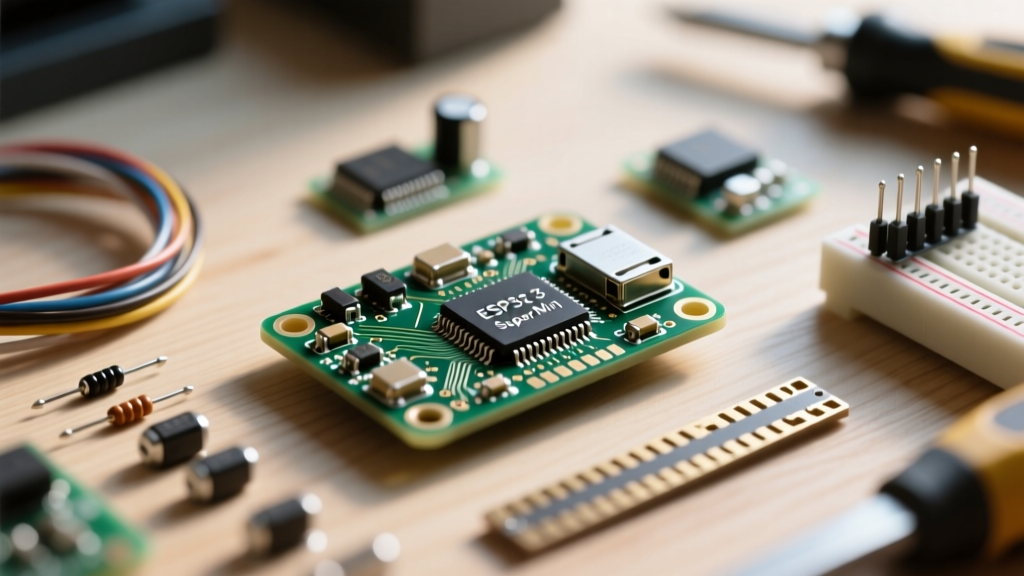

The Anatomy of the ESP32-C3 SuperMini Board
The ESP32-C3 SuperMini has rapidly become a staple in the DIY electronics community, offering a compelling alternative to the aging ESP8266 and the more expensive, dual-core ESP32-S3 boards. Built around the Espressif ESP32-C3FH4 chip, this board represents a shift toward RISC-V architecture in the microcontroller space. Measuring roughly 22.5 x 17.5 mm, it packs a 32-bit RISC-V single-core processor clocked at 160 MHz, 400 KB of SRAM, and 4 MB of onboard Flash memory.
But raw specifications only tell half the story. For makers and engineers, the true value lies in project suitability. At a street price often hovering between $2.50 and $4.00 on platforms like AliExpress, the SuperMini is an economic powerhouse. However, its ultra-compact form factor introduces specific hardware constraints and quirks that dictate exactly where this board should—and absolutely should not—be deployed.
Where the C3 SuperMini Excels: Ideal Project Profiles
The ESP32-C3 architecture was designed from the ground up for secure, low-power IoT connectivity. Because it supports both Wi-Fi 4 (802.11b/g/n) and Bluetooth 5.0 LE, it is uniquely positioned for modern smart home and sensor network applications.
Low-Power BLE Mesh and Sensor Nodes
If your project relies on Bluetooth Low Energy (BLE) beacons or mesh networking, the SuperMini is an exceptional choice. Unlike the original ESP32, which struggled with BLE power consumption, the C3 variant supports Bluetooth 5.0 Long Range. This makes it ideal for outdoor environmental sensors (e.g., pairing a BME280 or SHTC3 via I2C) that need to transmit data packets over extended distances while maintaining a minimal power footprint. According to the Espressif ESP32-C3 Datasheet, the chip's RF architecture is highly optimized for these low-duty-cycle transmissions.
Space-Constrained ESP-NOW Actuators
For robotics or drone telemetry where physical space is at a premium, the SuperMini's footprint is a massive advantage. Using Espressif's proprietary ESP-NOW protocol, you can achieve peer-to-peer Wi-Fi communication without the overhead of a traditional router. This is perfect for building lightweight, low-latency remote controls or mesh-controlled LED arrays where every gram and millimeter counts.
Critical Limitations: When to Avoid This Board
Despite its versatility, the ESP32-C3 SuperMini is not a universal replacement for the classic ESP32 DevKit. Understanding its limitations will save you hours of debugging.
- No PSRAM: The C3FH4 chip lacks external PSRAM. If your project involves audio streaming, complex web servers with heavy DOM rendering, or camera interfaces, this board will bottleneck immediately.
- GPIO Scarcity: Out of the box, you only have access to 11 usable GPIO pins. Furthermore, pins like GPIO18 and GPIO19 are tied to the native USB D- and D+ lines. If you use native USB, you lose those pins for general I/O.
- Strict 3.3V Logic: The RISC-V core and all GPIO pins are strictly 3.3V tolerant. Interfacing directly with 5V sensors or logic gates without a level shifter will permanently damage the silicon.
- Single-Core Bottleneck: Running heavy local computations (like FFTs for audio analysis) while simultaneously managing Wi-Fi stacks can lead to watchdog resets due to the single-core 160 MHz limitation.
Hardware Quirks and Real-World Troubleshooting
The low cost of the SuperMini is achieved by stripping away secondary support circuitry found on premium development boards. This leads to two major real-world failure modes that every developer must know how to navigate.
The GPIO9 Bootloader Trap
The most common issue reported by beginners is the inability to flash code to the SuperMini. Premium boards feature an auto-reset RC circuit that automatically toggles the bootloader and reset pins via the DTR/RTS signals of the USB interface. Many cheap SuperMini clones omit this circuit to save pennies.
Expert Fix: To manually enter download mode, you must bridge GPIO9 to GND, press the onboard Reset button (or briefly short the RST pin to GND), and then release GPIO9. Only then will the Espressif Hardware Reference boot ROM accept a new binary over the serial interface.
Deep Sleep Current Drain
If you are designing a battery-powered node intended to sleep for months, the SuperMini requires hardware modification. In deep sleep, the ESP32-C3 chip itself draws roughly 5 µA. However, the SuperMini board features an onboard LDO (often a generic ME6211) and a USB-C power path that introduce quiescent current leaks. A stock SuperMini can draw anywhere from 1.5 mA to 5 mA in deep sleep, which will drain a standard 18650 lithium cell in a matter of weeks. For true ultra-low-power deployments, you must physically desolder the onboard LDO and power the 3.3V pin directly from an external, high-efficiency switching regulator.
ESP32-C3 SuperMini vs. The Alternatives
To contextualize the SuperMini's place in your parts bin, here is a direct comparison against similarly sized or purpose-built alternatives.
| Feature | ESP32-C3 SuperMini | Seeed XIAO ESP32C3 | ESP8266 D1 Mini |
|---|---|---|---|
| Architecture | RISC-V (Single-Core) | RISC-V (Single-Core) | Xtensa LX106 |
| Bluetooth | BLE 5.0 | BLE 5.0 | None |
| Flash Memory | 4 MB | 4 MB | 4 MB |
| Antenna Design | PCB Trace (Detunes near metal) | Optimized PCB + U.FL Pad | PCB Trace |
| Battery/Deep Sleep | Poor (LDO Leakage) | Excellent (Optimized LDO) | Poor (High Sleep Current) |
| Approx. Price | $2.50 - $4.00 | $5.50 - $7.00 | $3.00 - $4.50 |
Final Verdict on Project Viability
The ESP32-C3 SuperMini is an unparalleled choice for high-volume, cost-sensitive IoT deployments where Wi-Fi and BLE 5.0 are required, and physical space is limited. It is the undisputed king of budget-friendly smart home sensor nodes, ESP-NOW mesh relays, and USB-C native HID devices.
However, if your project demands ultra-low-power battery operation out-of-the-box, high-pin-count peripherals, or audio processing, you should look toward the Seeed XIAO ESP32C3 or step up to an ESP32-S3. By respecting its hardware boundaries and mastering the GPIO9 manual boot sequence, the SuperMini will earn its place as the most versatile $3 microcontroller in your 2026 toolkit.