
The nRF52840 Foundation: What Powers the Arduino Nano BLE?
When makers and engineers search for an arduino nano ble solution, they are almost exclusively looking at boards built around the Nordic Semiconductor nRF52840 System-on-Chip (SoC). This ARM Cortex-M4F processor running at 64 MHz with an integrated Bluetooth 5.0 radio has become the gold standard for low-power IoT prototyping. Unlike older 8-bit AVR Nanos, the 32-bit architecture and 1MB Flash / 256KB SRAM footprint allow for complex edge-machine-learning (TinyML) and secure mesh networking.
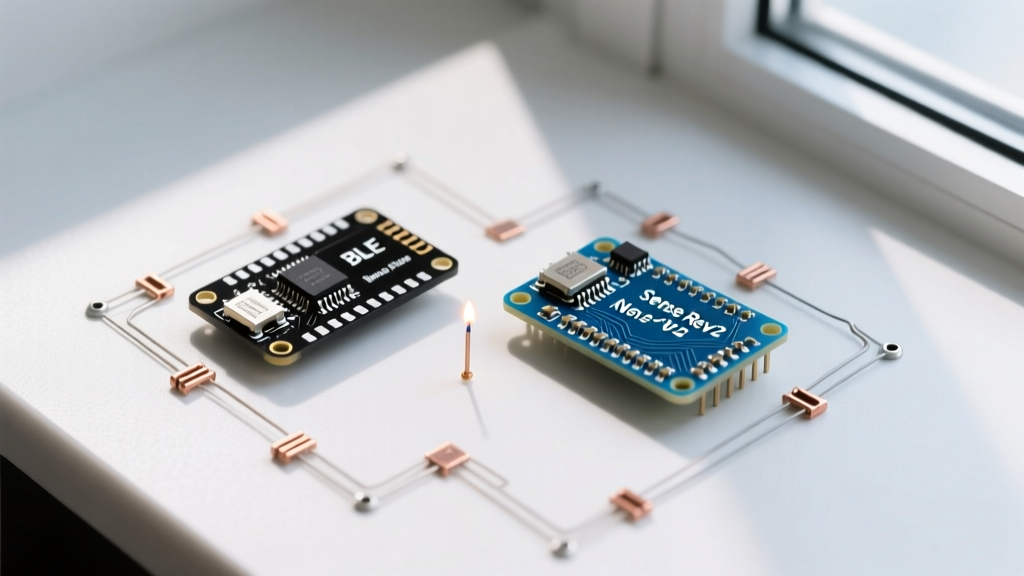
However, choosing the right board in the Nano BLE family requires navigating hardware revisions, sensor integrations, and firmware quirks. In this comprehensive 2026 review, we dissect the official Arduino Nano 33 BLE, the Nano 33 BLE Sense Rev2, and the reality of using third-party clones.
Hardware Showdown: Nano 33 BLE vs. Sense Rev2
The official Arduino lineup currently offers two primary nRF52840 boards in the Nano footprint. While they share the same core SoC and pinout, their peripheral support and target use cases differ drastically.
| Feature | Arduino Nano 33 BLE | Arduino Nano 33 BLE Sense Rev2 |
|---|---|---|
| Core SoC | nRF52840 (Cortex-M4F @ 64MHz) | nRF52840 (Cortex-M4F @ 64MHz) |
| Flash / SRAM | 1MB / 256KB | 1MB / 256KB |
| IMU / Motion | LSM9DS1 (9-axis) | BMI270 (6-axis) + BMM150 (3-axis Mag) |
| Environmental | None | HTS221 (Temp/Hum), LPS22HB (Baro) |
| Optical / Audio | None | APDS9960 (Light/Gesture), MP34DT05 (Mic) |
| Crypto Element | ECC508 / ECC608 | ECC508 / ECC608 |
| Typical Price (2026) | ~$22.50 USD | ~$38.00 USD |
The Sensor Suite Reality Check
If you are buying the Sense board today, you will receive the Rev2 hardware. Due to global component shifts over the last few years, Arduino replaced the original LSM9DS1 IMU with the Bosch BMI270 and BMM150 combination. According to the official Arduino Nano 33 BLE Sense Rev2 documentation, this change actually improved the power profile and gyro drift characteristics, making it vastly superior for TinyML gesture recognition models. If you are following a 2020-era tutorial that references the LSM9DS1 library, you will need to adapt your code to the BMI270 API.
Power Consumption & The Deep Sleep Trap
The primary reason engineers select an arduino nano ble platform is for battery-operated deployments. The Nordic nRF52840 datasheet advertises system-off currents as low as 1.5 µA. However, achieving this on the Nano form factor requires strict hardware discipline.
Expert Warning: Floating GPIO pins are the enemy of deep sleep. If you put the nRF52840 to sleep while leaving pins configured as standard inputs, leakage currents through the ESD protection diodes can push your 'sleep' current from 3 µA up to 2.5 mA, draining a CR2032 coin cell in days instead of years.
Actionable Sleep Configuration:
- Before calling
systemOff(), iterate through all unused GPIO pins and set them toINPUT_PULLDOWN. - For I2C pins (A4/A5), ensure external sensors are either powered down via a MOSFET or that internal pull-ups are disabled to prevent bus leakage.
- The onboard AP2112K-3.3 LDO has a quiescent current of ~60 µA. For ultra-low-power applications (<10 µA total), you must bypass the onboard LDO and power the 3.3V rail directly from a regulated external source, cutting the board's VIN trace.
Firmware Ecosystem in 2026: Mbed vs. Zephyr
Historically, the Arduino Nano 33 BLE relied heavily on the Mbed OS core. While functional, Mbed OS consumed a massive portion of the 1MB Flash, often leaving less than 400KB for user sketches and complex BLE stacks. Furthermore, Mbed's threading model introduced unpredictable latency for strict real-time sensor polling.
As of 2026, the community and professional developers have largely migrated to two alternatives:
- Native Arduino nRF52 Core: Stripped of heavy Mbed dependencies, utilizing the SoftDevice S140 for reliable, low-level BLE peripheral and central roles.
- Zephyr RTOS: For advanced users compiling outside the Arduino IDE (using VS Code and PlatformIO), Zephyr offers superior power management hooks, modern BLE 5.3 feature support, and a much smaller binary footprint.
Clone Alternatives: Seeed XIAO & Generic nRF52840
At $38 for the Sense Rev2, official boards are expensive for fleet deployments. This has opened the door for highly capable alternatives.
Seeed Studio XIAO nRF52840 Sense
Priced around $15.99, the XIAO nRF52840 packs the same SoC, a PDM microphone, and an IMU into a footprint smaller than a postage stamp. The catch? The pinout is entirely different, and it lacks the Nano's castellated headers and 5V-tolerant VIN regulator. It is perfect for custom PCBs but frustrating for breadboard prototyping.
Generic 'Blue Pill' Style nRF52840 Boards
You will find $8 generic nRF52840 boards on AliExpress. While the silicon is genuine, these boards almost universally ship with a locked or missing bootloader. To use them, you must own a Segger J-Link or SWD programmer to flash the Adafruit nRF52 Bootloader via the SWDIO/SWCLK test pads before they can accept Arduino code over USB.
Critical Hardware Failure Modes & Recovery
Working with the Arduino Nano BLE family introduces specific failure modes that catch beginners off guard.
1. The 5V Tolerance Myth
Despite the board accepting up to 6V on the VIN pin to feed the onboard LDO, the GPIO pins are strictly 3.3V logic. Feeding a 5V I2C sensor or a 5V UART signal directly into the Nano BLE's data pins will permanently destroy the nRF52840 I/O bank. Always use a bidirectional logic level shifter (like the BSS138) when interfacing with legacy 5V peripherals.
2. Bricking via Mbed OS Hard Faults
Writing out-of-bounds memory in an Mbed-based sketch can corrupt the bootloader's soft-device boundary, making the board disappear from your PC's USB device manager.
Recovery Protocol:
- Locate the reset button on the board.
- Tap the reset button twice in rapid succession (within 500ms).
- The onboard LED will begin a slow 'breathing' fade pattern, indicating the board has entered UF2 Bootloader mode.
- The board will mount as a USB mass storage device named
NRF52BOOT. Simply drag and drop your compiled.uf2firmware file onto the drive to reflash and unbrick the board.
Final Verdict: Which Arduino Nano BLE Should You Choose?
If your project requires environmental monitoring, acoustic event detection, or standalone TinyML inference without external hardware, the Nano 33 BLE Sense Rev2 justifies its $38 premium. The integrated BMI270 and MP34DT05 mic save hours of PCB design and I2C address conflict troubleshooting.
However, if you are building a custom mesh network, a simple BLE beacon, or a wearable where size and cost are paramount, bypass the official Nano entirely and integrate a Seeed XIAO nRF52840 or design a custom board around a bare nRF52840 module. The standard Nano 33 BLE (without sensors) sits in an awkward middle ground in 2026—excellent for learning, but outclassed by cheaper clones for production deployment.