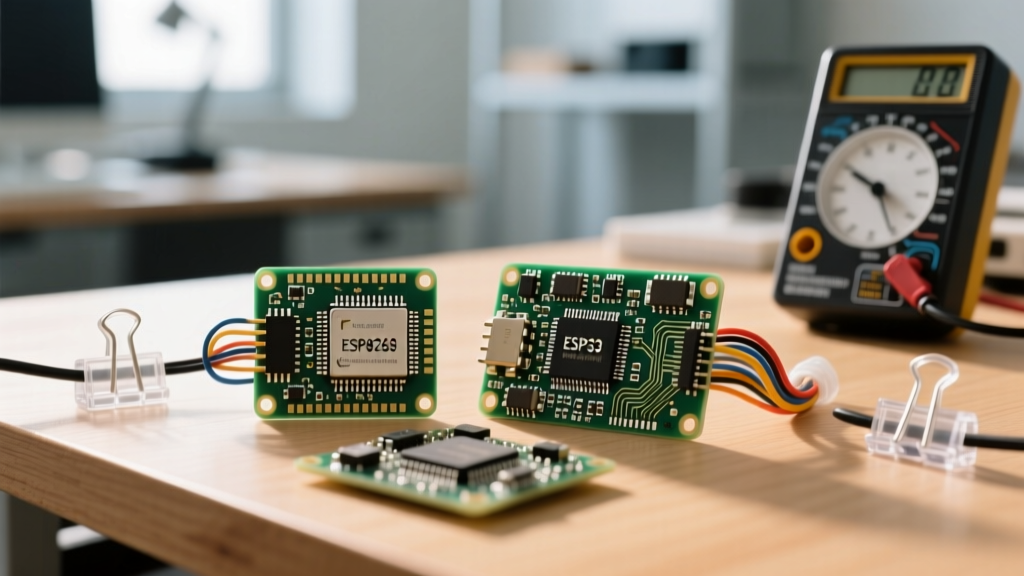

Building custom LED installations with WS2812B, NeoPixel, or SK6812 addressable strips has never been easier, thanks to the open-source WLED firmware. Whether you are running an ESP8266 NodeMCU or a high-performance ESP32-DevKitC, WLED provides a robust web interface for controlling thousands of LEDs. However, the rapid deployment of these IoT devices often leads to a critical oversight: ignoring the WLED default password and leaving the web administration panel completely exposed. In the realm of IoT electronics, convenience is the enemy of security. Leaving your ESP-based controllers on their factory settings doesn't just risk your LED layout; it creates a vulnerable pivot point into your home or commercial network.
Decoding the WLED Default Credentials
To properly secure your installation, you must first understand how WLED handles authentication out of the box. WLED operates with two distinct credential layers, and both present unique security challenges if left unmodified.
1. The Access Point (AP) Mode Password
When you first flash WLED onto an ESP chip, or when the device cannot find a configured Wi-Fi network, it broadcasts its own Access Point. The default SSID is typically WLED-AP (sometimes followed by the last digits of the MAC address). The WLED default password for connecting to this Access Point is wled1234. While this password is required to initially connect your phone or PC to the ESP board to input your home Wi-Fi credentials, it is universally known and documented in the WLED Official Getting Started Guide.
2. The Web UI Admin & OTA Password
Once the ESP chip connects to your local network and receives an IP address via DHCP, you access the control panel via a web browser. By default, there is no admin password protecting the WLED Web UI. Anyone on your local network can navigate to the device's IP address, change LED configurations, trigger effects, and most dangerously, initiate an Over-The-Air (OTA) firmware update without typing a single credential.
Threat Models: The Cost of Ignoring IoT Security
It is a common misconception that smart LED controllers are 'harmless' IoT devices. Because they lack the processing power to run heavy encryption or advanced intrusion detection, ESP8266 and ESP32 chips rely entirely on network-level perimeter defense. If an attacker gains access to your LAN—whether through a compromised smart TV, a phishing email, or a guest Wi-Fi network that lacks client isolation—an unauthenticated WLED node becomes a prime target.
The Malicious OTA Payload Vector
The most severe risk associated with the blank default admin password is the OTA update endpoint. According to the WLED OTA Update Documentation, the firmware allows users to upload custom .bin files directly through the browser. An attacker with LAN access can silently push a malicious, custom-compiled binary to your ESP32. This payload can repurpose the chip into a network sniffer, a botnet node for DDoS attacks, or a reverse shell that bypasses your router's WAN firewall by initiating an outbound connection to a command-and-control server.
Expert Insight: The ESP8266's limited SRAM (roughly 80KB usable) and lack of a dedicated cryptographic accelerator mean that WLED cannot natively support HTTPS (TLS/SSL) for the web interface without severely degrading LED rendering performance. Therefore, all web traffic, including passwords, is transmitted in plaintext HTTP. This makes network segmentation your only reliable defense against local eavesdropping.
Hardening Protocol: Securing the Web Interface
Before deploying your WLED nodes in permanent, hard-to-reach locations (like rooflines or architectural coves), you must enforce credential hardening. Follow this exact sequence to lock down the firmware:
- Navigate to Security Settings: Open the WLED Web UI, click on Config, and select Security.
- Set an OTA/Admin Password: Create a strong, unique password (minimum 12 characters, alphanumeric). This password will now be required to access the Config menus and to perform any future OTA firmware updates.
- Disable OTA when not in use (Optional but Recommended): If you are using a heavily memory-constrained ESP8266 (like the 1MB flash Wemos D1 Mini), disabling OTA entirely via the security menu frees up crucial RAM for LED buffers and prevents remote flashing altogether.
- Lock the AP: If you require AP mode for portable installations, change the default
wled1234passphrase to a complex WPA2 string to prevent unauthorized users from connecting directly to the chip.
Architectural Defense: VLANs and Port Restrictions
Passwords alone are insufficient for modern IoT deployments. Best practices dictate that WLED controllers should never reside on the same VLAN as your primary computers, NAS drives, or mobile devices. By placing your ESP nodes on a dedicated 'IoT' or 'Lighting' VLAN, you can enforce strict firewall rules at the router level.
When configuring your firewall (whether on a pfSense box, Ubiquiti Dream Machine, or a prosumer Asus router), apply the following rules to the WLED VLAN:
- Block TCP 80/443 to WAN: WLED nodes have no business communicating directly with the open internet. Block all outbound web traffic to prevent reverse-shell callbacks.
- Block Local LAN Access: Prevent the IoT VLAN from initiating connections to your main trusted LAN subnet.
- Allow UDP 5568 (E1.31): If you use xLights or FPP for sequenced light shows, allow inbound UDP traffic on port 5568 from your specific control PC's IP address.
- Allow UDP 19446 (WLED Sync): If you are using multiple WLED instances to synchronize effects across a large installation, permit this port only between the IP addresses of the WLED nodes themselves.
WLED Security Posture Matrix
| Security Layer | Default Posture (High Risk) | Hardened Posture (Recommended) | Air-Gapped / Offline (Maximum) |
|---|---|---|---|
| Web UI Access | Open, No Password | Locked with complex Admin/OTA Password | Disabled or Local-Only |
| AP Mode Password | wled1234 |
Custom WPA2 Passphrase | AP Mode Disabled entirely |
| Network Placement | Main Home LAN | Isolated IoT VLAN with mDNS reflector | Standalone offline router |
| Outbound WAN | Unrestricted | Blocked via Firewall Rules | Physically disconnected |
Hardware Recovery: Bypassing a Forgotten Password
A common issue when adopting second-hand ESP boards or returning to a project after several years is forgetting the custom admin password you set. Because WLED does not have a 'forgot password' email recovery mechanism, you must perform a physical factory reset to restore the WLED default password state and wipe the configuration.
To trigger a hardware factory reset on an ESP8266 or ESP32 running WLED:
- Locate the
GPIO0pin on your development board. On a NodeMCU or D1 Mini, this is often labeled asD3orGPIO0. - Use a jumper wire to bridge
GPIO0toGND(Ground). - While holding the connection, press the
RST(Reset) button or power cycle the board. - Keep
GPIO0grounded for approximately 5 to 10 seconds after boot. - Release the connection. The onboard LED (usually on GPIO2) will blink rapidly, indicating that the filesystem has been formatted and WLED has reverted to its factory defaults, broadcasting the
WLED-APnetwork once more.
For deeper troubleshooting and pinout diagrams specific to your microcontroller, always consult the WLED Troubleshooting Wiki. Securing your smart lighting infrastructure requires a shift in mindset: treat every ESP chip not as a simple light switch, but as a fully-fledged networked computer that requires active defense.