
The Hidden Cost of Counterfeit Parts in DIY Builds
As of 2026, the global semiconductor supply chain has largely stabilized, yet the secondary market remains heavily saturated with fake electronic components. For DIYers, makers, and independent repair technicians sourcing parts from online marketplaces, the risk of receiving counterfeit, re-marked, or salvaged silicon is higher than ever. A fake LM2596 buck converter might overheat and destroy your custom PCB, while a counterfeit STM32 microcontroller can brick your firmware deployment due to architectural mismatches.
Identifying these fraudulent parts requires moving beyond basic visual checks and implementing rigorous electrical benchmarking. According to data from ERAI (Electronic Risk Assurance Inc), counterfeit ICs and discrete semiconductors account for the vast majority of supply chain breaches. This guide provides a comprehensive, step-by-step framework to spot, test, and isolate fake electronic components before they compromise your DIY projects.
Most Commonly Faked Components (And How They Fail)
Counterfeiters target high-volume, high-margin, or legacy components. Below is a breakdown of the most frequently faked parts in the DIY space, their pricing discrepancies, and their typical failure modes in real-world circuits.
| Component Type | Genuine Price (Avg) | Fake Price (Avg) | Common Failure Mode in DIY Projects |
|---|---|---|---|
| STM32F103C8T6 (MCU) | $3.50 - $4.20 | $0.80 - $1.20 | Fails on Cortex-M3 DSP instructions; SWD flash errors. |
| IRF540N (MOSFET) | $1.10 - $1.50 | $0.25 - $0.40 | Thermal runaway at >5A due to high Rds(on); gate oxide punch-through. |
| LM2596 (Buck Converter) | $2.80 - $3.50 | $0.60 - $0.90 | Output voltage ripple >200mV; inductor saturation at 1A (rated for 3A). |
| LM7805 (Linear Regulator) | $0.80 - $1.20 | $0.15 - $0.30 | Lacks internal thermal shutdown; catastrophic failure at >500mA load. |
| Tantalum Capacitors | $0.40 - $0.80 | $0.05 - $0.10 | Ignites under reverse bias or high ripple current; massive ESR. |
Phase 1: Visual and Physical Inspection Techniques
Before applying power or soldering a component to your board, conduct a thorough physical inspection. Counterfeiters use several methods to disguise salvaged or inferior dies as premium, brand-new components.
The Acetone Swipe Test (Blacktopping Detection)
Many counterfeiters sand down the original markings on a salvaged chip and apply a new layer of black epoxy (known as 'blacktopping') before laser-etching fake logos.
- Procedure: Apply a small amount of acetone or 99.9% anhydrous isopropyl alcohol to a cotton swab.
- Action: Rub the swab firmly across the top surface of the IC for 15 to 30 seconds.
- Result: Genuine manufacturer laser etching will not degrade. If the black coating begins to dissolve, smear, or reveal older markings underneath, the part is re-marked and counterfeit.
Pin Oxidation and Re-tinning Scrutiny
Salvaged components pulled from e-waste often have oxidized, bent, or shortened pins. To hide this, fraudulent vendors re-tin the leads with cheap, lead-heavy solder.
- Examine the leads under a 10x to 30x macro loupe or a digital microscope.
- Look for inconsistent solder meniscus shapes, scratch marks from sanding, or a dull, matte finish indicative of low-temperature, high-lead solder alloys.
- Measure the pin length with digital calipers. Counterfeiters frequently shave down bent pins to make them look uniform, resulting in leads that are 0.5mm to 1.0mm shorter than the datasheet specifications.
Package Molding and Ejector Marks
Authentic IC packages feature precise injection molding marks. Look for the circular ejector pin indentations on the top or bottom of the package. Fake components often lack these indentations, or they are shallow, asymmetrical, and poorly defined due to the use of low-quality, aftermarket molds.
Phase 2: Electrical Benchmarking and Curve Tracing
Visual inspection alone cannot catch 'ghost chips'—inferior silicon dies packaged in legitimate-looking housings. To definitively identify fake electronic components, you must benchmark their electrical characteristics against the manufacturer's datasheet.
MOSFET Rds(on) and Gate Threshold Testing
Counterfeit power MOSFETs, such as fake IRF3205 or IRF540N transistors, frequently contain much smaller silicon dies than specified. This results in a significantly higher Drain-Source On-Resistance (Rds(on)).
The Multimeter Diode Test:
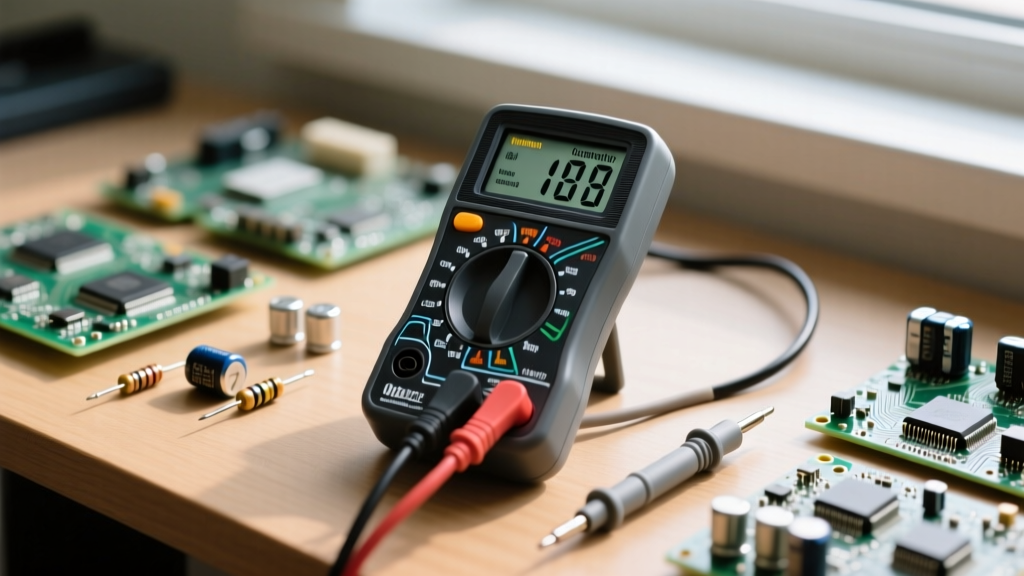
- Set your multimeter (e.g., Fluke 87V) to diode test mode.
- Place the black probe on the Drain and the red probe on the Source. It should read 'OL' (Open Loop).
- While keeping the probes in place, briefly touch the Gate pin to the Drain pin with a jumper wire to charge the gate capacitance.
- The multimeter should now show a low voltage drop (typically 0.3V to 0.5V for a genuine logic-level MOSFET). If the voltage drop remains high or the part fails to latch on, the internal die is undersized or damaged.
For advanced DIYers, using a DIY curve tracer or an oscilloscope (like the Siglent SDS1202X-E) to map the Vgs vs. Id transfer characteristics will immediately expose a fake silicon die that cannot handle the rated continuous drain current.
Capacitor ESR and Dielectric Absorption
Fake electrolytic and tantalum capacitors are notoriously dangerous. They often feature falsified capacitance ratings and lack the internal manganese dioxide or polymer layers required for low Equivalent Series Resistance (ESR).
- Tool Required: An ESR meter (such as the Peak Atlas ESR70 or DER EE DE-5000).
- Test: Measure the ESR at 100kHz. A genuine 1000µF 25V low-ESR capacitor should read below 0.05Ω. A counterfeit version will often read >0.20Ω, leading to massive internal heating and eventual venting in switching power supplies.
- Physical Weight: High-quality capacitors use dense, high-purity aluminum foils and robust rubber bungs. Fakes feel noticeably lighter when held in the hand.
Microcontroller Core Verification via SWD
A common scam involves sanding down cheap Cortex-M0 microcontrollers (like the STM32F030) and laser-etching them as premium Cortex-M3 or M4 chips (like the STM32F103 or STM32F401).
To catch this, do not rely on visual markings. Connect the chip to an ST-Link V2 programmer via the SWD (Serial Wire Debug) interface and read the DBGMCU_IDCODE register. The DEV_ID bits will return the actual silicon die identifier, instantly revealing if you are holding a genuine F103 or a re-marked F030 impostor.
Phase 3: Advanced Decapping (The Nuclear Option)
When electrical testing is inconclusive, advanced hardware hackers resort to 'decapping'—destroying the epoxy package to expose the bare silicon die. While fuming nitric acid (HNO3) is the industry standard for chemical decapping, DIYers sometimes use a hot air rework station set to 400°C to carefully burn away the epoxy, followed by mechanical scraping. Once the die is exposed, you can read the microscopic manufacturer lot codes and die-stepping revisions under a microscope, comparing them against known-good die photographs archived by the hardware reverse-engineering community.
Safe Sourcing Framework for Makers
The most effective way to avoid the headache of testing fake electronic components is to eliminate them from your supply chain entirely. While the allure of $0.50 microcontrollers on AliExpress or eBay is strong, the hidden costs of debugging, ruined PCBs, and lost time far outweigh the savings.
'The aerospace and defense industries rely on the SAE AS5553 standard to mitigate counterfeit parts. While DIYers do not need this level of compliance, adopting its core principle—strict supply chain traceability—is essential for reliable electronics design.' — SAE International AS5553 Standard Overview
Tier 1: Authorized Distributors (Zero Risk)
Always source critical components (microcontrollers, power management ICs, precision analog) from authorized, franchised distributors. Companies like Mouser Electronics, Digi-Key, Farnell, and LCSC (for Asian market equivalents) source directly from the manufacturers or their officially licensed regional partners. You pay a premium, but you receive guaranteed, factory-fresh silicon with full traceability.
Tier 2: Vetted Independent Brokers (Medium Risk)
If a part is obsolete or out of stock globally, you may need to use an independent broker. Refer to the NASA Electronic Parts and Packaging (NEPP) Program guidelines, which emphasize requiring brokers to provide original manufacturer certificates of conformity (CoC) and traceability documents back to the original factory lot.
Tier 3: Open Marketplaces (High Risk - Test Everything)
If you must buy from Amazon third-party sellers, eBay, or AliExpress for non-critical, low-cost passive components (like basic 1/4W resistors or generic 0.1-inch header pins), assume the inventory is mixed. Never use marketplace-sourced components for safety-critical DIY projects, such as mains-powered relays, high-current battery management systems (BMS), or automotive electronics.
Conclusion
Spotting fake electronic components requires a healthy dose of skepticism and a systematic approach to testing. By combining the acetone swipe test, rigorous ESR and Rds(on) benchmarking, and SWD register verification, you can protect your DIY projects from the catastrophic failures caused by counterfeit silicon. Invest in a good digital microscope and an ESR meter; they will pay for themselves the first time they save you from debugging a 'faulty' circuit that was actually built with fraudulent parts.