
The True Cost of Disorganized Silicon
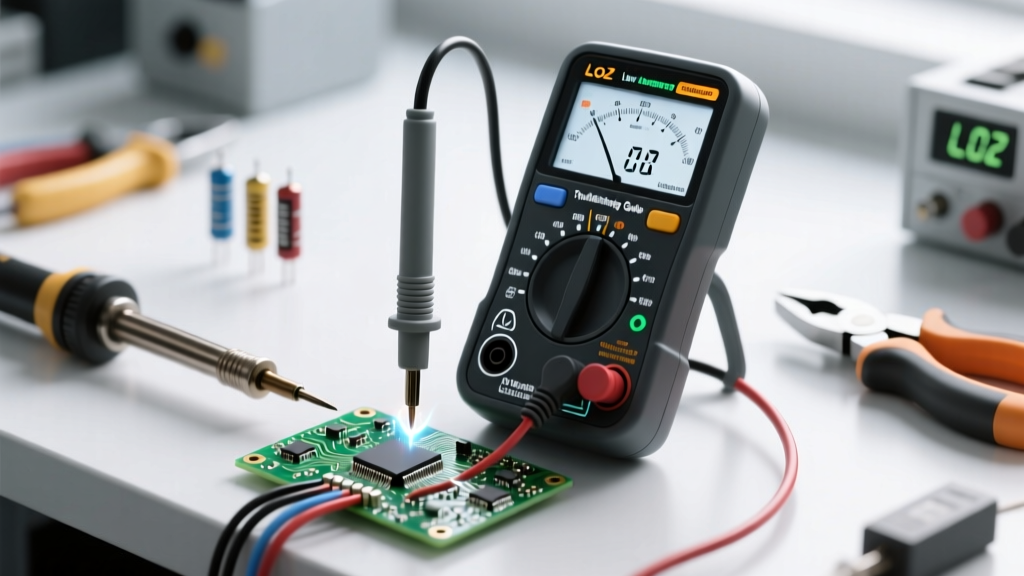
For both hobbyists and professional electrical engineers, the workbench is often a chaotic landscape of snipped resistor leads, loose SMD capacitors, and half-empty IC tubes. However, failing to implement a rigorous system for storing electronic components costs more than just time spent searching for a specific 10kΩ pull-up resistor. Improper storage leads to oxidized through-hole pins, moisture-induced popcorn cracking during reflow soldering, and catastrophic electrostatic discharge (ESD) failures in sensitive MOSFETs and microcontrollers.
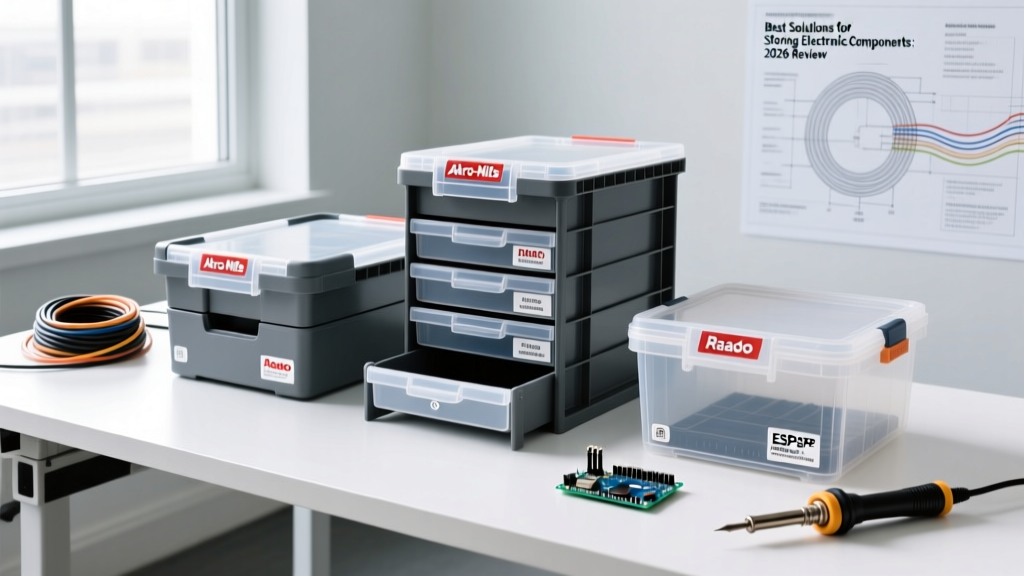
In this 2026 tool and storage review, we evaluate the most effective physical storage systems, ESD-safe packaging materials, and environmental controls available on the market. We will move beyond generic plastic bins and explore engineered solutions that preserve component integrity, referencing standards from the ESD Association and JEDEC.
Tier 1: Cabinet and Bin Hardware Reviews
The foundation of any component library is the physical housing. Below, we review three distinct categories of storage hardware based on modularity, durability, and footprint.
1. The Hobbyist Standard: Akro-Mils 10164 (64-Drawer Cabinet)
The Akro-Mils 10164 remains the undisputed workhorse for through-hole and larger SMD components. Featuring a heavy-duty steel frame and 64 polystyrene drawers, it offers exceptional modularity.
- Price Range: $45 – $55 USD
- Pros: Stackable design, included cardboard dividers, rear hang-hole for wall mounting, and smooth drawer glide.
- Cons: Standard polystyrene drawers are not inherently ESD-safe or anti-static. They can generate a triboelectric charge when drawers are rapidly pulled and pushed.
- Expert Modification: Line the backplane of the drawers with copper foil tape or place a small anti-static foam insert at the bottom of each drawer to mitigate static buildup for sensitive ICs.
2. The Professional SMD Solution: Raaco 230008 Assorter
For engineers dealing primarily with SMD tape reels, cut tape strips, and micro-components (0402 and 0603 footprints), the Raaco Assorter series is the premium choice.
- Price Range: $180 – $210 USD
- Pros: Includes specialized inserts designed specifically to hold 8mm and 12mm SMD tape reels. The polycarbonate cover seals tightly, preventing dust ingress and accidental spills.
- Cons: High initial capital cost; drawer dividers are proprietary and expensive to replace.
3. The Field Tech Portable: Stanley STST1-80151 (25-Compartment)
When storing electronic components for field repairs or on-site installations, portability is key. The Stanley 25-compartment bin features adjustable dividers and robust metal latches.
- Price Range: $18 – $25 USD
- Pros: Removable dividers allow customization for bulky items like terminal blocks and relays. The rubber seal on the lid offers basic moisture resistance.
- Cons: If the dividers are not fully snapped into the bottom groove, small 0805 capacitors will migrate between compartments during transit.
Tier 2: ESD-Safe Packaging Materials
Placing a sensitive microcontroller into a standard plastic bin is a recipe for latent ESD damage. According to guidelines on Electrostatic Discharge fundamentals, components must be stored in materials that either shield against static fields or safely dissipate surface charges. Below is a comparison matrix of the three primary bag types used in electronics manufacturing and repair.
| Material Type | Surface Resistivity | Visual ID | Best Use Case | Cost (per 100) |
|---|---|---|---|---|
| Static Shielding (Metal-In) | < 1011 Ω/sq | Semi-transparent Silver | ICs, MOSFETs, bare PCBs | $15 – $25 |
| Anti-Static (Polyethylene) | 1010 – 1012 Ω/sq | Translucent Pink | Passive components, cables, hardware | $8 – $12 |
| Conductive (Carbon-Loaded) | < 105 Ω/sq | Opaque Black | High-sensitivity RF parts, lasers | $30 – $45 |
Expert Warning: Never use standard pink anti-static bags for long-term storage of sensitive ICs. Pink bags only prevent the generation of new static charges; they do not shield against external electrostatic fields. For long-term archival of microcontrollers and FPGAs, always use Static Shielding (Metal-In) bags and heat-seal the edges.
Tier 3: Moisture Sensitivity and Dry Cabinets
One of the most overlooked aspects of storing electronic components is Moisture Sensitivity Level (MSL). Surface-mount ICs with plastic encapsulation absorb ambient humidity over time. When subjected to the rapid 250°C+ heat of a reflow oven or hot air station, the trapped moisture expands, causing the plastic package to crack—a phenomenon known as the 'popcorn effect.'
The IPC/JEDEC J-STD-033 standard categorizes components from MSL 1 (unlimited floor life) to MSL 6 (mandatory bake before reflow). If you are storing MSL 4, 5, or 6 components (common in high-density BGA packages and advanced RF transceivers), standard room-temperature storage in a plastic bin will destroy the batch within 48 to 72 hours.
Investing in a Dry Cabinet
For serious labs, a desiccant-based dry cabinet is non-negotiable. Brands like Dr. Storage and Sanity Auto offer active dehumidification cabinets that maintain an internal relative humidity (RH) of <5% or <10%.
- Target RH for MSL 3: <10% RH (Extends floor life indefinitely).
- Target RH for MSL 4-6: <5% RH (Required for safe archival).
- Cost: Entry-level 50L cabinets start around $350, while industrial 150L units with nitrogen-purge capabilities exceed $1,200.
Alternative for Hobbyists: If a dry cabinet is out of budget, store MSL-sensitive parts in sealed static shielding bags alongside indicating silica gel (which changes color when saturated) and a digital hygrometer. Avoid using standard desiccant packets salvaged from shoe boxes, as their absorption capacity is unknown and likely exhausted.
Step-by-Step: Building a Scalable Component Taxonomy
The best hardware in the world is useless if your taxonomy is flawed. A common beginner mistake is sorting components by value (e.g., grouping all 10k resistors together regardless of footprint). This fails in practice because an 0805 10k resistor is not interchangeable with a through-hole 10k resistor.
- Sort by Footprint First, Value Second: Dedicate entire drawers or bin sections to specific physical packages. For example, Drawer 1 is exclusively for '0603 Resistors', Drawer 2 for '0805 Resistors', and Drawer 3 for 'SOT-23 Transistors'.
- Implement a Grid Coordinate System: Label drawers with alphanumeric grid coordinates (e.g., A1, A2, B1). Maintain a digital spreadsheet or use inventory software like PartKeepr or Snipe-IT that maps the physical location of every SKU.
- Standardize Labeling: Use a thermal transfer label printer. The Brother PT-D210 paired with TZe-131 (black text on clear background, 12mm width) tape is the industry favorite. The clear background allows you to stick the label directly onto the drawer face without obscuring the component view, and the laminated tape resists peeling from plastic surfaces over time.
Final Verdict: Tailoring Storage to Your Workflow
There is no single 'best' solution for storing electronic components; the right choice depends entirely on your bill of materials. If your workbench is dominated by through-hole prototyping and Arduino modules, the Akro-Mils 10164 combined with pink anti-static bags offers the best price-to-performance ratio. However, if you are designing custom PCBs and hand-soldering dense SMD boards with BGA or QFN packages, investing in a Raaco Assorter, static shielding bags, and a <5% RH dry cabinet is essential to protect your inventory from ESD and moisture-induced catastrophic failures.