
The Direct Answer: What a Capacitor Actually Stores
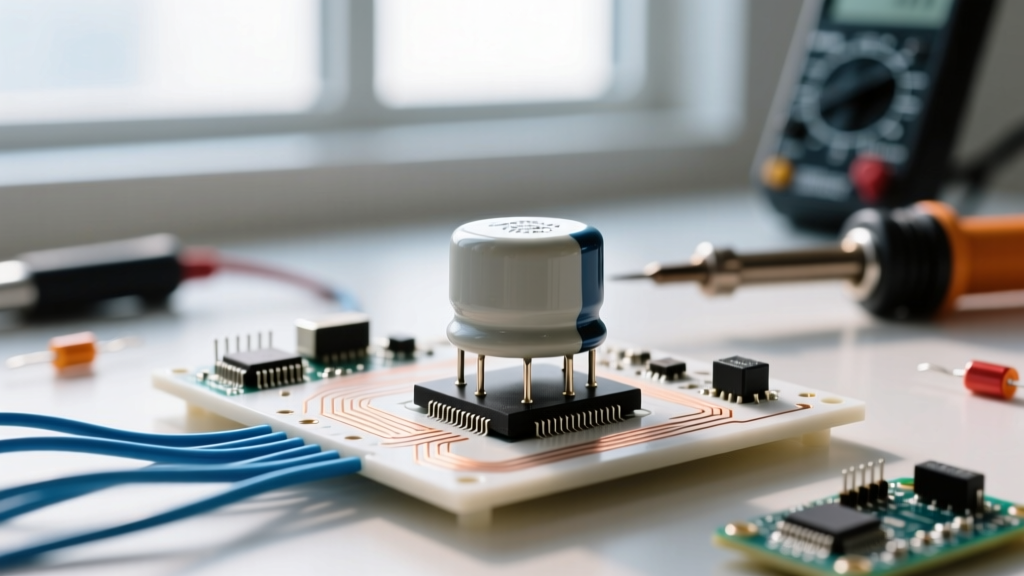
When asking what does a capacitor store, the most precise physics answer is electrical potential energy contained within an electrostatic field. While hobbyists and textbooks often say a capacitor "stores charge," this is technically a shortcut. A capacitor actually stores a separation of charge: an excess of electrons on one conductive plate and a corresponding deficit (positive charge) on the other, separated by an insulating dielectric material.
This charge separation creates an electric field across the dielectric, which manifests as voltage. The energy stored is not in the electrons themselves, but in the tension of the electric field holding those separated charges apart. We calculate this stored energy (in Joules) using the formula:
E = ½CV²
E = 0.5 × 0.001 × (50)²
E = 0.5 × 0.001 × 2500 = 1.25 Joules.
That is enough stored energy to weld a small copper wire or deliver a painful shock if shorted directly across your fingers.
The Water Analogy: Imagine a pipe blocked by a flexible rubber membrane. Water (current) cannot flow through the membrane, but as pressure (voltage) builds on one side, the membrane stretches, storing mechanical energy. When the pressure drops, the membrane snaps back, pushing water back out. The capacitor doesn't store the water (charge passes into one terminal and out the other in an AC circuit); it stores the pressure (voltage) applied to it.
Decoding the Dielectric: Which Capacitor Type for Which Job
The dielectric material defines the capacitor's behavior, temperature stability, and failure mode. Selecting the wrong type is the number one cause of premature circuit failure. Here is how the main families compare on the bench:
| Type / Dielectric | Construction | Tolerance & Tempco | Typical Use Case |
|---|---|---|---|
| Ceramic (C0G/NP0) | Multilayer ceramic (MLCC), paraelectric | ±5%, 0 ±30ppm/°C (Ultra-stable) | RF filters, precision timing, high-Q resonant circuits. |
| Ceramic (X7R/X5R) | MLCC, ferroelectric barium titanate | ±15%, high capacitance drop under DC bias | General decoupling, bypassing, bulk storage on PCBs. |
| Aluminum Electrolytic | Etched aluminum foil, liquid/polymer electrolyte | -20% / +80%, high tempco, polarized | Power supply smoothing, low-frequency audio coupling. |
| Tantalum | Sintered tantalum sponge, manganese dioxide cathode | ±10% to ±20%, stable, highly polarized | Space-constrained medical/aerospace, sample-and-hold circuits. |
| Metallized Film (PP) | Polypropylene film with vapor-deposited metal | ±1% to ±5%, excellent self-healing properties | Mains EMI suppression (X/Y class), motor run, high-voltage snubbers. |
Reading the Matrix: How to Decode Capacitor Markings
Through-hole and surface-mount capacitors use cryptic codes due to limited physical space. Misreading these leads to ordering a 100µF part when you actually need a 100pF part—a million-fold error.
The 3-Digit EIA Code (Ceramics)
Most small ceramic capacitors use a three-digit code based on picofarads (pF). The first two digits are the significant figures, and the third digit is the multiplier (number of zeros).
- 104: 10 followed by four zeros = 100,000 pF. Convert to microfarads (µF) by dividing by 1,000,000. 104 = 0.1 µF (or 100 nF). This is the most common decoupling cap in electronics.
- 472: 47 followed by two zeros = 4,700 pF = 4.7 nF.
- 221: 22 followed by one zero = 220 pF.
Tolerance and Voltage Letters
You will often see a letter trailing the numeric code. J means ±5% tolerance, K means ±10%, and M means ±20%. Voltage codes are less standardized but frequently follow the EIA standard where the first character represents the multiplier and the second represents the base voltage (e.g., 1H = 50V, 1E = 25V, 0J = 6.3V). Always verify against the specific manufacturer's datasheet (like Murata or KEMET) before assuming voltage ratings.
When Things Go Wrong: Failure Modes and Visual Symptoms
Capacitors are the most common point of failure in aging electronics. Understanding how capacitors behave under stress helps you diagnose dead boards on the bench.
- Aluminum Electrolytic (Venting & Bulging): Over time, or when subjected to reverse polarity, the internal electrolyte boils. Visual symptom: The scored cross on top of the can bulges upward, or the rubber bottom plug extrudes. You will often smell a distinct, acrid "fishy" odor. Electrically, the Equivalent Series Resistance (ESR) spikes, causing power supply ripple.
- MLCC Ceramics (Flex Cracking): As noted by Murata's technical resources, board flexure during PCB assembly or mechanical shock can crack the brittle ceramic layers. Visual symptom: Often invisible to the naked eye until moisture enters the crack, causing a dead short that burns a crater into the PCB. Look for cracks in the solder fillet at the terminals.
- Tantalum (Thermal Runaway): Tantalum capacitors fail short-circuit. Because the manganese dioxide cathode contains its own oxygen, a short circuit causes the part to ignite violently. Visual symptom: A charred, melted lump on the board, often accompanied by a popped breaker or dead main fuse.
The Bench Guide: How to Safely Substitute Missing Parts
When you are troubleshooting at 11 PM and lack the exact replacement part, you must know the rules of substitution to avoid creating a fire hazard or a noisy circuit.
- Voltage Rating: You can always substitute a higher voltage rating for a lower one (e.g., using a 50V cap in a 16V circuit). Exception: Do not use a 400V aluminum electrolytic in a 12V circuit. Aluminum caps require a minimum formation voltage to maintain their internal oxide dielectric layer; severe under-voltage causes the dielectric to degrade and the cap to fail prematurely.
- Capacitance Value: For decoupling and bulk filtering, a higher capacitance is generally safe and often beneficial. For timing circuits (555 timers), oscillators, and active filters, the value must be exact, or the frequency/cutoff will shift.
- ESR and Ripple Current: Never replace a "Low-ESR" polymer or high-frequency electrolytic cap (like a Nichicon UHE series) with a standard general-purpose cap in a switching power supply. The high ripple current will overheat and destroy the standard cap in weeks.
- Temperature Rating: Always match or exceed the temperature rating (e.g., replacing an 85°C cap with a 105°C cap is an upgrade; the reverse is a guaranteed failure in hot environments).
Frequently Asked Questions
Does a capacitor store charge or energy?
Strictly speaking, a capacitor stores energy. The net charge of a fully charged capacitor is exactly zero because it has the same number of protons and electrons it had when it was uncharged. What changes is the distribution of that charge. By forcing electrons onto one plate and pulling them off the other, you do work against the electric field. That work is stored as potential energy in the dielectric field, ready to be released when a discharge path is provided.
What does a capacitor store in a DC circuit vs AC?
In a DC circuit, a capacitor stores a static electric field (a fixed voltage) once fully charged, acting as an open circuit that blocks further DC current flow. In an AC circuit, the capacitor never holds a static charge for long. Instead, it continuously stores and releases energy back and forth with the source every half-cycle. It stores the phase-shifted energy required to sustain alternating current flow, which is why capacitors are used for power factor correction and AC coupling.
How long does a capacitor store electricity after power is removed?
This depends entirely on the dielectric's leakage current and the external circuit impedance. A high-quality metallized polypropylene film capacitor in a vacuum can hold a lethal charge for months or even years. Conversely, a cheap ceramic or heavily aged electrolytic capacitor might self-discharge through internal dielectric leakage in minutes. Always assume a high-voltage capacitor (like those in microwave ovens or CRT monitors) is fully charged and lethal until you have manually verified it with a multimeter and bled it with a resistor.
Can a capacitor store energy indefinitely?
No. All real-world capacitors have a parallel leakage resistance modeled into their equivalent circuit. The dielectric is never a perfect insulator. Over time, electrons slowly tunnel or migrate through the dielectric material, neutralizing the charge separation. This is known as self-discharge. Furthermore, phenomena like dielectric absorption (where the dielectric material physically polarizes and slowly relaxes) can cause a seemingly "dead" capacitor to spontaneously regenerate a small, surprising voltage hours after being shorted.