Voltage RMS (Root Mean Square) is the effective DC-equivalent voltage of an AC waveform that delivers the exact same amount of power to a resistive load. When a US residential outlet is labeled '120V,' that is the RMS voltage, not the peak voltage the wire actually experiences at the crest of the sine wave. Understanding this distinction is the difference between correctly sizing a circuit and watching your wire insulation melt under a non-linear load.
The DC Heating Equivalent and the Water Analogy
To understand RMS, forget the oscillating wave for a moment and look at heat. If you connect a 120V DC battery to a 10-ohm heating element, it draws 12 amps and dissipates exactly 1,440 watts of heat. If you connect a 120V RMS AC source to that exact same 10-ohm element, it also dissipates 1,440 watts. RMS is simply the mathematical translation of AC power into its DC heating equivalent.
Because AC voltage is constantly changing from zero to a positive peak, back through zero to a negative peak, a simple mathematical average of a pure sine wave is actually zero. RMS solves this by squaring the instantaneous values (making them all positive), finding the mean (average) of those squares, and then taking the square root of that mean. Hence: Root-Mean-Square.
The Math: A Worked Numeric Example
For a pure, undistorted sine wave (like clean utility grid power), the relationship between RMS and Peak voltage is fixed. You can calculate it using the form factor of 0.7071 (which is $1 / \sqrt{2}$).
- Formula: $V_{RMS} = V_{peak} \times 0.7071$
- Inverse Formula: $V_{peak} = V_{RMS} / 0.7071$ (or $V_{RMS} \times 1.414$)
Example 1: Standard 120V AC Mains
Your multimeter reads 120V RMS at a standard NEMA 5-15 receptacle. What is the wire actually enduring at the peak of the wave?
$120V \times 1.414 = 169.7V Peak$.
This is why the dielectric insulation on your wire must be rated for the peak voltage, not just the RMS voltage. Standard 600V-rated THHN wire handles this easily, but if you were designing a custom low-voltage cable for a 48V RMS system, you must ensure the insulation can withstand the 68V peak without breaking down.
Example 2: The Chopped Wave Trap
You install a triac-based dimmer switch on a 120V halogen lighting circuit and set it to 50% brightness. The dimmer 'chops' the sine wave in half. If you measure this with a cheap, average-responding multimeter, it might display 85V. However, the actual heating effect (True RMS) being delivered to the transformer and wiring is closer to 110V. If you used that 85V reading to calculate your voltage drop and sized your feeder wire accordingly, your wire will run hotter than expected because it is actually carrying the thermal equivalent of 110V.
Where You Meet RMS Voltage in Practice
RMS is the foundational metric for almost all AC power calculations in the field. Here is what it changes in real installations:
- Wire and Breaker Sizing: NEC ampacity tables and breaker thermal trip curves are based on RMS current and voltage heating effects. A 20A breaker trips based on the RMS heating of the internal bimetallic strip, not the peak current.
- Motor Nameplates: When a 3-phase motor nameplate says '460V', it means 460V RMS. The Variable Frequency Drive (VFD) feeding it must be programmed to output this RMS value, even though the VFD is synthesizing the wave using 650V DC bus pulses via PWM (Pulse Width Modulation).
- Solar Inverters: Grid-tie inverters must match the utility's RMS voltage and phase angle to export power. If the grid sags to 114V RMS, the inverter adjusts its output to match; it does not push 120V into a 114V grid.
True RMS vs. Average-Responding: The Multimeter Decision Path
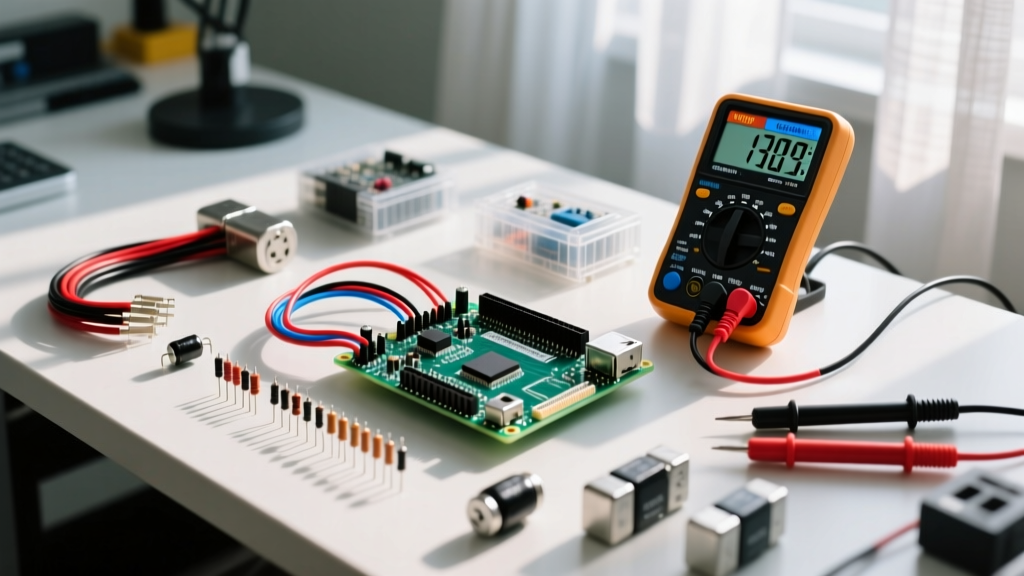
The most common mistake hobbyists and junior technicians make is buying an 'average-responding' multimeter and using it on modern, non-linear circuits. Average-responding meters measure the absolute average of the wave and multiply it by a fixed 1.11 form factor to guess the RMS value. This math only works on pure, perfect sine waves. If the wave is distorted (LED drivers, VFDs, UPS outputs, dimmers), the meter's guess is wrong, sometimes by 30% or more.
| What Are You Measuring? | Waveform Type | Meter Required | Concrete Tool Pick |
|---|---|---|---|
| Utility grid power, basic transformers, resistive heaters | Pure Sine Wave | Average-Responding (Budget) | Klein Tools MM400 (~$45) |
| LED drivers, computer power supplies, VFDs, solar inverters | Non-Linear / Distorted | True RMS (Mandatory) | Fluke 117 True RMS (~$210) |
| High-frequency PWM, complex harmonics, industrial PLC I/O | High-Frequency / Chopped | True RMS with High Bandwidth | Fluke 87V Industrial (~$450) |
The Default Recommendation: If you only buy one meter for your bench or truck, buy a True RMS meter. The price gap has narrowed significantly. For professional and commercial electrical work, the Fluke 117 True RMS Multimeter is the definitive standard, offering non-contact voltage detection and the bandwidth to accurately read VFD outputs. For home DIY and basic Arduino/mains troubleshooting, the Klein Tools MM400 is a capable True RMS entry point.
Common Confusions: Peak, Average, and RMS
Even experienced makers mix up these three terms when reading datasheets or scoping a circuit.
- Peak Voltage ($V_p$): The absolute maximum excursion from zero. On a 120V RMS line, this is ~170V. Use case: Sizing capacitor voltage ratings and wire insulation dielectric strength. A 200V-rated capacitor will explode on a 120V RMS AC line because the 170V peak exceeds its limit.
- Peak-to-Peak Voltage ($V_{pp}$): The total swing from the positive peak to the negative peak. On a 120V RMS line, this is ~340V. Use case: Setting the vertical scale on an oscilloscope.
- Average Voltage ($V_{avg}$): The mathematical mean. For a full AC sine wave, this is exactly 0V (the positive half cancels the negative half). For a half-wave rectified signal, it is $V_{peak} \times 0.318$. Use case: Calculating DC offset or designing half-wave rectifier power supplies.
- RMS Voltage ($V_{RMS}$): The heating equivalent. Use case: Sizing wire, breakers, fuses, and calculating real power (Watts).
FAQ: RMS Voltage in the Field
Does RMS apply to DC voltage?
Technically, the RMS value of a pure, steady DC voltage is exactly equal to its DC value. If you have a 12V car battery, its RMS voltage is 12V. However, if that DC voltage has 'ripple' (like the output of an unfiltered bridge rectifier), the True RMS value will be slightly higher than the average DC value shown on a basic meter.
Why does my cheap multimeter read 140V on my UPS battery backup?
Cheaper UPS systems output a 'stepped approximation' or modified square wave when on battery power, not a pure sine wave. An average-responding meter applies the 1.11 sine-wave multiplier to this square wave, resulting in a wildly inflated and incorrect reading. A True RMS meter will correctly calculate the heating value, which should read closer to the expected 120V. For sensitive electronics, always use a Pure Sine Wave UPS.
How do I measure RMS voltage on an oscilloscope?
Modern digital storage oscilloscopes (DSOs) have built-in math functions. Capture the waveform, press the 'Measure' button, and select 'RMS'. Ensure your timebase captures at least two full cycles of the fundamental frequency so the scope's internal algorithm can calculate the true mean of the squares. For high-frequency noise riding on a mains signal, use the scope's bandwidth limit filter to get the fundamental RMS value.