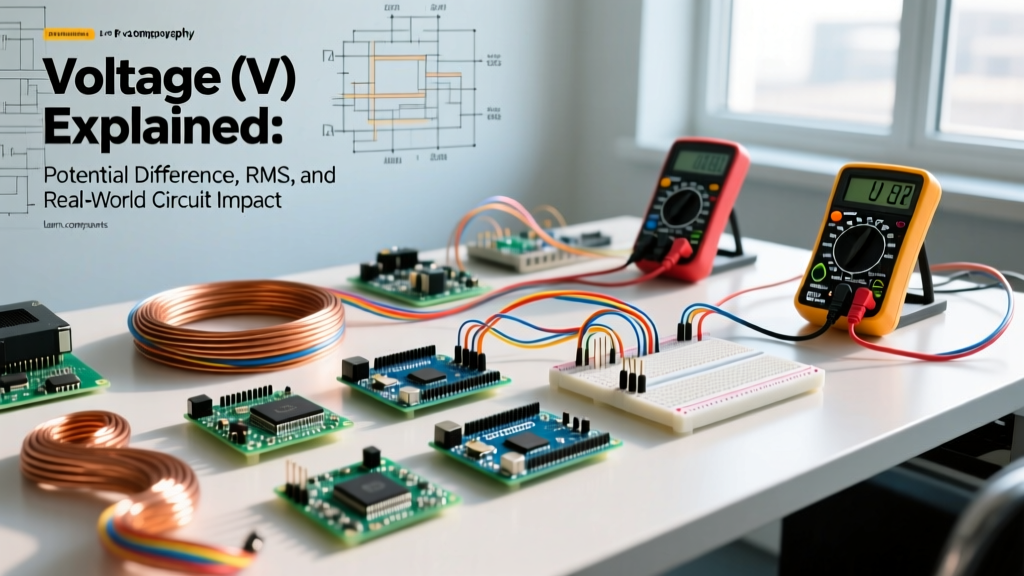
The voltage of home electricity in North America is a nominal 120V for standard branch circuits and 240V for heavy appliances, delivered as a split-phase alternating current (AC) system that provides the electromotive force to push electrons through your wiring to do work.
The Baseline: What the Voltage of Home Electricity Actually Means
To understand residential power, you have to look at the utility transformer on the pole outside your house. It steps down high-voltage distribution lines to 240V AC. This secondary winding has a center tap that is bonded to ground, creating the neutral wire. This gives you two 120V 'hot' legs that are 180 degrees out of phase with each other. If you measure from either hot leg to neutral, you get 120V. If you measure across both hot legs, the potentials add up to 240V.
Think of voltage like water pressure in a municipal pipe system: it is the pushing force that drives the flow (current) through the pipes (wires) to turn the turbine (appliance). Higher pressure means you can push the same amount of water through a narrower pipe.
What Voltage Changes in a Real Circuit
Voltage dictates the physical architecture of your installation. For a given wattage, doubling the voltage halves the current (amperage). This changes three critical installation factors:
- Wire Gauge (AWG): Lower current allows for smaller, cheaper copper wire.
- Breaker Sizing: Overcurrent protection devices must be matched to the wire's ampacity at the specific voltage tier.
- Insulation and Clearances: While 120V and 240V both use standard 600V-rated THHN or NM-B insulation, 240V circuits demand stricter adherence to terminal torque specs and panel clearance rules due to the higher arc-flash potential across the two opposing hot legs.
Common Confusions
Beginners frequently confuse voltage (the pressure) with amperage (the volume of flow). A 240V circuit isn't necessarily 'more powerful' than a 120V circuit; a 120V/20A circuit (2400W) delivers the exact same power as a 240V/10A circuit (2400W). Additionally, people confuse the nominal voltage (120V/240V) with the measured voltage. If your multimeter reads 118V at the receptacle, your system is operating perfectly, not 'losing power.'
Where You Meet This in Practice
You interact with the split-phase voltage of home electricity every time you plug in a device or open your main panel.
- Standard Receptacles (NEMA 5-15R / 5-20R): These are your standard wall outlets. They connect to one 120V hot leg, the neutral, and the ground. They power lighting, TVs, and small appliances.
- Heavy Appliance Receptacles (NEMA 14-50R / 14-30R): Found in kitchens (ranges), laundry rooms (dryers), and garages (EV chargers). These connect to both 120V hot legs (yielding 240V for the heating elements or motors), plus a neutral (for 120V control boards or timers), and a ground.
- The Main Panel Bus Bars: Inside your breaker box, you will see two distinct metal stabs (bus bars) running down the center. One carries Hot Leg A (120V to neutral), and the other carries Hot Leg B (120V to neutral). A standard single-pole breaker clips to one bar; a double-pole breaker clips to both, bridging the 240V gap.
Worked Numeric Example: Sizing for a 2000W Baseboard Heater
Let's look at how the voltage of home electricity changes material costs and wire sizing for a fixed load: a 2000-watt electric baseboard heater. According to the NFPA 70 (National Electrical Code), fixed electric space heating is considered a continuous load, meaning the circuit must be sized at 125% of the actual draw.
Scenario A: Wiring at 120V
- Calculate Base Current: I = P / V → 2000W / 120V = 16.67 Amps.
- Apply Continuous Load Rule: 16.67A × 1.25 = 20.83 Amps.
- Select Breaker: You need a breaker rated for at least 20.83A. The next standard size up is a 25A or 30A breaker.
- Select Wire: To feed a 30A breaker safely using standard NM-B (Romex) cable, you must use 10 AWG copper wire.
Scenario B: Wiring at 240V
- Calculate Base Current: I = P / V → 2000W / 240V = 8.33 Amps.
- Apply Continuous Load Rule: 8.33A × 1.25 = 10.41 Amps.
- Select Breaker: You need a breaker rated for at least 10.41A. A standard 15A double-pole breaker is perfect.
- Select Wire: To feed a 15A breaker, you only need 14 AWG copper wire.
The Takeaway: By utilizing the 240V side of your home's voltage, you drop the wire requirement from thick, stiff 10 AWG down to flexible, inexpensive 14 AWG, and you free up space in your panel by using a smaller breaker. This is exactly why high-draw appliances are designed for 240V.
Real-World Scenario Walkthrough: The 120V RV and the 240V Dryer Outlet Disaster
Misunderstanding the split-phase voltage of home electricity is a fast track to destroying expensive equipment. Here is a benchmark failure case we see in the field.
The Setup
An RV owner wants to plug their 30-amp, 120V RV shore power cord (NEMA TT-30 plug) into their garage's 50-amp, 240V dryer/RV outlet (NEMA 14-50R) to run the air conditioning while parked at home. They purchase a cheap, unbranded 'TT-30 to 14-50' adapter dongle online.
The Numbers
- The RV's internal wiring and appliances expect 120V between the Hot pin and the Neutral pin.
- The garage's NEMA 14-50R provides 120V from L1 to Neutral, 120V from L2 to Neutral, and 240V between L1 and L2.
The Outcome
The owner plugs the adapter into the wall, connects the RV cord, and flips the main breaker inside the RV. Instantly, the microwave transformer emits a loud hum and begins smoking. The rooftop AC compressor seizes and trips its internal thermal overload. The RV's surge protector is destroyed. Total damage: roughly $3,200 in appliance replacements.
What Went Wrong
- The Adapter Miswire: The cheap adapter was incorrectly manufactured. Instead of mapping the RV's single Hot pin to just L1 (or just L2) of the 14-50R, the internal wiring mistakenly bridged the RV's Hot pin to L1, and the RV's Neutral pin to L2.
- The Voltage Spike: Because L1 and L2 are 180 degrees out of phase, the potential difference between them is 240V. The adapter fed 240V directly across the RV's 120V Hot-to-Neutral bus.
- The Failure Mode: The RV's appliances experienced a 200% overvoltage. The microwave's magnetic core saturated instantly, drawing massive current and overheating. The AC run capacitor exploded under the dielectric stress.
Prevention: Always buy adapters from reputable electrical manufacturers (like Camco or Hubbell). Before plugging in, use a multimeter to measure the voltage across the adapter's TT-30 female pins. You must read ~120V between Hot and Neutral, and 0V between Neutral and Ground.
Frequently Asked Questions
Why do older electricians still call it 110V or 115V?
This is historical inertia. In the early 20th century, the US electrical grid and early appliances were standardized around 110V. As utility infrastructure improved and transformer tolerances tightened, the nominal standard was officially bumped to 115V, then 117V, and finally 120V/240V in the 1960s to reflect the actual delivered voltage. Today, 110V, 115V, and 120V all refer to the exact same residential branch circuit.
Can I run a 240V European appliance on a standard US 120V outlet?
No, not directly, and usually not even with a step-up transformer. European appliances operate on 230V at 50Hz. North American home electricity is 120V/240V at 60Hz. While a step-up transformer can fix the voltage, it cannot fix the frequency. A 50Hz motor running on 60Hz US power will spin 20% faster, overheat, and likely fail. Furthermore, the appliance's internal control boards may not handle the 60Hz sine wave correctly.
What happens if my house voltage drops below 114V (a brownout)?
When voltage drops, resistive loads (like incandescent lights or space heaters) simply output less heat and light. However, inductive loads (like refrigerator compressors, well pumps, and AC units) suffer severely. To maintain their required wattage output at a lower voltage, these motors must draw more amperage (I = P / V). This excess current generates heat in the motor windings, which can degrade the insulation and eventually burn out the motor if the brownout persists and the breaker doesn't trip in time.