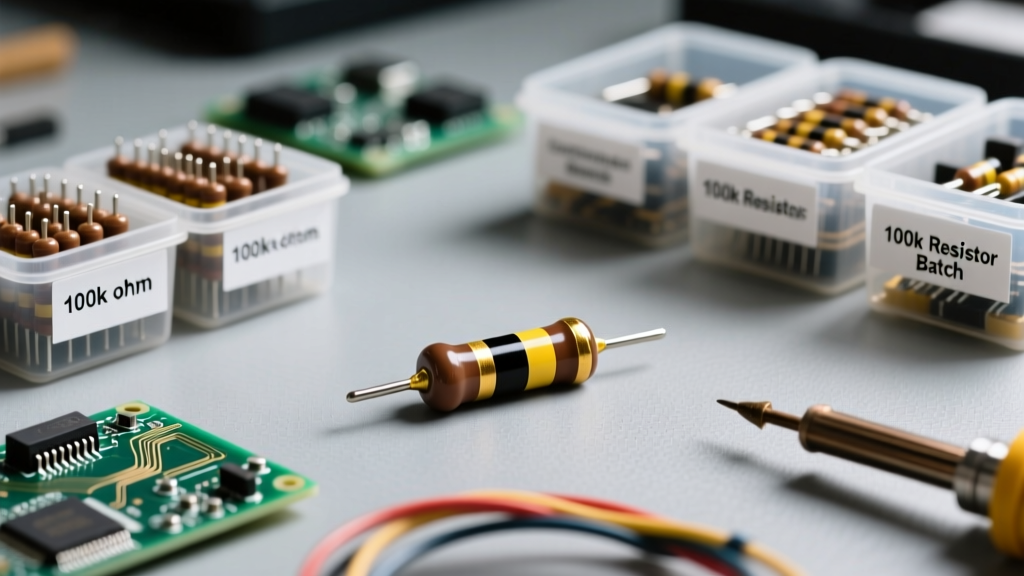
Active elements can inject net energy or amplify a signal's power using an external source, while passive elements can only dissipate, store, or release energy without adding power gain. This single distinction dictates everything from the physical size of your audio crossovers to the stability of your power supply regulation. If you are designing a circuit, knowing whether a component can provide power gain or merely shape the existing energy is the first step in selecting the right topology.
The Core Distinction: Power Gain and Energy Injection
To understand component classification, we have to look at energy conservation. A passive component is strictly bound by the energy already present in the circuit. It can resist current flow (dissipating energy as heat), store energy in an electric field (capacitance), or store energy in a magnetic field (inductance). However, the total power output of a passive network will always be less than or equal to the power input, minus internal losses.
Active elements, on the other hand, act as control valves. Think of an active component like a water valve controlled by a small lever (the input signal) that releases a massive flow from a pressurized main tank (the external DC power supply). The small lever doesn't create the water; it just modulates the massive energy available from the tank. In electronics, transistors and operational amplifiers use a small input voltage or current to modulate a much larger current flowing from a power rail, resulting in a net power gain greater than 1.
| Component Class | Example Part | Power Gain | Energy Behavior | Requires External DC Bias? |
|---|---|---|---|---|
| Resistor (Passive) | Yageo CFR-25 (1kΩ) | < 1 (Attenuates) | Dissipates as heat | No |
| Ceramic Capacitor (Passive) | Kemet C315C (100nF) | < 1 (Attenuates) | Stores electric field | No |
| Inductor (Passive) | Würth 744043 (10µH) | < 1 (Attenuates) | Stores magnetic field | No |
| BJT Transistor (Active) | ON Semi 2N3904 (NPN) | > 1 (Amplifies) | Modulates external supply | Yes (Collector/Emitter) |
| Op-Amp (Active) | TI OPA1678 (Dual) | > 1 (Amplifies) | Modulates external supply | Yes (V+ / V- rails) |
Worked Numeric Example: Passive Attenuator vs. Active Buffer
Let's prove the power gain concept with real numbers. Suppose you have a high-impedance sensor outputting 1V RMS with a source impedance of 1,000Ω. You need to drive a 50Ω coaxial cable or load without the signal collapsing.
The Passive Attempt (Maximum Power Transfer)
If you connect the 50Ω load directly to the 1kΩ source, the voltage will divider down to roughly 0.047V RMS due to the massive impedance mismatch. To get the absolute maximum power out of this passive source, you must match the load impedance to the source impedance ($R_L = R_S = 1000Ω$).
- Total circuit resistance: $1000Ω + 1000Ω = 2000Ω$
- Current ($I$): $1V / 2000Ω = 0.5mA$ RMS
- Power delivered to load ($P = I^2R$): $(0.0005A)^2 \times 1000Ω =$ 0.25 mW
No matter what passive transformer or resistor network you use, you cannot extract more than 0.25 mW from this source. The signal is fundamentally weak.
The Active Solution (Op-Amp Buffer)
Now, we place a unity-gain buffer using a TI OPA1678 op-amp between the source and the 50Ω load. The op-amp is powered by ±5V DC rails.
- The op-amp's input impedance is roughly 100 GΩ, so it draws virtually zero current from the sensor. It sees the full 1V RMS.
- The op-amp outputs 1V RMS directly into the 50Ω load.
- Output Current ($I$): $1V / 50Ω = 20mA$ RMS
- Power delivered to load ($P = I^2R$): $(0.02A)^2 \times 50Ω =$ 20.0 mW
Where You Meet This in Practice: Filter and Crossover Design
The choice between passive and active elements drastically changes physical layout, cost, and performance in filter design. According to Analog Devices, the decision usually hinges on frequency, power handling, and component bulk.
Passive Filters (RLC Networks)
Passive filters rely on resistors, capacitors, and inductors. You meet these in high-power audio speaker crossovers and RF front-ends. A 2nd-order passive Butterworth low-pass filter for a subwoofer might use a massive 5mH air-core inductor and a 47µF metallized polypropylene capacitor. These components can handle hundreds of watts of amplifier power without melting, but the inductors are physically huge, heavy, and expensive. Furthermore, passive filters suffer from insertion loss and their response shifts if the load impedance changes.
Active Filters (Op-Amp + RC)
Active filters use op-amps combined with resistors and capacitors (avoiding bulky inductors entirely). A Sallen-Key active low-pass filter can achieve the exact same 2nd-order Butterworth response using two 10kΩ resistors, two 15nF capacitors, and an LM358 op-amp. The total cost is under $0.50, and it fits on a dime. However, because it relies on active elements, it is limited by the op-amp's supply voltage (it will clip if the signal exceeds the rails) and its Gain-Bandwidth Product (GBWP). You cannot use an LM358 active filter at 50 MHz; the active elements simply cannot react fast enough.
| Criteria | Passive Filters (RLC) | Active Filters (Op-Amp + RC) |
|---|---|---|
| Power Handling | Very High (100W+) | Limited by Op-Amp Rails (mW to ~2W) |
| High-Frequency Use | Excellent (RF, GHz range) | Poor (Limited by Op-Amp GBWP) |
| Component Size | Large (Inductors are bulky) | Very Small (Surface mount RC) |
| Power Gain | Always < 1 (Insertion loss) | Can be > 1 (Provides gain) |
| Power Supply Needed? | No | Yes (Requires DC rails) |
Common Confusions and Edge Cases
When classifying components, a few edge cases frequently trip up hobbyists and students. As noted in foundational texts like those on Electronics Tutorials, the defining metric is always net power gain, not voltage manipulation.
- Transformers: A step-up transformer can take 12V AC and output 120V AC. Because it increases voltage, beginners often classify it as active. However, it steps down the current proportionally ($P = V \times I$). Accounting for core and copper losses, $P_{out}$ is always slightly less than $P_{in}$. Therefore, transformers are strictly passive.
- Diodes: Diodes are non-linear semiconductors that rectify AC to DC. Because they are made of silicon and have a 'forward voltage drop', they are sometimes grouped with transistors in parts catalogs. But a diode cannot amplify a signal or provide power gain. It is a passive (specifically, non-linear passive) element.
- Active Cables (USB/HDMI): If you buy a 10-meter USB-C or HDMI cable labeled 'Active', it is not just a passive copper wire. It contains internal active ICs (redrivers or retimers) powered by the 5V VBUS line to amplify and equalize the high-frequency digital signals, compensating for cable capacitance. The presence of these active elements is what allows the cable to exceed standard passive length limits.
Frequently Asked Questions
What does using an active element change in a real installation?
Introducing active elements means your circuit now requires a dedicated, clean DC power supply. If your power rail has ripple or noise, the active element will amplify that noise alongside your signal. It also introduces thermal limits; active components dissipate the voltage dropped across them as heat ($P = V_{drop} \times I_{load}$), requiring heatsinks or thermal management that passive components rarely need.
Can a circuit be entirely passive?
Yes. Crystal radios, simple LED current-limiting networks, and basic AC mains EMI filters are entirely passive. They are highly reliable because they lack semiconductor junctions that can fail from overvoltage or thermal runaway, but they cannot drive low-impedance loads without severe signal degradation.