
The Anatomy of the 100k Resistor Color Code
The 100k ohm resistor is a foundational component in modern electronics, frequently deployed in I2C pull-up networks, op-amp feedback loops, and high-impedance voltage dividers for ADC scaling. For electrical engineers, lab managers, and makerspace administrators, accurately identifying and managing the color code for 100k resistor variants is a daily operational necessity. Misidentifying a 100k resistor as a 10k or 1M resistor due to faded bands or poor lighting can lead to catastrophic circuit failures, ranging from oscillating amplifiers to bricked microcontrollers.
According to the IEC 60062 standard, through-hole resistors utilize a color-coded band system to denote their nominal value, multiplier, and tolerance. When sourcing components for a high-volume production run or organizing a university lab's component library, understanding the exact chromatic breakdown of the 100k value is the first line of defense against assembly errors.
4-Band vs. 5-Band Decoding Matrix
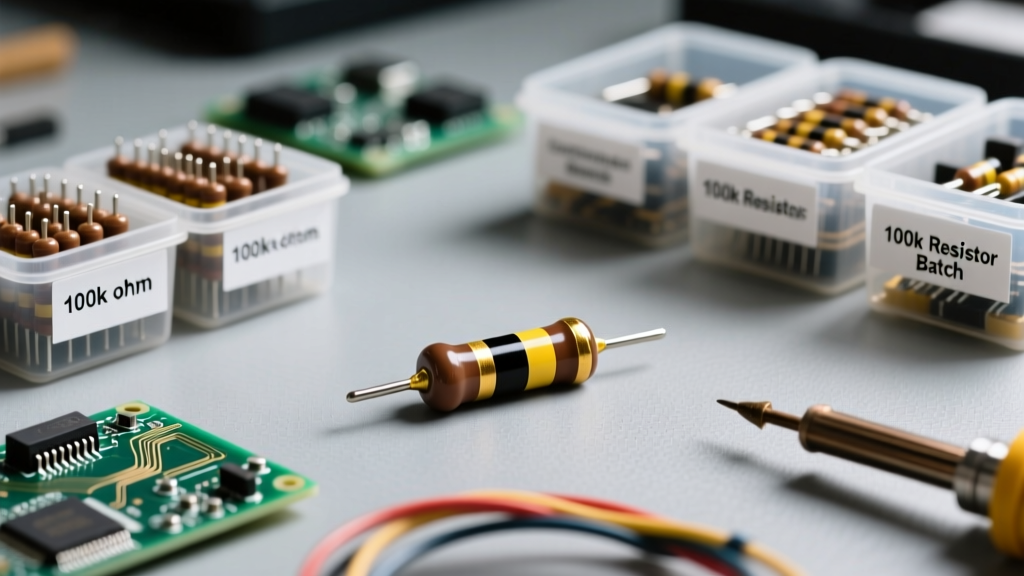
The color code for 100k resistor bands shifts depending on the tolerance and precision of the component. A standard 5% carbon or metal film resistor uses a 4-band system, while a 1% precision metal film resistor requires a 5-band system to account for the extra significant digit.
| System | Band 1 (1st Digit) | Band 2 (2nd Digit) | Band 3 (3rd Digit / Multiplier) | Band 4 (Multiplier / Tolerance) | Band 5 (Tolerance) |
|---|---|---|---|---|---|
| 4-Band (5%) | Brown (1) | Black (0) | Yellow (x10,000) | Gold (±5%) | N/A |
| 5-Band (1%) | Brown (1) | Black (0) | Black (0) | Orange (x1,000) | Brown (±1%) |
| 6-Band (1%, High TCR) | Brown (1) | Black (0) | Black (0) | Orange (x1,000) | Brown (±1%) |
For a comprehensive breakdown of standard values, procurement teams often rely on tools like Digi-Key's Resistor Color Code Calculator to verify bulk shipments against manufacturer datasheets.
Sourcing Strategies: Tolerance, TCR, and Packaging
When procuring 100k resistors, the color code is only the beginning of the specification sheet. Modern sourcing requires a deep understanding of the underlying resistor technology, temperature coefficient of resistance (TCR), and packaging formats.
Why Metal Film is Dominating Modern Procurement
Historically, the 4-band Brown-Black-Yellow-Gold carbon film resistor was the default for 100k pull-ups. However, carbon composition and carbon film resistors suffer from high thermal noise and significant drift over time. In 2026, procurement best practices dictate standardizing on metal film resistors (typically 5-band Brown-Black-Black-Orange-Brown) even for non-critical applications.
Metal film resistors offer a TCR of around 50 to 100 ppm/°C, compared to the 500+ ppm/°C of older carbon variants. When sourcing from major distributors like Mouser or Digi-Key, look for industry-standard part numbers such as the Vishay MRS25000C1003FRP00 (1% tolerance, 0.6W) or the Yageo CFR-25JR-52-100K (a legacy 5% carbon film option, still useful for high-voltage snubber networks where inductance matters).
Procurement Tip: When ordering 100k resistors for automated PCB assembly (PCBA), always select 'Tape and Reel' (TR) packaging over 'Ammo Pack' or 'Bulk'. TR packaging ensures the color-coded bands are oriented consistently, reducing the optical inspection rejection rate during the pick-and-place phase.
Inventory Management: Automating Color Code Recognition
In high-volume makerspaces, university labs, and contract manufacturing environments, mixed bins of through-hole resistors are a notorious bottleneck. Manual sorting of 100k resistors based on the yellow vs. orange multiplier band is prone to human error, especially under warm LED room lighting.
Vision Systems and the Yellow-Orange Ambiguity
The most common inventory error involving the color code for 100k resistor components is confusing the 4-band Yellow multiplier (100k) with the 4-band Orange multiplier (10k). A faded yellow band on an older carbon film resistor can easily be misread as orange by the human eye, leading to a 10x magnitude error in the bin.
Advanced inventory stations now utilize machine vision and OpenCV to sort components. By calibrating the camera's HSV (Hue, Saturation, Value) thresholds, automated sorting machines can accurately distinguish the specific 45°-55° hue angle of the yellow multiplier band from the 15°-25° hue angle of the orange band. For lab managers building custom sorting jigs, illuminating the resistor with a 5000K (daylight) LED array is critical to prevent the yellow band from reflecting as green or brown.
Quality Control: Catching Mislabeled 100k Resistors
Sourcing from secondary markets, unauthorized brokers, or direct-from-manufacturer surplus channels (like certain AliExpress or Amazon third-party vendors) introduces the risk of mislabeled components. Counterfeiters often take 10k or 1M resistors, scrape the original bands, and repaint them to mimic the 100k color code.
Real-World Failure Modes in Bulk Sourcing
How do you verify a bulk batch of 100k resistors without measuring every single unit? Implement an Acceptable Quality Limit (AQL) sampling plan. Pull 30 random samples from a reel of 5,000 and verify them using a digital multimeter (DMM).
Unlike milliohm shunt resistors that require 4-wire Kelvin measurements to eliminate lead resistance, verifying a 100k resistor only requires a standard 2-wire DMM. At 100,000 ohms, the 0.1-ohm resistance of your test leads is mathematically negligible (a 0.0001% error). However, dirty probe tips or a dying 9V battery inside the DMM can skew high-impedance readings. Always zero your probes and ensure your meter's battery is fresh before auditing a batch of 1% 100k resistors. For further reading on standard component verification, the Electronics Notes Resistor Guide provides excellent baseline testing methodologies.
Best Practices for Organizing Your Component Library
Once sourced and verified, the physical storage of 100k resistors dictates your workflow efficiency. While through-hole resistors are not highly sensitive to Electrostatic Discharge (ESD) compared to bare CMOS ICs, the plastic bins used to store them can generate static charges that attract dust, obscuring the color bands over time.
- Cabinet Selection: Use anti-static treated Akro-Mils drawer systems. Label the drawer not just with '100k', but with the specific tolerance and package size (e.g., '100K 1% 1/4W MF').
- API Integration: Link your physical bin locations to digital inventory management software. Platforms like Octopart allow you to track real-time pricing and global stock levels, ensuring you never hit a stockout on this critical pull-up value.
- Kitting for Production: If you run a small assembly line, pre-kit 100k resistors into labeled ESD bags alongside their mating components (e.g., specific NPN transistors or optocouplers) to eliminate the need to read the color code on the shop floor.
Mastering the color code for 100k resistor identification goes far beyond memorizing Brown-Black-Yellow. It encompasses a holistic approach to supply chain verification, optical sorting technology, and rigorous quality control. By treating this ubiquitous component with the same sourcing discipline as a microcontroller, you ensure the reliability and scalability of your electronic designs.


