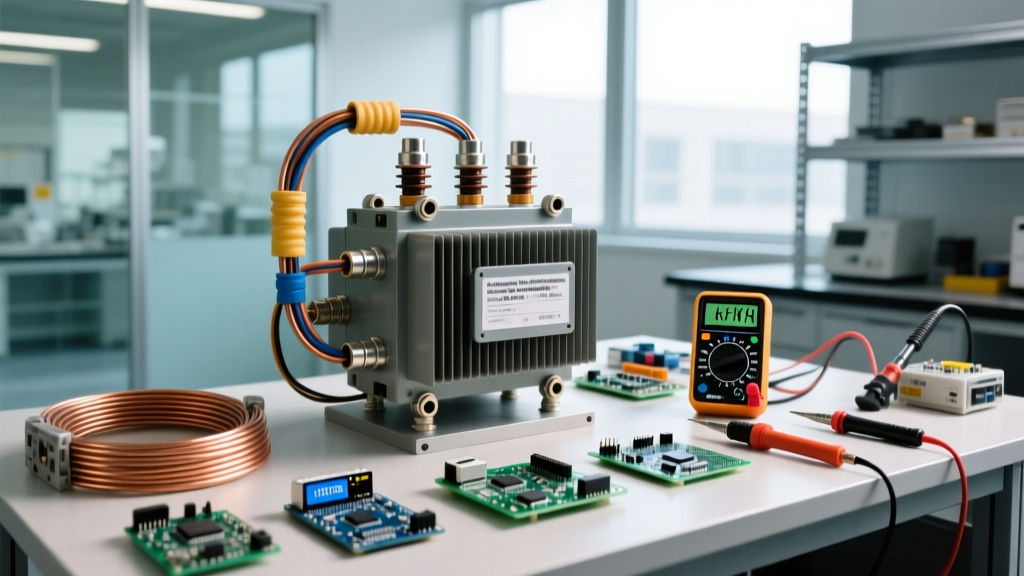
High-voltage direct current (HVDC) is the transmission or distribution of electrical power using direct current at voltages typically exceeding 100 kV for grid infrastructure, or 400 V to 1000 V in prosumer solar and EV applications.
The Core Concept
What it changes in a circuit: HVDC eliminates reactive power losses and skin effect, allowing conductors to carry more real power over long distances, but it makes arc extinction brutal because DC lacks a natural voltage zero-crossing to naturally extinguish a spark.
What people commonly confuse it with: Hobbyists and junior techs frequently confuse HVDC with high-frequency AC, or fatally assume that standard AC thermal-magnetic breakers can safely interrupt high-voltage DC circuits without catastrophic arcing.
What High-Voltage Direct Current Actually Is (And Isn't)
When we talk about high-voltage direct current on the bench or in the field, we are usually referring to unidirectional current flow at potentials high enough to cause severe arcing and insulation breakdown if mishandled. In utility-scale transmission, HVDC means ±320 kV to ±800 kV lines moving power across continents. But for electrical DIYers, solar installers, and EV converters, HVDC means the 400V to 1000V DC range found in modern string inverters, level 3 fast chargers, and marine DC microgrids.
Think of AC like rapidly reversing the water flow in a hose; the friction creates heat at the walls (skin effect), and if you kink the hose, the pressure drops to zero twice every cycle, letting the leak seal itself. DC is a steady, high-pressure stream; it flows through the whole pipe, but if you kink it, the steady pressure blows a continuous, unyielding hole in the hose. That continuous hole is the DC arc, and at 800V, it will melt copper busbars and ignite enclosures if your switchgear isn't explicitly rated for it.
The Physics: Why DC Changes the Rules at High Voltage
The primary engineering driver for pushing DC to high voltages is the reduction of I²R (copper) losses. Because power is the product of voltage and current (P = V × I), raising the voltage allows you to drastically lower the current for the same power transfer. Lower current means you can use smaller, cheaper wire and suffer less voltage drop.
Worked Numeric Example: 10 kW Solar Array Routing
Let's look at a real-world 10 kW solar array routed 50 feet (100 feet total loop length) from the panels to the inverter. We will compare a legacy 48V DC battery-tied system against a modern 800V HVDC string inverter setup.
Scenario A: 48V Nominal DC System
- Current: 10,000W / 48V = 208.3 Amps
- Wire Size Required: 2/0 AWG stranded copper (to handle >200A safely)
- Resistance: 0.194 ohms per 1,000 ft (NEC Chapter 9, Table 8)
- Loop Resistance (100 ft): 0.0194 ohms
- Voltage Drop: 208.3A × 0.0194Ω = 4.04 Volts
- Percentage Drop: (4.04 / 48) × 100 = 8.4% (Unacceptable; NEC-style guidance recommends <3%)
Scenario B: 800V HVDC String System
- Current: 10,000W / 800V = 12.5 Amps
- Wire Size Required: 10 AWG stranded copper (rated for 30A-40A depending on insulation)
- Resistance: 1.21 ohms per 1,000 ft
- Loop Resistance (100 ft): 0.121 ohms
- Voltage Drop: 12.5A × 0.121Ω = 1.51 Volts
- Percentage Drop: (1.51 / 800) × 100 = 0.18% (Excellent)
By stepping up to HVDC, we dropped the wire size from a stiff, expensive 2/0 AWG cable to flexible 10 AWG, while virtually eliminating transmission losses. According to the U.S. Department of Energy, this exact physics principle is why HVDC is the backbone of modern long-distance renewable energy integration.
Where You Meet HVDC in Practice
While you won't be building an 800 kV cross-country transmission line in your garage, HVDC is increasingly common in prosumer and commercial-adjacent installations:
- Commercial Solar Combiner Boxes: Modern 60 kW to 100 kW string inverters (like the SMA Sunny Tripower series) operate at input voltages up to 1000V or 1500V DC. The combiner boxes feeding them require specialized HVDC fuses and disconnects.
- EV Fast Charging (CCS/CHAdeMO): Level 3 DC fast chargers rectify grid AC into 400V to 900V DC to push directly into an EV's battery pack, bypassing the car's onboard charger. The liquid-cooled cables and contactors inside these pedestals are pure HVDC.
- High-Voltage Home Battery Banks: Systems like the Tesla Powerwall or modular high-voltage LiFePO4 racks (e.g., EG4 48V servers wired in series to create 192V or 384V DC buses) use HVDC to interface with hybrid inverters like the Sol-Ark 15k or LuxPower.
Component Selection: Sizing HVDC Switchgear and Protection
Selecting the right switchgear is where most HVDC projects fail. AC breakers rely on the AC waveform crossing zero volts 120 times a second (in a 60Hz system) to naturally extinguish the arc when contacts separate. DC never crosses zero. If you open a standard AC breaker on an 800V DC circuit, the arc will sustain, bridge the gap, and destroy the breaker.
You must use components with magnetic blowouts, gas-filled chambers, or specialized arc chutes designed specifically for DC.
| System Voltage | Current Load | Switchgear Requirement | Concrete Part Recommendation |
|---|---|---|---|
| 12V - 120V DC | Up to 150A | Standard marine DC breaker with magnetic arc blowout. | Blue Sea Systems 285-Series (Thermal-Magnetic DC) |
| 120V - 400V DC | Up to 100A | Sealed contactor with internal arc suppression. | Gigavac MX14 Series Contactor |
| 400V - 1000V DC | Up to 50A | Hermetically sealed HVDC relay with gas fill (Nitrogen/Hydrogen) to prevent oxidation and quench arcs. | DEFAULT PICK: TE Connectivity ECK250 or Gigavac GX14 |
| 400V - 1000V DC | 50A - 250A | Heavy-duty motorized HVDC disconnect or industrial contactor with external magnetic blowout magnets. | Albright SW200 or Eaton Bussmann HVDC Fuses + Motorized Switch |
The Default Pick: For the vast majority of prosumer HVDC applications—such as switching an 800V solar string or a 400V EV battery pack under 50A—the Gigavac GX14 or TE Connectivity ECK250 is the correct choice. These hermetically sealed, gas-filled relays cost roughly $60 to $90, fit on a standard DIN rail or panel mount, and safely interrupt up to 1000V DC without the arc sustaining. Never substitute a cheaper AC-rated automotive relay here; the National Renewable Energy Laboratory (NREL) consistently highlights improper DC switching as a leading cause of residential and commercial solar fires.
HVDC Troubleshooting and Design FAQ
Can I use a standard AC breaker if I wire two of them in series for DC?
No. While wiring two AC breakers in series (ganging them) is an outdated hack sometimes seen in legacy 12V/24V telecom systems to increase the physical gap for arc extinction, it is strictly forbidden and highly dangerous at HVDC potentials (400V+). The mechanical linkage between ganged breakers is not fast enough to guarantee simultaneous contact separation, meaning one breaker will take the full DC arc energy and fail catastrophically. Always buy a breaker or contactor explicitly rated for your specific DC voltage.
Does polarity matter when wiring HVDC fuses and contactors?
Yes, absolutely. Many HVDC fuses and directional contactors are polarity-sensitive. Inside a DC fuse, there is often a specific arc-quenching filler (like silica sand) and a physical offset in the fuse element designed to drive the arc into the quenching medium using the Lorentz force. If you wire it backward, the magnetic field pushes the arc away from the quenching medium, potentially causing the fuse body to explode. Always check the manufacturer's datasheet for the anode/cathode markings.
Why do HVDC cables use different insulation than AC cables?
High-voltage DC creates a static electric field that causes space charges to accumulate within the dielectric insulation of standard AC cables (like standard XLPE). Over time, these trapped charges distort the electric field, leading to premature insulation breakdown. True HVDC cables use specially formulated insulation (like HVDC-XLPE) designed to prevent space charge accumulation. For prosumer 800V-1000V solar applications, standard 1000V-rated PV wire (which uses cross-linked polyethylene) is sufficient, but you must never use standard 600V THHN in conduit for an 800V DC string.