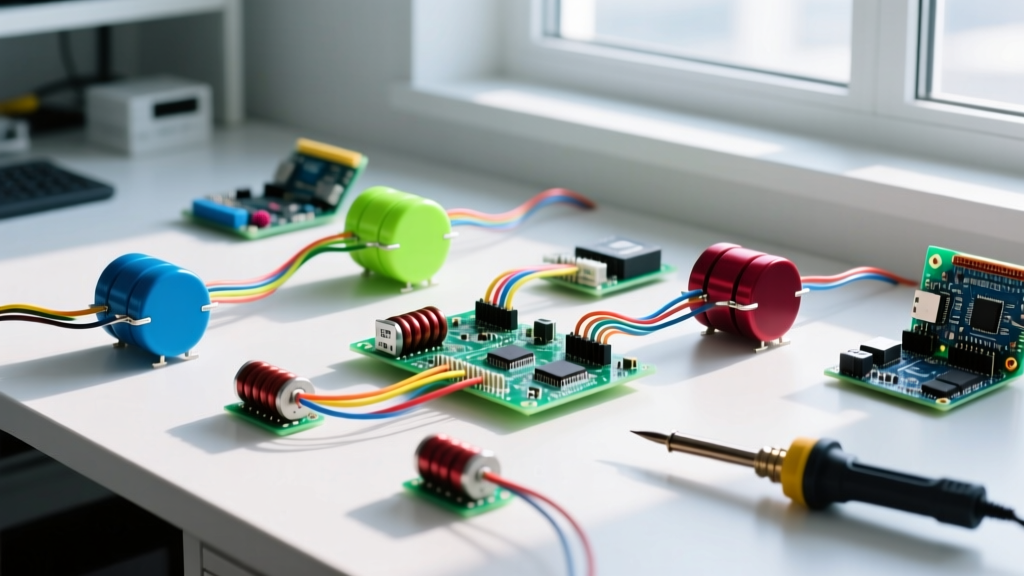
An electrical volt is the unit of electric potential difference, measuring the exact amount of work required to move one coulomb of charge between two specific points in a circuit. While beginners tend to obsess over current (amps) and battery capacity (amp-hours), it is the system voltage that dictates your wire gauge, breaker sizing, and overall heat dissipation. If you double the voltage, you halve the current for the exact same power output, fundamentally changing the physical hardware you need to buy. The most common mistake makers and DIYers make is confusing a component's nominal voltage label with its actual operating voltage, leading to fried logic boards, undersized wire that sags under load, or premature LED failure.
What an Electrical Volt Actually Changes in Your Circuit
To understand what voltage changes on your workbench, you have to look at the power equation: Power (Watts) = Current (Amps) × Voltage (Volts). Because power is the product of the two, raising your system voltage allows you to deliver the same wattage with significantly less current. Think of voltage like water pressure in a pipe: higher pressure pushes the same amount of water through a much narrower hose.
Let us look at a concrete numeric example that dictates how you build a project. Suppose you are wiring a 100W COB LED strip for a workshop bench light, and the power supply is 20 feet away from the strip (requiring a 40-foot round trip of wire).
The 12V Build vs. The 24V Build
- At 12V Nominal: The strip draws 8.33 Amps (100W / 12V). If you use standard 14 AWG copper wire (which has a resistance of roughly 2.525 ohms per 1,000 feet), your 40-foot run has a resistance of 0.101 ohms. The voltage drop is 8.33A × 0.101Ω = 0.84V. That is a 7% voltage drop. Your LEDs at the end of the strip will visibly dim, and the wire will get warm.
- At 24V Nominal: The exact same 100W strip draws only 4.16 Amps (100W / 24V). Using the exact same 14 AWG wire, the voltage drop is 4.16A × 0.101Ω = 0.42V. That is a 1.75% drop, well within the NIST standard recommendations for efficient power transfer. The wire stays cool, and the LEDs run at full brightness.
This single change in electrical volts forces you to either buy thicker 10 AWG wire for the 12V system, or stick with cheaper 14 AWG wire for the 24V system. According to Electronics Tutorials, minimizing I²R (current squared times resistance) heat losses is the primary reason electrical grids transmit power at hundreds of thousands of volts rather than 120V.
Nominal vs. Measured Voltage (The 12V and 24V Trap)
When you buy a "12V" battery or a "24V" solar panel, you are buying a marketing category, not a precise measurement. Nominal voltage is simply the standard name of the battery chemistry class. Actual measured voltage is what your multimeter reads at the terminals, and it fluctuates wildly based on state of charge (SoC) and whether the system is under load or being charged.
| Battery Chemistry | Nominal Label | Actual Voltage (100% SoC Resting) | Actual Voltage (Absorption Charging) | Actual Voltage (0% SoC Cut-off) |
|---|---|---|---|---|
| Flooded Lead-Acid | 12V | 12.6V - 12.8V | 14.4V | 10.5V |
| LiFePO4 (Lithium Iron) | 12V | 13.4V - 13.6V | 14.2V - 14.6V | 10.0V (BMS Cut-off) |
| LiFePO4 (Lithium Iron) | 24V | 26.8V - 27.2V | 28.4V - 29.2V | 20.0V (BMS Cut-off) |
Where You Meet This in Practice
Voltage variations are not just a battery quirk; they exist everywhere in electrical work. Here is where you will physically encounter the difference between nominal and actual volts on the job:
- Mains AC Power: In North America, your wall outlet is nominally 120V. However, the ANSI C84.1 standard allows utility delivery anywhere between 114V and 126V. If you are calculating the exact amperage draw of a 1500W space heater, you must assume the lower end (114V) to find the maximum current draw (13.15A), which is dangerously close to tripping a standard 15A breaker.
- Maker Logic Levels: The ESP32-WROOM-32 microcontroller operates at a nominal 3.3V logic level. If you connect it to an Arduino Uno (which operates at 5V) via UART without a logic level shifter, the 5V TX line from the Arduino will push 5 volts into the ESP32's 3.3V RX pin. This exceeds the absolute maximum ratings of the silicon and will permanently fry the input diode.
- Solar Panel Strings: A "12V nominal" monocrystalline solar panel actually has an Open Circuit Voltage (Voc) of roughly 21V to 22V. If you wire two of these in series to charge a 24V battery bank, your actual Voc is 44V. If your charge controller has a maximum input limit of 40V, you will blow its internal MOSFETs on a cold, sunny morning when voltage spikes.
Decision Tree: Choosing 12V, 24V, or 48V for Your Next Build
Do not default to 12V just because it feels familiar from car batteries. Use this decision path to select the correct system voltage and pick the exact power hardware for your next DC project.
| IF your project parameters are... | THEN choose this system voltage... | CONCRETE PICK (Power Supply / Component) |
|---|---|---|
| Total load is under 50W, wire run is under 5 feet, and you want plug-and-play USB compatibility. | 5V DC | Mean Well GST220A05 (5V 40A Desktop Supply) |
| Total load is 50W to 200W, wire run is under 15 feet, and you are using standard automotive/marine off-the-shelf accessories. | 12V DC | Mean Well LRS-200-12 (12V 17A Enclosed Supply) |
| Total load is over 200W, OR your wire run exceeds 15 feet, OR you are wiring high-density COB LED strips in a home. | 24V DC (Default for high-power DIY) | Mean Well LRS-200-24 (24V 8.8A Enclosed Supply) |
| You are building an off-grid solar system or RV inverter setup with loads exceeding 1000W continuous. | 48V DC | Victron SmartSolar MPPT 150/45 Charge Controller |
The Default Recommendation: If you are building a custom DC lighting, motor, or heating system from scratch and your total load exceeds 150W, choose 24V. The hardware is identically priced to 12V gear, but it allows you to use thinner, cheaper wire, runs cooler, and suffers half the voltage drop over distance.
Frequently Asked Questions
Can I use a 14V power supply on a device rated for 12V?
Generally, no. Unless the device has an internal switching buck regulator (like a modern laptop charger or a USB-C PD trigger board), feeding 14V into a linear 12V device will cause it to draw excess current, overheat, and fail. Always match the actual measured voltage of the supply to the required input of the load.
Why does my multimeter read 0 volts when the breaker is on?
If you are measuring across a hot wire and a ground wire and reading 0V, you either have a tripped GFCI upstream, a broken neutral/ground bond, or you are measuring a switched loop where the switch is currently open. Always verify your meter's functionality on a known live source (like a standard outlet) before trusting a 0V reading on a suspected dead circuit.
Does higher voltage mean more danger?
Yes. While current (amps) is what causes the physical tissue damage and cardiac fibrillation during a shock, it is the voltage (electrical volts) that provides the "pressure" required to push that lethal current through the high resistance of human skin. Anything above 50V AC or 120V DC is considered hazardous and requires strict lock-out/tag-out procedures and insulated tools.