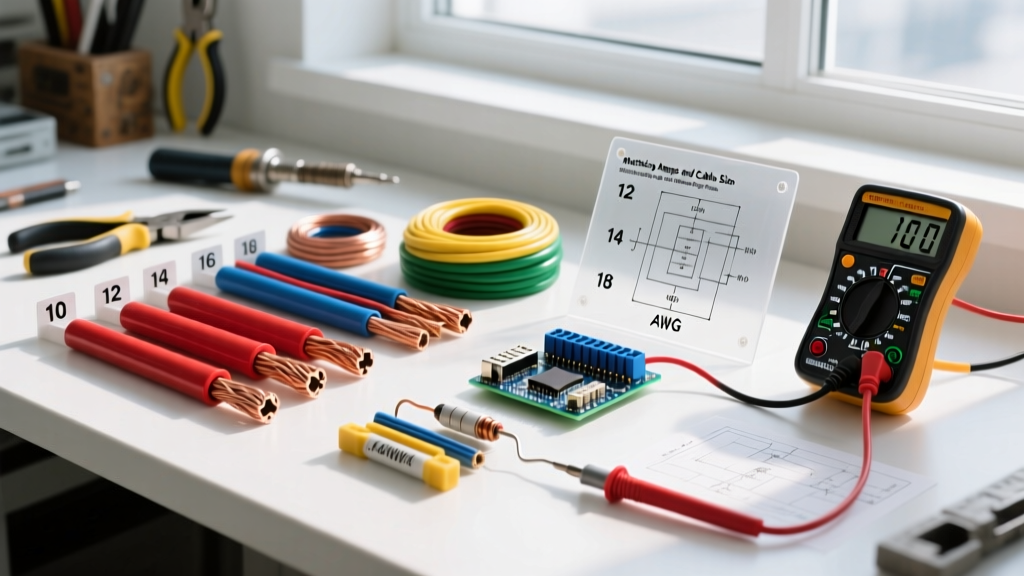

The relationship between amps and cable size dictates the minimum wire gauge required to safely carry a specific electrical current without overheating or causing an unacceptable voltage drop. When you push current through a conductor, the inherent resistance of the metal generates heat. If the wire is too thin for the amperage, the insulation degrades and melts, leading to short circuits or structural fires. Conversely, if the wire gauge is too small for a long run, the voltage at the load sags, causing motors to overheat, power supplies to whine, and sensitive electronics to brown out. Getting this right is the foundation of every safe electrical installation.
The Core Table: Copper Wire Ampacity (NEC Table 310.16)
Before you pull any wire, you need to know its ampacity—the maximum current it can carry continuously under specific conditions without exceeding its temperature rating. The National Electrical Code (NEC) publishes these values in Table 310.16. Below is a data-dense extract for common copper wire sizes used in residential and light commercial branch circuits.
| AWG Size | 60°C Column (NM-B / Romex) | 75°C Column (THWN / THHW) | 90°C Column (THHN / XHHW) |
|---|---|---|---|
| 14 AWG | 15 Amps | 20 Amps | 25 Amps |
| 12 AWG | 20 Amps | 25 Amps | 30 Amps |
| 10 AWG | 30 Amps | 35 Amps | 40 Amps |
| 8 AWG | 40 Amps | 50 Amps | 55 Amps |
| 6 AWG | 55 Amps | 65 Amps | 75 Amps |
| 4 AWG | 70 Amps | 85 Amps | 95 Amps |
Source data derived from Cerrowire Ampacity Charts and NEC Table 310.16 for copper conductors, 3 current-carrying conductors in a raceway, ambient temperature 30°C (86°F).
Worked Example: Sizing a 40A EV Charger Circuit
Let’s apply this to a real-world scenario. You are installing a Level 2 Electric Vehicle (EV) charger rated for 40 amps continuous at 240V. The panel is 200 feet away from the charger location, and you are pulling individual THHN conductors through PVC conduit.
Step 1: Calculate the Continuous Load Requirement
An EV charger runs for more than 3 hours, making it a "continuous load" under NEC Article 100. You must multiply the rated current by 125% to size the overcurrent protection and the wire.
40A × 1.25 = 50 Amps
Step 2: Select the Breaker and Base Wire Size
You need a 50A double-pole breaker. Looking at the 75°C column in our table (since modern 50A breakers have 75°C rated lugs), 6 AWG copper is rated for 65A. Thermally, 6 AWG is perfectly safe for a 50A breaker.
Step 3: Check Voltage Drop (The Hidden Trap)
This is where amps and cable size calculations often fail in the field. The NEC recommends a maximum voltage drop of 3% for branch circuits. Let’s calculate the drop for 6 AWG copper over a 200-foot run.
- Formula: V_drop = (2 × Length × Current × Resistance per 1000ft) / 1000
- Resistance of 6 AWG at 75°C: ~0.49 ohms/kft
- Calculation: (2 × 200 × 40 × 0.49) / 1000 = 7.84 Volts
- Percentage: (7.84V / 240V) × 100 = 3.26%
Step 4: Recalculate with 4 AWG
Resistance of 4 AWG at 75°C is ~0.31 ohms/kft.
(2 × 200 × 40 × 0.31) / 1000 = 4.96 Volts (2.06%)
This is well under the 3% threshold. Your final bill of materials requires three strands of 4 AWG THHN (two hots, one neutral) and one 8 AWG green ground, protected by a 50A breaker.
Where You Meet This in Practice (and Common Mistakes)
Understanding the interplay between amps and cable size changes how you approach almost every installation. You will encounter this directly when sizing feeders for subpanels, running DC lines for off-grid solar arrays (where low voltage makes voltage drop brutal), and wiring heavy-duty workshop equipment like welders or air compressors.
However, the field is riddled with common confusions that lead to failed inspections or degraded equipment:
- Confusing Breaker Size with Wire Ampacity: Many DIYers assume that if a breaker is 20A, 12 AWG wire is always correct. But if that 20A load is continuous (like a server rack or a baseboard heater), the 125% rule pushes the required ampacity to 25A. 12 AWG (rated 20A at 60°C) will overheat, and a 20A breaker will eventually nuisance-trip. You must use 10 AWG wire and a 25A or 30A breaker.
- The 90°C Column Illusion: THHN wire is rated for 90°C, and the table shows 12 AWG can handle 30A at that temperature. People mistakenly use this to put 12 AWG on a 30A breaker. This is a severe code violation. NEC 110.14(C) dictates that you must use the lowest temperature rating of any connected component. Since the breaker lug is 75°C (or 60°C), you are locked into that lower column.
- Ignoring Conduit Derating: The table above assumes no more than three current-carrying conductors in a raceway. If you pull four circuits (12 current-carrying conductors) through a single PVC conduit, NEC Table 310.15(C)(1) requires you to derate the ampacity to 50%. Your 6 AWG wire suddenly drops from 65A to 32.5A, meaning it can no longer be used on a 40A or 50A circuit.
FAQ: Edge Cases in Wire Sizing
Can I use aluminum wire to save money on large feeder runs?
Yes, but the relationship between amps and cable size shifts significantly. Aluminum has higher resistance and expands/contracts more than copper under thermal cycling. As a rule of thumb, aluminum wire must be two AWG sizes larger than copper for the same ampacity. For example, to carry 100A, you would use 3 AWG copper, but you need 1 AWG aluminum. Always use anti-oxidant paste (like Noalox) on aluminum terminations and torque lugs to the manufacturer's exact inch-pound specifications to prevent arcing.
Does the ground wire need to be the same size as the current-carrying conductors?
Not always, but it scales with the breaker. NEC Table 250.122 dictates minimum equipment grounding conductor (EGC) sizes based on the overcurrent device rating. For a 20A breaker, 12 AWG copper is fine. For a 60A breaker, you need a minimum 10 AWG copper ground. However, if you upsized your current-carrying wires to compensate for voltage drop (like our EV charger example), NEC 250.122(B) requires you to increase the ground wire proportionally. If you bumped the hots from 6 AWG to 4 AWG (two sizes), you must bump the ground from 10 AWG to 8 AWG.
How does ambient temperature affect cable sizing?
The ampacity tables assume an ambient temperature of 30°C (86°F). If you are running wire through a hot attic that reaches 120°F (49°C) in the summer, you must apply temperature correction factors from NEC Table 310.15(B)(1). At 120°F, the ampacity of THHN (90°C column) is multiplied by 0.71. A wire that normally carries 55A is now only good for 39A. Always check the environment before finalizing your gauge.


