
The Physics of Illumination: Bridging Photons and Electrons
When an electrician, lighting designer, or electronics hobbyist asks, "what is light", the answer extends far beyond philosophical or pure physics definitions. In the context of electrical fundamentals, light is the usable byproduct of energy conversion. Specifically, it is electromagnetic radiation within the visible spectrum (roughly 380 to 750 nanometers) generated when electrical energy (electron flow) is forced through a resistive or semiconductive medium.
According to Georgia State University's HyperPhysics, visible light is just a narrow band of the broader electromagnetic spectrum. But for those designing circuits, sizing wires, and selecting breakers, the critical question isn't just what light is, but how efficiently the circuit produces it and how much thermal and electrical stress that production places on the wiring infrastructure.
The Quantum Leap: How Circuits Create Photons
To understand lighting loads, you must understand the two primary methods of electrical light generation:
- Incandescence: Current passes through a high-resistance tungsten filament. The electrical friction generates immense heat (up to 4,500°F), causing the atoms to vibrate and release energy as photons. This is highly inefficient, converting nearly 90% of electrical energy into waste heat rather than light.
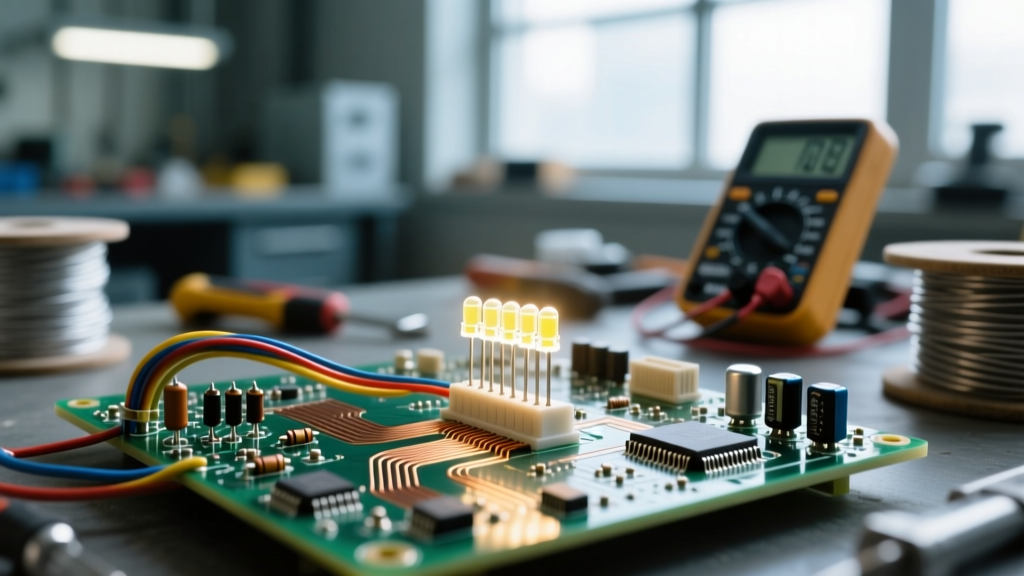
- Electroluminescence (LEDs): Current passes through a semiconductor diode. As electrons drop across the 'bandgap' from the n-type to the p-type material, they release energy directly as photons. This solid-state lighting (SSL) generates minimal heat at the light source, drastically altering how we calculate branch circuit loads.
Real-World Metric Translation: Watts vs. Lumens vs. Lux
Historically, wire sizing for lighting was based on wattage. If you knew a fixture consumed 100 watts, you could easily calculate the amperage draw on a 120V circuit. Today, understanding what light is requires separating the electrical consumption (Watts) from the luminous output (Lumens). Efficacy, measured in lumens per watt (lm/W), dictates the real-world electrical load.
| Light Source Technology | Typical Wattage | Luminous Output (Lumens) | Efficacy (lm/W) | Circuit Impact & Heat Load |
|---|---|---|---|---|
| Incandescent | 60W | 800 lm | 13 lm/W | High current, massive heat dissipation required in enclosed fixtures. |
| Halogen | 43W | 750 lm | 17 lm/W | Moderate current, high localized heat (requires thermal rated wire). |
| Compact Fluorescent (CFL) | 13W | 800 lm | 61 lm/W | Low current, contains ballast that introduces minor harmonic distortion. |
| Standard Residential LED | 9W | 800 lm | 89 lm/W | Negligible current, shifts load calculations to VA (Volt-Amps) due to driver power factor. |
| Commercial High-Bay LED | 150W | 20,000 lm | 133 lm/W | Requires dedicated 277V/480V branch circuits and careful continuous load derating. |
As highlighted by the U.S. Department of Energy's Solid-State Lighting program, the shift to high-efficacy LEDs means modern electricians are dealing with drastically lower continuous amperage on standard branch circuits, but they face new challenges regarding power quality and low-voltage DC distribution.
Sizing Branch Circuits for Lighting Loads (NEC Rules)
When designing a circuit to deliver power for light generation, the National Electrical Code (NEC) provides strict frameworks. According to the National Fire Protection Association (NFPA), lighting in commercial spaces or outdoor security setups is often considered a continuous load (operating for 3 hours or more).
The 80% Rule for Continuous Lighting
If you are wiring a commercial office with LED panel lights, you must apply the 80% derating rule to your breakers and wire ampacity. For example, on a standard 20-Amp breaker using 12 AWG copper wire (rated for 20A), your maximum continuous lighting load cannot exceed 16 Amps.
At 120V, a 16A continuous limit equates to 1,920 Watts. If you are installing 150W commercial LED high-bays, you can only place a maximum of 12 fixtures on this 20-Amp circuit (12 x 150W = 1,800W), despite the wire's physical ability to handle more. This prevents the breaker's thermal trip mechanism from degrading over time.
Volt-Amps (VA) vs. Watts in LED Drivers
A common mistake DIYers make when asking "what is light" in an electrical context is assuming Watts equal Volt-Amps. LED fixtures use internal switching power supplies (drivers). These drivers often have a Power Factor (PF) of 0.7 to 0.9. Therefore, a 100W LED fixture with a PF of 0.8 actually draws 125 VA from the circuit. Wire sizing and breaker selection must always be based on the VA rating, not the raw optical wattage.
The Low-Voltage Trap: DC Lighting and Voltage Drop
The physics of light generation remain the same whether you are pushing 120V AC or 12V DC, but the wiring fundamentals change drastically. Low-voltage landscape lighting, RV lighting, and architectural LED strip lighting operate on 12V or 24V DC. Because Power (P) = Voltage (V) x Current (I), dropping the voltage forces the current to increase proportionally to deliver the same luminous output.
Real-World Voltage Drop Calculation
Imagine you are installing a 60W architectural LED strip under kitchen cabinets, powered by a remote 12V DC transformer located 30 feet away.
- Current Draw: 60W / 12V = 5 Amps.
- Wire Choice: 14 AWG copper (4,110 Circular Mils).
- Voltage Drop Formula: Vd = (2 x K x I x L) / CM
- Calculation: (2 x 12.9 x 5 x 30) / 4110 = 0.94 Volts.
A 0.94V drop on a 12V system is a 7.8% voltage drop. This exceeds the NEC recommended 5% maximum for branch circuits. In the real world, this doesn't just waste energy; it alters the physics of the light. The LED strip at the end of the run will receive only 11.06V, causing a noticeable drop in lumen output and a potential shift in color temperature. To fix this, you must step up the wire size to 10 AWG (10,380 CM), which drops the voltage loss to an acceptable 3.7%.
Power Quality: THD, Flicker, and Dimmer Compatibility
Understanding what light is also means understanding the quality of the electrical wave driving it. Traditional incandescent bulbs act as massive resistors, creating a perfect sine wave alignment between voltage and current. Modern LEDs, however, rely on non-linear switching drivers.
Cheap LED drivers chop the AC waveform, introducing Total Harmonic Distortion (THD). In large commercial installations, high THD from hundreds of LED fixtures can cause the neutral conductor in a 3-phase wye system to overheat, even if the phase conductors are perfectly balanced. Furthermore, when paired with legacy TRIAC dimmers designed for resistive incandescent loads, the capacitive nature of LED drivers causes the circuit to oscillate, resulting in visible strobing or flickering. To resolve this, real-world applications require either ELV (Electronic Low Voltage) reverse-phase dimmers or a transition to 0-10V DC analog dimming circuits, which use a separate low-voltage signaling wire to control the light output without chopping the main AC power wave.
Summary: Designing with Light in Mind
Ultimately, light is the visible manifestation of electrical work. By understanding the physics of photon generation, the difference between optical lumens and electrical Volt-Amps, and the severe impact of voltage drop on low-voltage DC circuits, you can design safer, more efficient, and longer-lasting lighting systems. Proper wire sizing isn't just about preventing fires; it is about ensuring the electrical infrastructure delivers the precise energy required for the light source to perform exactly as engineered.