
The Golden Rule: The First Point of Disconnect
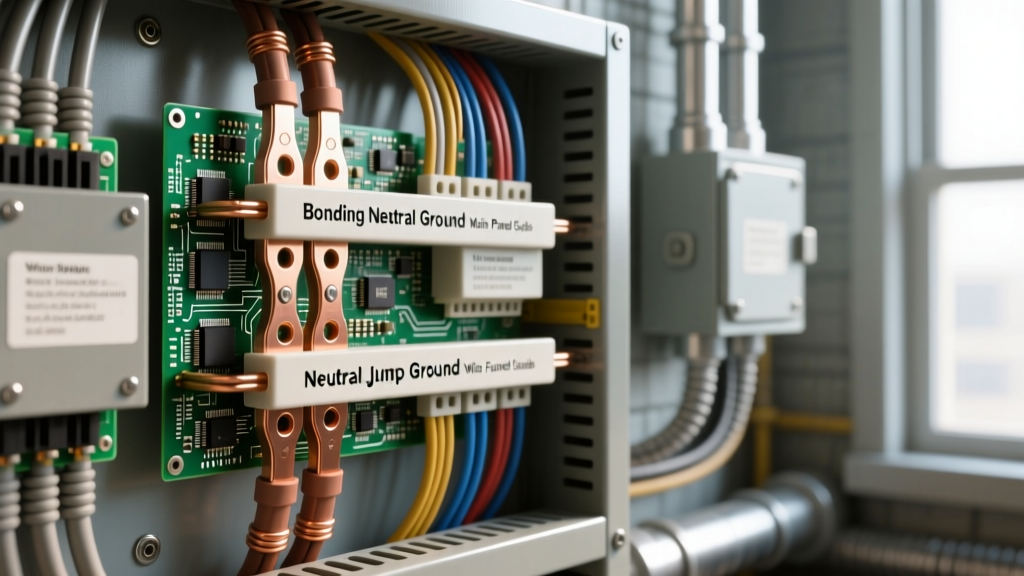
When dealing with service entrance equipment, the most critical safety mechanism in your electrical system is the main bonding jumper (MBJ). The act of bonding neutral and ground at main panel enclosures is not just a code requirement; it is the fundamental physics that allows overcurrent protective devices (breakers and fuses) to clear ground faults. According to the NFPA 70 National Electrical Code (NEC) Article 250.24, this bond must occur strictly at the first point of disconnect. This is typically the main service panel, the meter-main combo, or the first disconnect switch downstream of the utility transformer.
If you bond the neutral and ground anywhere downstream of this first point (such as in a subpanel), you create parallel neutral paths. This results in normal neutral return current flowing on metal enclosures, conduit, and plumbing—a dangerous condition known as 'objectionable current' under NEC 250.6.
Quick Reference Matrix: Main Panel vs. Subpanel
Electricians and DIYers frequently confuse the treatment of grounded (neutral) and grounding (EGC) conductors. Use this matrix as a rapid field reference to ensure compliance and safety.
| Feature | Main Service Panel | Subpanel (Downstream) |
|---|---|---|
| Neutral & Ground Bond | REQUIRED (via MBJ) | STRICTLY PROHIBITED |
| Bus Bar Configuration | Can share a single combined bar | Must have isolated, separate bars |
| Neutral Bar Isolation | Bonded to metal enclosure | Floated (isolated from enclosure) |
| EGC (Ground) Bar | Bonded to enclosure & neutral | Bonded to enclosure ONLY |
| Grounding Electrode Conductor | Terminates here (Ground Rods/Water) | Not required (unless separately derived) |
Sizing the Main Bonding Jumper (NEC 250.102)
The main bonding jumper must be sized to handle the maximum available fault current. It is not sized based on the main breaker rating, but rather on the circular mil area of the largest ungrounded (hot) service entrance conductor. As detailed by Mike Holt Enterprises' grounding guides, undersizing this jumper can result in the jumper vaporizing during a ground fault before the main breaker trips, leaving the enclosure energized at line voltage.
Copper Main Bonding Jumper Sizing Chart
The following table is derived from NEC Table 250.102(C)(1) for copper conductors. If your service entrance conductors are aluminum, you must use the aluminum column in the NEC, or size the copper jumper equivalent to the aluminum requirement.
| Size of Largest Hot Conductor (Copper) | Minimum Size of Main Bonding Jumper (Copper) |
|---|---|
| 2 AWG or smaller | 8 AWG |
| 1 AWG or 1/0 AWG | 6 AWG |
| 2/0 AWG or 3/0 AWG | 4 AWG |
| 4/0 AWG | 2 AWG |
| Over 4/0 AWG to 350 kcmil | 1/0 AWG |
| Over 350 kcmil to 600 kcmil | 2/0 AWG |
| Over 600 kcmil to 900 kcmil | 3/0 AWG |
Troubleshooting: Symptoms of Improper Bonding
When the rules for bonding neutral and ground at main panel setups are violated, or when a bond is missing entirely, the electrical system exhibits distinct, measurable failure modes. Here is how to diagnose bonding issues in the field using a multimeter and visual inspection.
- Missing Bond (Open Neutral-to-Ground): If the MBJ is missing or the green bonding screw is backed out, a ground fault on a 120V appliance will not trip the breaker. The current will travel back to the utility transformer via the earth (ground rods), which has too high of an impedance to generate the thousands of amps needed to trip a 200A main breaker. The metal chassis of the appliance will remain energized at 120V, presenting a lethal shock hazard.
- Double Bonding (Subpanel Bonded): If a subpanel is incorrectly bonded, neutral current splits. You will measure voltage (typically 0.5V to 3V) between the neutral bar and the ground bar in the subpanel. More dangerously, you will measure current flowing on the bare copper equipment grounding conductors and metal conduits using a clamp meter.
- Nuisance GFCI Tripping: Downstream GFCI receptacles rely on a strict balance between the hot and neutral conductors. If a neutral-to-ground bond exists downstream of the GFCI, some return current bypasses the GFCI's neutral sensor via the ground wire, causing the GFCI to interpret this as a ground fault and trip immediately.
- Tingling Shocks at Plumbing Fixtures: If the main bonding jumper is intact but the water pipe bonding jumper (NEC 250.52) is missing or corroded, a fault could energize the municipal water supply. Conversely, improper neutral bonding can push neutral current onto the plumbing system, causing a 'tingle' when touching a faucet and a grounded appliance simultaneously.
Field Inspection Checklist for Electricians
Before energizing a new service or passing a rough-in inspection, run through this specific mechanical checklist to ensure the bonding neutral and ground at main panel execution is flawless.
- Verify the Bonding Method: Check if the panel uses a green bonding screw, a bonding strap, or a bonding lug. Ensure the method is listed for that specific panel brand. (e.g., A Siemens green screw has a different thread pitch than a Square D or Eaton screw; forcing the wrong screw will strip the neutral bar threads, ruining the connection).
- Check Torque Specifications: Per NEC 110.14(D), the main bonding jumper must be tightened to the manufacturer's specified torque. Use a calibrated inch-pound torque screwdriver. A loose MBJ will arc and burn open under fault conditions.
- Inspect for Paint and Oxidation: The bonding jumper must make metal-to-metal contact with the panel enclosure and the neutral bar. Scrape away any paint, powder coating, or rust at the termination points. Apply an antioxidant compound (like Noalox) if using aluminum jumpers or lugs.
- Confirm Conductor Routing: The grounded (neutral) service conductor and the main bonding jumper must be routed within the same enclosure. Never route the neutral out through a non-metallic hub without the accompanying EGC.
- Separate Neutrals and Grounds Downstream: Double-check that all multi-wire branch circuits (MWBCs) and standard neutrals landing in downstream subpanels are strictly on the floating neutral bar, and all bare/green wires are on the grounded enclosure bar.
Expert Insight: Never assume a panel is bonded just because it is a 'Main Breaker' kit. Many modern load centers are shipped as 'Main Lug' or convertible panels without the bonding screw installed. Always physically verify the presence and tightness of the MBJ. For a deeper dive into testing these connections, refer to the Fluke guide on grounding and bonding testing procedures, which outlines how to measure the impedance of the grounding electrode system to ensure your bond has a viable path to earth.
Summary of Code Compliance
Mastering the rules for bonding neutral and ground at main panel configurations is the dividing line between a safe electrical installation and a lethal one. Remember: bond only at the service disconnect, size the jumper by the hot conductor's circular mils, and keep neutral and ground strictly separated everywhere else in the facility. By adhering to NEC Article 250 and utilizing proper torque and termination methods, you ensure that ground faults clear instantaneously, protecting both human life and critical infrastructure.