
Decoding the Basics: What Are NPN Transistors in Modern Circuits?
When procurement teams, lab managers, and hardware engineers ask, "what are NPN transistors" from an inventory perspective, the answer goes far beyond basic semiconductor physics. At a silicon level, an NPN (Negative-Positive-Negative) bipolar junction transistor (BJT) is a three-terminal device where a small current at the base terminal controls a much larger current flowing from the collector to the emitter. Because electrons are the majority charge carriers in NPN devices, they inherently offer higher mobility and faster switching speeds compared to their PNP counterparts.
However, for those managing a component library or stocking a prototyping lab, understanding what are NPN transistors means understanding their parametric spread, packaging evolution, and lifecycle status. Unlike digital logic ICs which are often specified by exact functional architectures, discrete NPNs are frequently treated as generic commodities. This is a dangerous procurement fallacy. Substituting a high-frequency RF NPN for a standard low-noise audio NPN, or ignoring hFE (DC current gain) binning, can lead to catastrophic yield failures in precision analog designs or switching power supplies.
The Procurement Matrix: Selecting NPNs for Your Inventory
Building a resilient inventory of NPN transistors requires a strategic approach to parametric selection. Buyers must evaluate components based on the stress profiles of their target applications rather than just matching legacy part numbers.
- Collector-Emitter Breakdown Voltage (VCEO): Standard logic-level switching requires 30V-40V ratings, but offline SMPS (Switch-Mode Power Supply) designs demand high-voltage NPNs rated for 400V or more.
- Continuous Collector Current (IC): Inventory should be segmented into small-signal (under 500mA) and power discrete (1A to 15A+) categories.
- DC Current Gain (hFE) Binning: Manufacturers sort NPNs into gain buckets. For example, the BC547 family is split into BC547A (110-220), BC547B (220-450), and BC547C (450-800). Procuring un-binned 'BC547' stock is a massive risk for analog audio labs where predictable gain is mandatory.
- Transition Frequency (fT): Crucial for RF and high-speed switching applications. A standard 2N3904 has an fT of ~300MHz, whereas specialized RF NPNs like the BFR93A push past 5GHz.
Through-Hole vs. SMD: Stocking the Right Form Factors
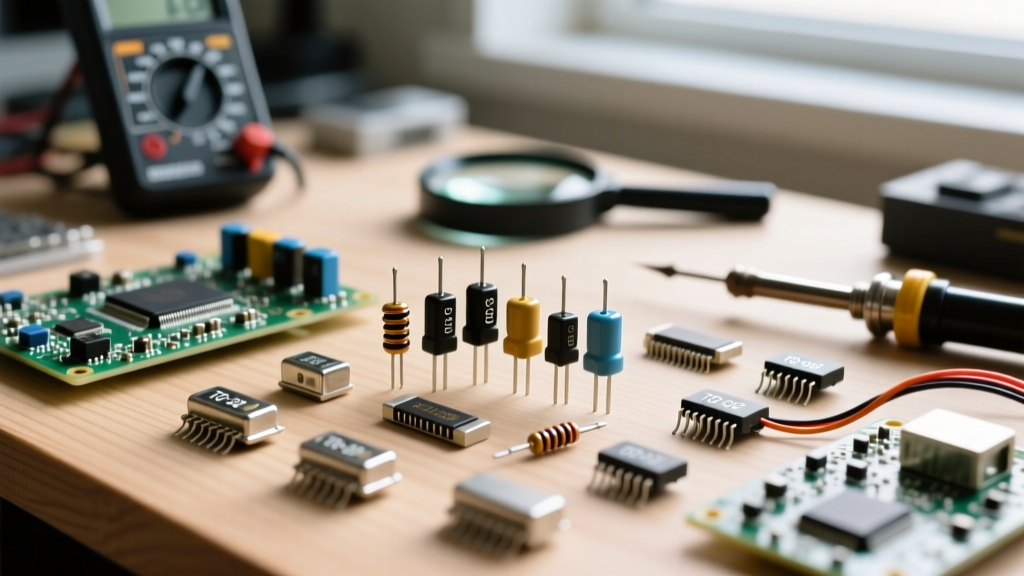
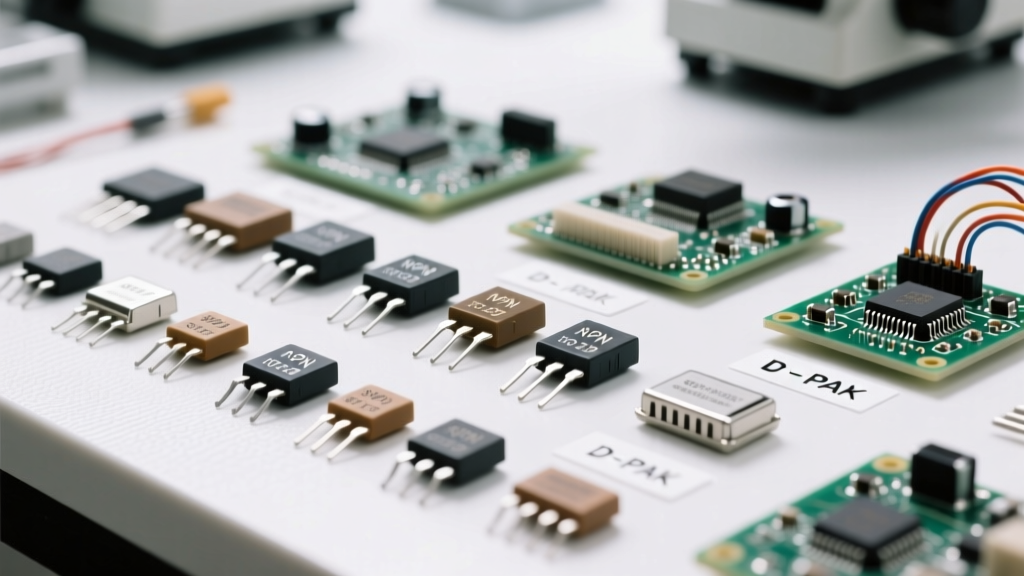
While through-hole (THT) components like the TO-92 and TO-220 remain staples for educational labs and high-voltage prototyping, modern production sourcing heavily favors Surface Mount Devices (SMD). Inventory managers must balance the ease of manual hand-soldering (THT) with the automated pick-and-place requirements of SMD reels (SOT-23, SOT-89). A best-practice lab maintains a 20/80 split, keeping 20% THT for rapid breadboarding and 80% SMD on cut-tape reels for PCB fabrication.
Core Inventory SKUs: The 'Must-Stock' NPN Transistor Families
To minimize SKU bloat while maximizing design flexibility, labs should consolidate their NPN inventory around highly available, multi-sourced silicon families. According to ON Semiconductor and other tier-one fabricators, the following part numbers represent the highest global availability and lowest obsolescence risk.
| Part Number | Package | Max IC | VCEO | Typical Bulk Price (1k+) | Primary Application |
|---|---|---|---|---|---|
| 2N3904 / MMBT3904 | TO-92 / SOT-23 | 200mA | 40V | $0.02 - $0.04 | General-purpose switching, logic level translation |
| BC547B / BC847B | TO-92 / SOT-23 | 100mA | 45V | $0.03 - $0.05 | Low-noise audio preamps, precision analog |
| TIP31C | TO-220 | 3A | 100V | $0.25 - $0.40 | Medium power switching, motor drivers, linear regulators |
| 2N3055 | TO-3 | 15A | 60V | $0.80 - $1.50 | Heavy-duty linear power supplies, audio output stages |
| MJE340 | TO-220 | 10A | 300V | $0.45 - $0.70 | High-voltage switching, ignition systems, SMPS |
Supply Chain Pitfalls: Counterfeits and Obsolescence
The discrete semiconductor market is notoriously plagued by counterfeit components, particularly in the power NPN segment. When sourcing high-current NPNs like the 2N3055 or TIP31C from unauthorized gray-market brokers or unverified online marketplaces, labs frequently receive re-marked, undersized silicon dies.
A counterfeit power NPN might pass a basic multimeter diode-test, but under load, it will suffer from secondary breakdown or thermal runaway. Fraudsters often take cheap, low-current small-signal dies, encapsulate them in TO-220 or TO-3 packages, and laser-etch them with premium part numbers. When a hardware engineer pushes 5A through a fake TIP31C that internally houses a 200mA die, the bond wires instantly vaporize.
Procurement Rule of Thumb: Always source discrete power BJTs from authorized franchised distributors. If you must audit gray-market stock, perform a decapsulation (decap) test using nitric acid to verify the physical die size and topology against the manufacturer's datasheet, or test the VBE saturation curves on a semiconductor curve tracer.
Furthermore, buyers must monitor End-of-Life (EOL) notices. As the industry shifts toward wide-bandgap semiconductors and advanced MOSFETs, certain legacy high-voltage NPNs are being phased out. Utilizing lifecycle tracking tools via DigiKey's component lifecycle resources helps labs identify drop-in replacements before a critical production run is halted by a stockout.
Lab Organization: Storing and Tracking Discrete Semiconductors
Proper physical inventory management is just as critical as the initial sourcing. While Bipolar Junction Transistors are generally less sensitive to Electrostatic Discharge (ESD) than modern CMOS logic or RF MOSFETs, they are not immune. High-frequency NPNs with ultra-thin base regions can still suffer junction degradation from severe ESD strikes.
Implementing a First-In-First-Out (FIFO) Binning Strategy
For SMD NPNs delivered on tape-and-reel, Moisture Sensitivity Level (MSL) dictates storage protocols. While most standard TO-92 and SOT-23 BJTs are rated MSL 1 (unlimited floor life), certain high-power or specialized epoxy packages may carry an MSL 3 rating. If these reels are exposed to ambient humidity for too long, moisture ingress can cause the 'popcorn effect' during reflow soldering, cracking the transistor internally.
To maintain inventory integrity, labs should implement the following storage hierarchy:
- ESD-Safe AkroBins: For loose THT components, organized by part number and hFE bin.
- Desiccant Dry Cabinets: Maintained at <5% RH for opened SMD reels with MSL ratings above 1.
- Barcode Tracking: Linking cut-tape reels to your ERP system to ensure FIFO usage, preventing the oxidation of lead finishes on aging stock which can lead to poor solder wetting.
By treating NPN transistors not as infinite, generic commodities, but as highly specific, parametrically diverse building blocks, engineering teams can drastically reduce prototyping delays, eliminate field failures caused by gray-market fakes, and optimize their overall BOM costs.