
The Short Answer: Is Rubber a Conductor or Insulator?
If you are asking whether rubber is a conductor or insulator, the fundamental answer is that pure rubber is an exceptional electrical insulator. In its natural, unadulterated state (polyisoprene), rubber possesses a massive band gap, meaning its electrons are tightly bound to their atoms and cannot freely flow to create an electrical current. This makes it a staple material for electrical safety gear, wire jacketing, and switchgear mats.
However, in real-world electrical engineering and DIY applications, the answer becomes significantly more complex. Industrial rubber is rarely pure. To make rubber durable, UV-resistant, and mechanically tough, manufacturers add chemical compounds, vulcanizing agents, and fillers. Some of these additives—most notably carbon black—can fundamentally alter the material's electrical properties, shifting it from a pure insulator to a semi-conductive or static-dissipative material. Furthermore, environmental degradation can cause insulative rubber to fail catastrophically over time.
The Physics of Polyisoprene and Dielectric Strength
To understand rubber's behavior in electrical circuits, we must look at its volume resistivity and dielectric strength. Volume resistivity measures how deeply a material resists the flow of electrical current through its bulk, while dielectric strength measures the maximum electric field the material can withstand before it breaks down and begins to conduct (arcing or tracking).
Pure natural rubber boasts a volume resistivity in the range of 10^13 to 10^15 ohm-centimeters (Ω·cm). Compare this to copper, which sits at a mere 1.68 x 10^-6 Ω·cm. The difference is astronomical, confirming rubber's baseline status as an insulator.
Material Comparison: Volume Resistivity and Dielectric Strength
| Material | Volume Resistivity (Ω·cm) | Dielectric Strength (kV/mm) | Primary Electrical Application |
|---|---|---|---|
| Pure Polyisoprene (Natural Rubber) | 10^13 - 10^15 | 20 - 30 | Lab baseline, specialized molds |
| EPDM (Unfilled) | 10^14 - 10^16 | 25 - 35 | Medium-voltage cable insulation |
| Silicone Rubber | 10^12 - 10^15 | 15 - 25 | High-temp wire jacketing |
| Carbon-Black Filled Rubber | 10^2 - 10^6 | 1 - 5 | Anti-static mats, tires |
| Copper (Baseline Conductor) | 1.68 x 10^-6 | N/A | Wire conductors, busbars |
Real-World Application 1: High-Voltage Lineman Gloves
When working on live circuits, utility linemen rely on rubber insulating gloves. But not just any rubber will do. These gloves are manufactured from highly refined natural or synthetic rubber (like neoprene or nitrile) specifically compounded to maximize dielectric strength while maintaining flexibility.
The ASTM D120 Standard strictly governs the manufacturing and testing of these gloves. They are categorized by voltage classes, ranging from Class 00 (rated for 500V AC) up to Class 4 (rated for 36,000V AC).
The Ozone Cracking Failure Mode
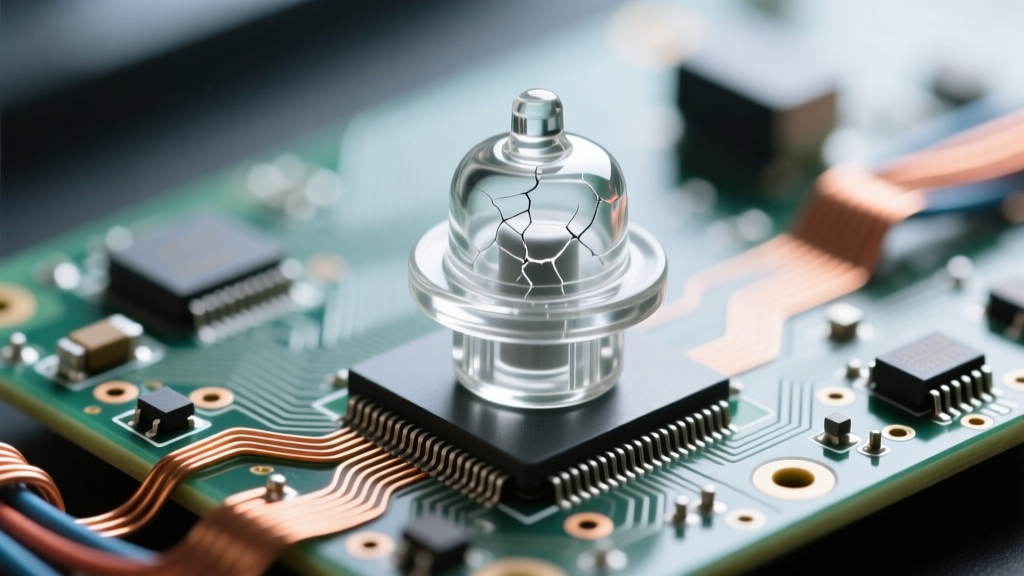
One of the most critical real-world failure modes of rubber insulation is ozone cracking. Ozone (O3) is naturally present in the atmosphere and is also generated in high concentrations by electrical arcing and corona discharge near high-voltage equipment. Ozone aggressively attacks the carbon-carbon double bonds in natural rubber polymers.
When a rubber glove or wire jacket is under mechanical tension (stretched) and exposed to ozone, microscopic cracks form perpendicular to the stress lines. These cracks compromise the dielectric barrier. If moisture or conductive dust enters these micro-fissures, it creates a pathway for electrical tracking, leading to a fatal shock or arc flash. This is why OSHA and ASTM mandate that lineman gloves be visually inspected, inflated, and rolled before every single use, and dielectrically tested every six months.
Real-World Application 2: Medium-Voltage Cable Jacketing
In wire sizing and cable manufacturing, rubber compounds like Ethylene Propylene Diene Monomer (EPDM) and silicone rubber are heavily utilized for medium-voltage (5kV to 35kV) underground distribution cables. EPDM is favored for its excellent dielectric properties, resistance to moisture, and ability to withstand continuous operating temperatures up to 90°C (and short-circuit spikes up to 250°C).
Silicone rubber, while slightly less mechanically tough than EPDM, is chosen for applications requiring extreme thermal stability, such as wiring inside industrial ovens or aerospace applications, maintaining its insulative properties well beyond 200°C.
The Carbon Black Conductivity Trap
Here is where DIYers and junior technicians often make a dangerous assumption. Many outdoor cables and heavy-duty rubber mats are black. The black color usually comes from carbon black, a filler added to rubber to protect it from ultraviolet (UV) light degradation and to improve tensile strength.
Carbon black is essentially pure, finely divided carbon. Carbon is conductive. If a rubber compound is loaded with too much carbon black, the carbon particles form a percolation network—a continuous microscopic pathway through the rubber. This drops the volume resistivity from 10^15 Ω·cm down to 10^4 Ω·cm, effectively turning the insulator into a semiconductor. High-voltage cable manufacturers must use highly specialized, low-structure carbon blacks or alternative UV inhibitors (like specific waxes and titanium dioxide) in the insulative layers to ensure the rubber remains a true insulator despite environmental protections.
Critical Safety Warning: Never assume that a black rubber mat, hose, or glove is electrically insulative. Industrial black rubber often contains carbon black and metallic oxides that lower its dielectric strength. Always verify the ASTM rating and voltage class before using any rubber product near live electrical panels.
Switchgear Mats: Insulative vs. Static-Dissipative Rubber
A common point of confusion in industrial electrical environments is the rubber matting placed on the floor in front of 480V switchgear and server racks. The electrical requirements for these two environments are diametrically opposed, highlighting the dual nature of modern rubber compounding.
Insulative Mats (ASTM D178)
In front of a live 480V or 4160V switchgear panel, the goal is to isolate the worker from the ground plane. If a phase-to-ground fault occurs and the worker touches an energized component, the rubber mat must prevent current from flowing through their body to the earth. These mats are governed by OSHA Electrical Safety guidelines and ASTM D178. They are manufactured from pure, unfilled synthetic rubber with a surface resistance greater than 10^12 ohms. They are designed to be absolute insulators.
Static-Dissipative Mats (ANSI/ESD S20.20)
Conversely, in a data center, telecommunications hub, or sensitive electronics manufacturing floor, an absolute insulator is a hazard. If a pure insulative rubber mat is used, friction from workers' shoes will generate massive static electrical charges (triboelectric charging). When the worker touches a sensitive microcontroller or server board, that static charge will discharge in an instant (Electrostatic Discharge, or ESD), frying the silicon.
To solve this, manufacturers intentionally dope the rubber with conductive carbon fibers or metallic particles to lower its resistance to between 10^6 and 10^9 ohms. This makes the rubber static-dissipative. It conducts electricity just enough to slowly and safely bleed off static charges to the ground wire, but not enough to allow a lethal 120V/480V shock to pass through a human body. Understanding this distinction is vital for facility managers and electrical safety officers.
Summary Checklist for Electrical Professionals
When evaluating rubber for electrical applications, run through this real-world checklist to ensure safety and compliance:
- Verify the Compound: Is it pure EPDM/Silicone for insulation, or carbon-loaded for ESD protection?
- Check the ASTM Standard: Look for ASTM D120 (gloves), ASTM D178 (switchgear mats), or ANSI/ESD S20.20 (electronics mats).
- Inspect for Ozone and UV Damage: Look for micro-cracking, chalking, or brittleness, which destroy the dielectric barrier.
- Beware of Moisture Tracking: Even the best rubber insulator will fail if surface dirt and moisture create a conductive path around the material (creepage).
- Respect the Voltage Class: Never use a Class 0 glove (1000V AC) for work on a 4160V circuit, regardless of the rubber's thickness.
Ultimately, while the basic physics dictate that rubber is an insulator, the real-world application of rubber in electrical systems requires a deep understanding of material science, environmental stressors, and rigorous safety standards. Treating all rubber as a universal insulator is a dangerous misconception that can lead to equipment failure or fatal electrical accidents.