
The Definitive Answer: Is Glass an Insulator or Conductor?
At standard room temperature and normal atmospheric conditions, glass is an exceptional electrical insulator. To understand why, we must look at the atomic structure of glass, which is primarily composed of amorphous silicon dioxide (SiO2). In solid glass, the valence electrons are tightly bound within covalent and ionic bonds, leaving virtually no free electrons available to carry an electrical charge. The energy band gap of fused quartz (pure glass) is approximately 9 electron volts (eV), meaning it requires an immense amount of energy to excite an electron from the valence band into the conduction band. By comparison, conductors like copper have overlapping bands, allowing electrons to flow freely with minimal resistance.
However, the question of whether glass is an insulator or a conductor is not entirely binary. Under extreme thermal or electrical stress, glass can undergo phase changes or dielectric breakdown, temporarily or permanently transforming its electrical characteristics. This quick reference guide breaks down the material science, failure modes, and practical applications of glass in electrical engineering and DIY electronics.
Quick Reference: Dielectric & Thermal Properties Matrix
The insulating capability of glass varies significantly based on its chemical composition. The addition of alkali metals (like sodium or calcium) lowers the melting point but also degrades electrical resistivity. Below is a quick reference table for common glass types used in electrical applications.
| Glass Type | Primary Composition | Dielectric Strength (MV/m) | Volume Resistivity (Ω·m) | Common Electrical Use |
|---|---|---|---|---|
| Soda-Lime | SiO2, Na2O, CaO | 10 - 15 | 10^10 - 10^12 | Standard cartridge fuses, basic enclosures |
| Borosilicate | SiO2, B2O3 | 15 - 25 | 10^12 - 10^14 | High-temp standoff insulators, vacuum tubes |
| Fused Quartz | Pure SiO2 | 25 - 40 | > 10^16 | High-voltage RF applications, precision lab gear |
| Aluminosilicate | SiO2, Al2O3 | 20 - 30 | 10^13 - 10^15 | High-durability electronic display substrates |
Data sourced from material science databases and Corning Incorporated technical specifications.
The Exception: When Glass Becomes a Conductor
While glass is an insulator in its solid state, it exhibits a fascinating anomaly when subjected to extreme heat. If you heat glass to a red-hot state (typically between 600°C and 800°C, depending on the composition), it transitions from an electrical insulator to an ionic conductor.
The Physics of Molten Glass Conductivity
Unlike metals, which conduct electricity via free electrons (electronic conduction), hot glass conducts electricity through the movement of ions (ionic conduction). As the rigid amorphous lattice softens, the alkali metal ions (such as Na+ or Ca2+) added during the manufacturing process as flux gain enough thermal energy to become highly mobile. When a voltage is applied across red-hot glass, these positive ions migrate toward the cathode, creating a measurable electrical current. This principle is frequently demonstrated in advanced physics laboratories, where a glass rod is heated with a blowtorch and subsequently used to complete a circuit, illuminating a light bulb.
Material Science Note: The conductivity of molten glass is highly dependent on its alkali content. Fused quartz, which lacks alkali flux agents, remains a relatively poor conductor even in a molten state compared to standard soda-lime glass. For more on dielectric behaviors, refer to The Physics Hypertextbook's section on dielectrics.
Dielectric Breakdown and the Avalanche Effect
Even at room temperature, no insulator is perfect. If the voltage applied across a piece of glass exceeds its dielectric strength (measured in Megavolts per meter, MV/m), the material will experience dielectric breakdown.
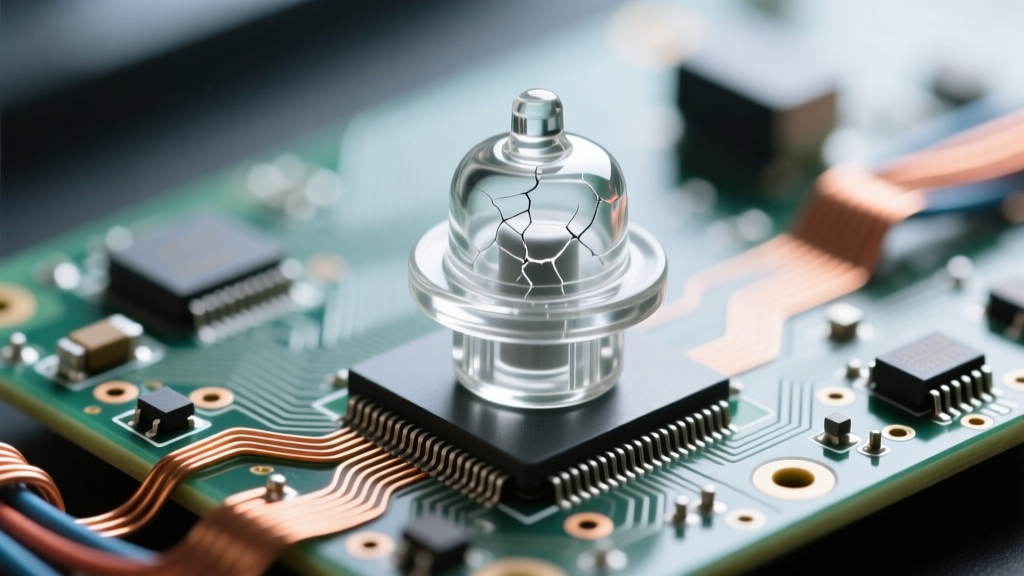
During breakdown, the intense electric field physically tears electrons from their atomic bonds. These free electrons are accelerated by the field, colliding with neighboring atoms and freeing more electrons in a chain reaction known as an avalanche breakdown. This results in a sudden, catastrophic surge of current that punctures the glass, leaving a permanent, carbonized, or melted conductive pathway (a Lichtenberg figure or puncture crater). Once punctured, the glass is permanently compromised and must be replaced.
Practical Applications in Electrical Engineering & DIY
Understanding the exact parameters of the glass insulator or conductor debate is crucial for selecting the right components in circuit design and high-voltage distribution.
1. Cartridge Fuses (AGC and GMA Types)
In DIY electronics and automotive wiring, 5x20mm and 1/4x1-1/4 inch glass cartridge fuses are ubiquitous. The glass body serves two critical functions: it acts as an insulating chamber to contain the arc when the metal element melts, and it provides visual transparency so technicians can instantly verify if the fuse is blown. However, glass fuses are strictly limited to low-rupture capacity (LRC) applications. If used in high-fault-current circuits, the glass tube can shatter explosively due to the rapid expansion of vaporized metal and plasma.
2. High-Voltage Transmission Line Insulators
While ceramic and polymer insulators are more common today, toughened glass insulators are still heavily utilized on high-voltage transmission lines (115kV to 500kV) in regions like Russia, France, and parts of North America. Engineers specifically choose toughened glass for its unique failure mode: if the dielectric is compromised by a lightning strike or internal defect, the entire glass bell shatters into small, dull cubes. This makes visual inspection from a helicopter incredibly easy—a missing bell is instantly obvious, whereas a cracked ceramic insulator can harbor hidden, dangerous faults.
3. Vacuum Tubes and High-Frequency Standoffs
In high-frequency RF amplifiers and vintage audio equipment, borosilicate glass is used as the envelope for vacuum tubes. Its high dielectric strength and low dielectric loss at high frequencies prevent signal attenuation, while maintaining the vacuum necessary for thermionic emission.
Glass vs. Ceramic vs. PTFE: Selecting the Right Dielectric
When designing high-voltage standoffs or selecting insulating materials for harsh environments, engineers must weigh glass against alternative dielectrics. Below is a comparative selection matrix.
| Material | Max Operating Temp | Moisture Absorption | Mechanical Shock Resistance | Best Use Case |
|---|---|---|---|---|
| Borosilicate Glass | ~300°C | Near Zero | Low (Brittle) | Vacuum feedthroughs, RF lab equipment |
| Alumina Ceramic | >1000°C | Near Zero | Moderate | HRC fuses, spark plug insulators, HV busbars |
| PTFE (Teflon) | ~260°C | Zero | High (Flexible) | Coaxial cable dielectrics, flexible HV wiring |
| Mica (Muscovite) | ~600°C | Low | High (Cleavable) | High-power RF capacitors, tube amplifier sockets |
For an in-depth look at how these materials compare in industrial applications, Electrical4U's guide on insulating materials provides excellent foundational context.
Safety Protocols and Failure Troubleshooting
When working with glass dielectrics in high-voltage or high-current environments, specific safety and maintenance protocols must be followed to prevent catastrophic failure.
- Surface Tracking Prevention: While glass is highly resistant to moisture absorption, surface contaminants (dust, salt, industrial fallout) can create a conductive path across the outside of the insulator. Always clean high-voltage glass insulators with high-purity isopropyl alcohol (99%+) to prevent surface arcing and tracking.
- Micro-Fracture Inspection: Glass is highly susceptible to mechanical shock and thermal stress fractures. A microscopic crack can compromise the dielectric strength of a vacuum tube or fuse body. Inspect glass components under magnification if they have been subjected to mechanical drops or rapid thermal cycling.
- Arc Quenching Limitations: Never substitute a glass fuse for a ceramic High Rupturing Capacity (HRC) fuse in high-fault-current panels. Ceramic bodies are filled with arc-quenching silica sand, which absorbs the thermal energy of a short circuit. Glass lacks this property and will violently rupture under similar fault conditions.
Summary
In summary, glass is a highly reliable electrical insulator at room temperature, prized for its transparency, chemical inertness, and high dielectric strength. It only transitions into a conductor under extreme thermal conditions (via ionic mobility) or when subjected to voltages exceeding its dielectric breakdown threshold. By understanding the specific composition—whether soda-lime, borosilicate, or fused quartz—engineers and DIYers can safely leverage glass in everything from microscopic circuit protection to massive high-voltage transmission networks.