
The Anatomy of a Potentiometer Wiper
When designing analog control circuits, audio mixing consoles, or precision sensor interfaces, engineers often obsess over the resistive track of a potentiometer while ignoring the most critical point of failure: the potentiometer wiper. The wiper is the sliding electrical contact that bridges the resistive element and the output terminal. Its material composition, spring tension, and metallurgy dictate the component's rotational lifespan, noise profile, and susceptibility to environmental degradation.
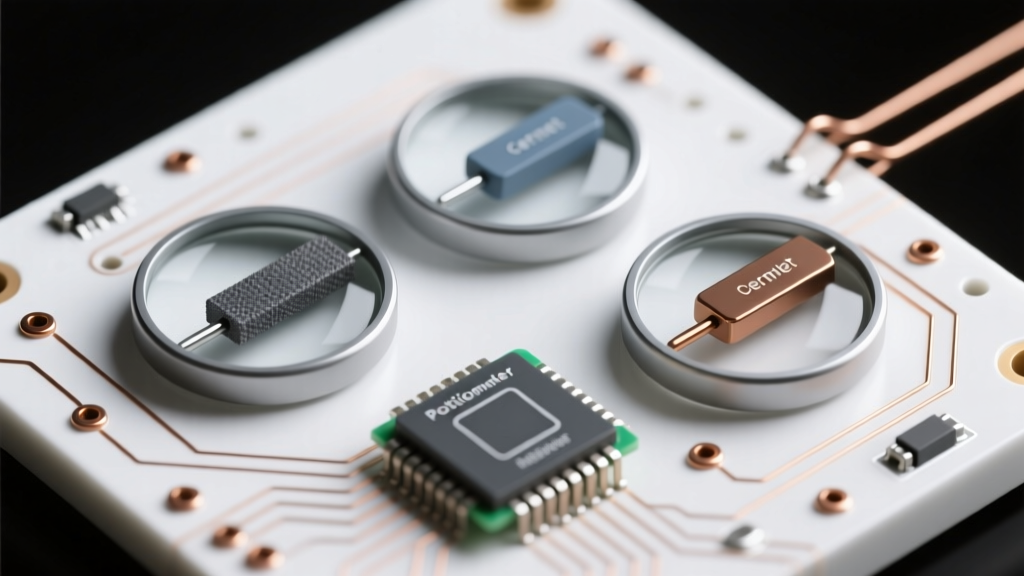
In this comprehensive guide, we compare the primary mechanical wiper and track technologies—carbon composition, cermet, conductive plastic, and wirewound. Furthermore, we evaluate modern solid-state alternatives that eliminate the physical wiper entirely, providing a decision framework for your next prototyping or production design.
Metallurgy and Contact Resistance Variation (CRV)
Before comparing track materials, we must understand the wiper itself. High-quality potentiometers do not use simple wire brushes. Instead, they employ a multi-finger spring design stamped from beryllium copper (BeCu) or phosphor bronze. The actual contact tip that rides the track is frequently plated with a palladium-ruthenium (PdRu) alloy or hard gold. This precious metal plating minimizes the friction coefficient and prevents oxidation at the contact point.
The most vital metric for wiper performance is Contact Resistance Variation (CRV). CRV measures the maximum fluctuation in resistance between the wiper and the track as it moves. A high CRV results in voltage spikes, manifesting as 'scratchy' noise in audio paths or erratic data in microcontroller ADC readings. As we evaluate alternatives, CRV and mechanical cycle life will be our primary differentiators.
Comparing Mechanical Wiper Track Materials
Carbon Composition: The Budget Standard
Carbon track potentiometers, such as the ubiquitous Alpha RD901F or Bourns Pro Audio series, are manufactured by molding a mixture of carbon powder, graphite, and a resin binder onto a phenolic substrate. The wiper rides directly over this composite surface.
- Pros: Extremely low cost (often under $0.80 per unit), widely available, and provides a smooth, continuous analog resolution.
- Cons: High CRV. As the carbon track wears down from wiper friction, loose carbon dust accumulates, causing resistance spikes of 100 ohms or more. They are also highly susceptible to humidity and temperature drift.
- Best For: Consumer electronics, basic hobbyist prototyping, and non-critical volume controls where occasional replacement is acceptable.
Cermet (Ceramic-Metal): The High-Temp Workhorse
Cermet tracks are created by firing a mixture of glass, ceramic, and metal oxides onto a substrate at high temperatures. The Bourns 3296 multi-turn trimpot is a classic example. The wiper, usually a stiff beryllium copper spring, scrapes across this hard, glass-like surface.
- Pros: Exceptional thermal stability (operating up to 125°C or higher), high power dissipation relative to size, and excellent long-term resistance stability.
- Cons: The hard cermet surface is abrasive. Over thousands of cycles, the wiper tip itself can degrade. Cermet also exhibits moderate wiper noise, making it unsuitable for audio signal paths.
- Best For: PCB-mount calibration trimmers, high-temperature industrial environments, and precision DC biasing circuits.
Conductive Plastic: The Audiophile and Precision Choice
Conductive plastic potentiometers, like the premium ALPS RK27 series or Bourns 3590 precision pots, utilize a specialized polymer matrix infused with conductive particles. The surface is incredibly smooth, allowing the wiper to glide with minimal friction.
- Pros: Extraordinary cycle life (frequently exceeding 1,000,000 rotations), ultra-low CRV (typically under 10 ohms), and excellent resistance to moisture. The low wiper noise makes them the undisputed king of professional audio.
- Cons: Higher manufacturing cost (ranging from $5.00 to over $20.00 for multi-gang units) and lower power dissipation limits compared to wirewound.
- Best For: Studio audio mixing desks, medical equipment, aviation yoke controls, and high-end synthesizers.
Wirewound: High Power, Stepped Resolution
Wirewound pots feature a resistive wire (typically Nichrome or a copper-nickel alloy) wound tightly around a non-conductive toroidal core. The wiper slides across the top of the wire loops.
- Pros: Can handle significant power (2W to 5W+), excellent thermal stability, and precise total resistance tolerances.
- Cons: The wiper 'jumps' from one wire turn to the next, creating a stepped resolution rather than a truly continuous analog sweep. This causes high-frequency noise in AC or audio circuits.
- Best For: High-current rheostat configurations, motor speed controls, and heavy-duty industrial load banks.
Wiper Material Comparison Matrix
| Track Material | Cycle Life | CRV (Noise) | Power Rating | Approx. Cost | Primary Failure Mode |
|---|---|---|---|---|---|
| Carbon Comp. | 10k - 50k | High (>100Ω) | Low (0.05W) | $0.50 - $1.50 | Track wear, carbon dust accumulation |
| Cermet | 100k - 200k | Moderate (20Ω) | Medium (0.5W) | $1.20 - $3.00 | Wiper tip abrasion, fretting |
| Conductive Plastic | 1M - 5M+ | Very Low (<10Ω) | Low (0.1W) | $5.00 - $25.00 | Mechanical spring fatigue |
| Wirewound | 100k - 500k | Stepped Noise | High (2W+) | $4.00 - $15.00 | Wire breakage, wiper jumping |
Solid-State Alternatives: Eliminating the Physical Wiper
When mechanical wiper wear, dust ingress, or vibration-induced fretting is unacceptable, engineers must pivot to solid-state alternatives. These technologies remove the physical sliding contact entirely, replacing it with semiconductor logic or magnetic fields.
Digital Potentiometers (Digipots)
Digital potentiometers, such as the Microchip MCP4131 or Analog Devices AD5292, utilize an internal CMOS resistor ladder. Instead of a physical wiper, an array of electronic switches selects the desired tap point based on SPI or I2C commands. While they completely eliminate mechanical wiper noise and wear, they introduce new constraints. Digipots are limited to the IC's supply voltage (typically 3.3V or 5V) and possess an internal 'wiper resistance' (Rw) of 50 to 100 ohms, which can introduce gain errors in precision analog circuits. For detailed specifications on solid-state alternatives, consult the Analog Devices Digital Potentiometers portfolio.
Magnetic and Hall Effect Encoders
For high-reliability control knobs, Hall effect sensors like the AMS AS5600 offer a brilliant alternative. A diametrically magnetized rotor is placed above a Hall sensor array. As the magnet rotates, the IC calculates the angular position and outputs an analog voltage or digital I2C data. Because there is no physical wiper making contact with a track, the mechanical life is virtually infinite (limited only by the bearing). They are immune to dust, moisture, and vibration, making them ideal for automotive and marine applications.
Troubleshooting Wiper Degradation and Fretting
If you are maintaining existing equipment with mechanical wipers, understanding failure modes is critical. The most common cause of wiper noise in carbon and cermet pots is fretting corrosion. Micro-vibrations cause the wiper to oscillate slightly on the track, breaking down the protective oxide layer and creating insulating debris.
Never use standard WD-40 or pure isopropyl alcohol on carbon or cermet tracks. Alcohol dries out the carbon resin binder, accelerating wear, while WD-40 leaves a dielectric residue that increases contact resistance. Always use a dedicated contact enhancer.
To restore degraded wipers, apply a specialized cleaner like CAIG DeoxIT D5. This formulation dissolves oxidation on the palladium or gold wiper tip and deposits a thin, conductive protective film that prevents future fretting and lubricates the track.
Authoritative References
- Bourns Potentiometer Technical Data and Product Catalogs - Comprehensive specifications on cermet, carbon, and conductive plastic track tolerances.
- Analog Devices: Digital Potentiometer Design Guides - Application notes on replacing mechanical wipers with solid-state CMOS resistor ladders.
- CAIG Laboratories: DeoxIT D5 Contact Enhancer - Chemical analysis of wiper oxidation removal and fretting corrosion prevention.