
The Enduring Legacy of the Sony IMX219
Despite the release of newer modules, the camera raspberry pi v2 remains a cornerstone of the single-board computer maker community. Built around the Sony IMX219PQ sensor, this 8-megapixel module offers a 1/4-inch optical format with 1.12 µm square pixels. While the newer Camera Module V3 (IMX708) boasts phase-detection autofocus and HDR, the V2 module’s fixed-focus reliability, lower price point (typically hovering around $25 to $30), and vast repository of community-driven 3D-printed mounts keep it highly relevant in 2026.
In this community showcase, we are moving past basic tutorials to explore how advanced makers are pushing the hardware limits of the V2 module. From stratospheric balloon payloads to reversed-lens microscopy and localized smart-home security, these projects highlight the practical realities, failure modes, and brilliant workarounds of deploying the IMX219 in the wild.
Showcase 1: High-Altitude Balloon (HAB) Payloads
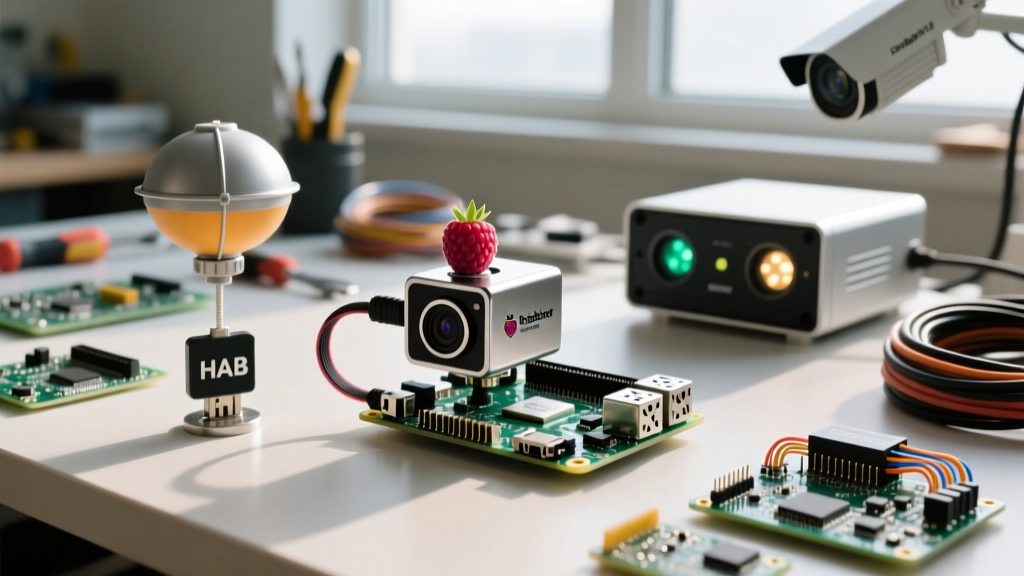
High-Altitude Ballooning requires strict weight management and extreme temperature resilience. The community has heavily favored pairing the Pi Camera V2 with the Raspberry Pi Zero 2 W for HAB payloads. The combined weight of the SBC, camera, and a shortened 15-pin CSI-2 cable sits under 25 grams, leaving ample mass budget for GPS modules and radiosondes.
Cold-Weather Failure Modes & Mitigation
At altitudes exceeding 30,000 meters, ambient temperatures plummet to -50°C. Makers have documented a specific failure mode unique to the V2’s Flexible Printed Circuit (FPC) ribbon cable: the polyimide substrate becomes highly brittle and snaps under the micro-vibrations of the balloon's ascent.
- The Fix: Community engineers reinforce the FPC cable using 3M Kapton tape and apply a dab of neutral-cure RTV silicone at the ZIF (Zero Insertion Force) connector joints to absorb high-frequency vibrations.
- Software Tweak: To prevent the ISP (Image Signal Processor) from hanging during rapid lighting changes above the cloud layer, makers disable automatic exposure by hardcoding
exposure_mode=offand setting a fixed shutter speed via the modernlibcamerastack.
Showcase 2: Reversed-Lens Mycology Timelapse
Mycologists and botanists in the maker space have discovered that the V2 camera's stock 3.04mm lens can be repurposed for extreme macro photography. By carefully breaking the factory Loctite seal on the lens barrel, the lens can be unscrewed, flipped upside down, and re-mounted using a custom 3D-printed M12 adapter ring.
This reversed-lens technique transforms the 8MP IMX219 into a digital microscope capable of capturing the sporulation process of mushrooms at 10x to 15x magnification. Because the V2 lacks the motorized autofocus of the V3, manual focus is achieved by physically moving the entire camera module on a precision lead-screw rail, driven by a NEMA 17 stepper motor and an A4988 driver.
"The rolling shutter effect of the IMX219 can cause 'jello' artifacts if your stepper motor rail has too much micro-vibration. Always use 1/16th micro-stepping on your A4988 driver and implement a 500ms software delay between the motor stopping and the camera triggering the capture." — Open-source Mycology Hardware Forum
Showcase 3: Frigate NVR on a Budget
For smart home enthusiasts running Home Assistant, integrating the camera raspberry pi v2 as a dedicated IP camera for Frigate NVR is a highly popular budget build. While the Pi 5 handles AI object detection natively, many community members still deploy Pi 4B (4GB) nodes as remote camera endpoints, streaming via RTSP to a central server.
libcamera vs. Legacy Stack
A major hurdle for legacy codebases is the deprecation of raspistill and raspivid. The community has fully migrated to the rpicam-apps suite. To stream the V2 camera efficiently without melting the Pi 4B's CPU, makers use the hardware-accelerated H.264 encoder pipeline:
rpicam-vid -t 0 --width 1640 --height 1232 --framerate 15 --inline --listen -o tcp://0.0.0.0:8554
This specific resolution (1640x1232) utilizes the sensor's 2x2 binning mode, which dramatically improves low-light sensitivity—a crucial factor for outdoor driveway security cameras at dusk.
Community Build BOM: Remote Driveway Cam
| Component | Model / Specification | Est. Cost | Role in Build |
|---|---|---|---|
| Compute | Raspberry Pi 4B (4GB) | $55.00 | H.264 Encoding & RTSP Server |
| Sensor | Pi Camera V2 (IMX219) | $25.00 | 8MP Image Capture |
| Optics | Arducam M12 Wide Angle | $18.00 | Replaces stock lens for 120° FoV |
| Enclosure | IP66 Aluminum IP Cam Housing | $14.00 | Weatherproofing & Thermal Mass |
| Power | PoE HAT (802.3af) | $22.00 | Data & Power over single Cat6 |
Troubleshooting Common V2 Module Failures
Deploying the camera raspberry pi v2 in permanent installations inevitably leads to hardware quirks. Based on community troubleshooting logs from the official Raspberry Pi forums, here are the most frequent failure modes and their exact solutions.
1. The "ENOSPC" and "No Data Received" Errors
If your terminal throws mmal: No data received from sensor or ENOSPC, it is rarely a software bug. In 90% of cases, the microscopic 15-pin FPC connector on the Pi board has a broken plastic retention flap. The ribbon cable is making intermittent contact with the gold pins, causing the I2C bus to fail during the camera's initialization handshake. Solution: Use a small piece of folded paper to apply downward pressure on the cable before locking the ZIF latch, or replace the board's SMD connector using hot-air rework.
2. Brownout Drops Under Peak Load
The IMX219 sensor draws approximately 260mA during peak capture, while the Pi's ISP and CPU can spike simultaneously. If you are powering your setup via long, thin USB cables, the voltage at the Pi's PMIC will drop below 4.63V, triggering a brownout warning and instantly killing the camera pipeline. Solution: Always use an official USB-C power supply or, for custom PCBs, feed 5V/3A directly into the GPIO 5V and GND pins to bypass the Pi's polyfuse and USB power-path management IC.
3. Infrared Filter (IR-Cut) Degradation
Makers using the V2 camera for outdoor wildlife monitoring have noted that prolonged exposure to direct UV sunlight can cause the stock IR-cut filter's adhesive to delaminate, resulting in a pink or purple hue in the center of the image. For 24/7 outdoor deployments, the community highly recommends purchasing the "NoIR" (No Infrared Filter) version of the V2 camera and pairing it with an external, mechanical IR-cut filter or an 850nm LED illuminator for night vision.
Final Verdict: Is the V2 Still Worth Building With?
While the Camera Module V3 offers superior HDR and autofocus for consumer desktop projects, the camera raspberry pi v2 remains undisputed for specialized, ruggedized, and budget-conscious maker projects. Its fixed-focus mechanical stability, predictable rolling-shutter behavior, and massive ecosystem of third-party M12 lens adapters make it an irreplaceable tool in the community's workbench. Whether you are tracking weather patterns in the stratosphere or monitoring mycelium networks in your basement, the IMX219 continues to punch well above its weight class.