
Bridging Physics and Fire Safety: The NEC Perspective on Conductive Materials
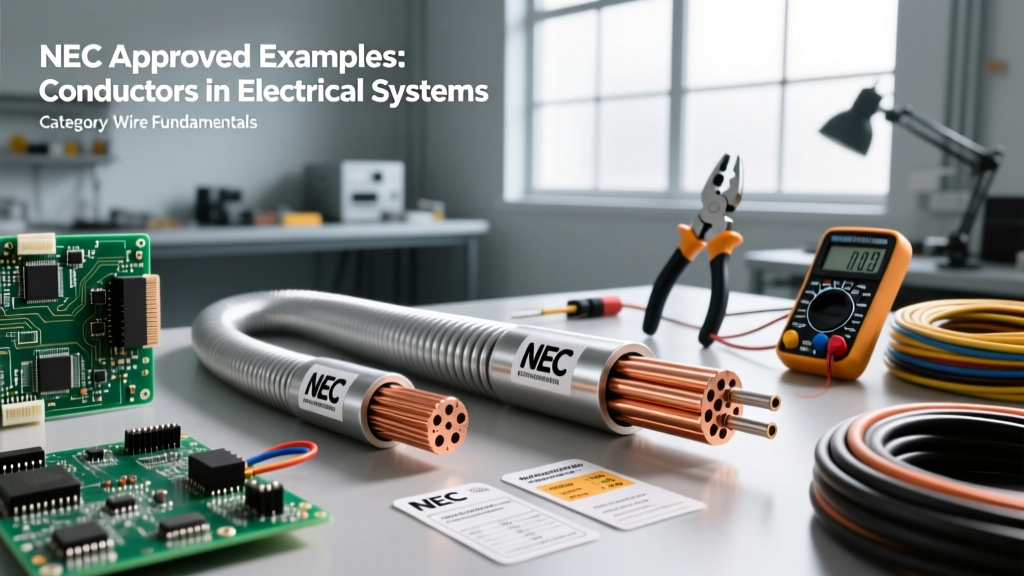
In the realm of electrical engineering and physics, a conductor is simply any material that permits the free flow of electrical charge. However, when reviewing examples of conductors electricity professionals deploy in the field, it becomes immediately clear that theoretical physics must yield to strict safety codes. The National Electrical Code (NEC), published by the National Fire Protection Association (NFPA), does not merely suggest which materials to use; it strictly mandates the metallurgical composition, insulation ratings, and installation methods for every wire inside a building.
Understanding the code-approved examples of electrical conductors requires looking past basic conductivity metrics. An electrician or DIY enthusiast must consider thermal expansion, galvanic corrosion, creep, and termination temperature ratings. This comprehensive guide explores the exact materials recognized by the NEC, the historical failures that shaped modern code requirements, and the critical installation standards that ensure electrical safety.
The Code's Definition: What Makes a Material 'Approved'?
Under NEC Article 100 and the general requirements of Article 110, all electrical equipment and materials must be 'approved'—meaning they have been tested and listed by a Nationally Recognized Testing Laboratory (NRTL) such as UL (Underwriters Laboratories) or CSA. For conductors, NEC Article 310 dictates the specific requirements for insulated and uninsulated wires.
The code evaluates conductive materials based on three primary failure modes:
- Thermal Overload: Can the material handle the resistive heating (I²R losses) at maximum ampacity without melting its insulation?
- Physical Degradation: Will the material suffer from 'creep' (slow deformation under mechanical stress) or excessive thermal expansion that loosens terminal screws over time?
- Chemical Reactivity: Will the material oxidize rapidly or cause galvanic corrosion when mated with dissimilar metals?
Because of these stringent requirements, the list of code-approved examples of conductors electricity systems rely upon is remarkably short compared to the periodic table.
Primary Code-Approved Conductive Materials
1. Copper: The Undisputed Benchmark (ASTM B3 / B8)
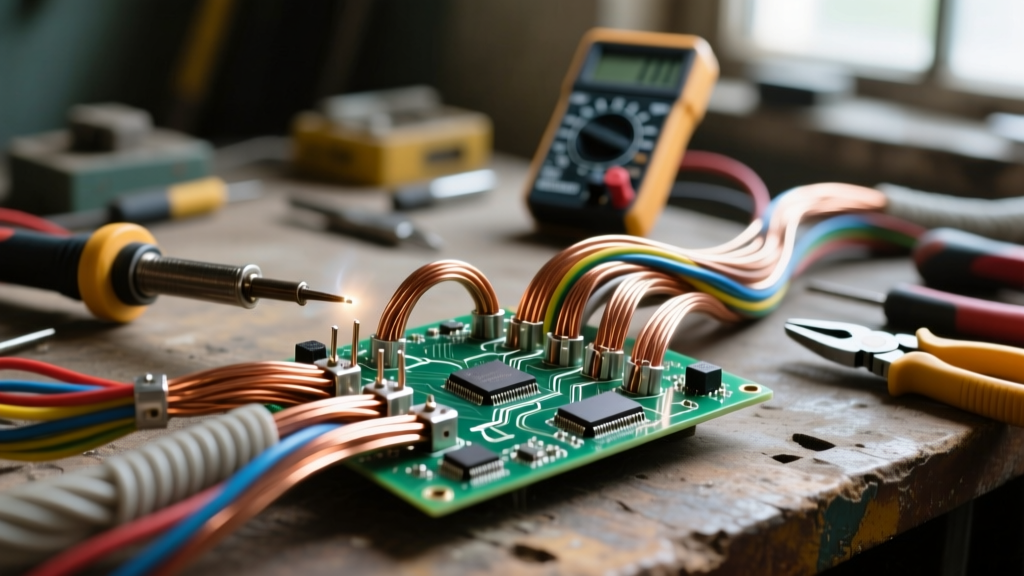
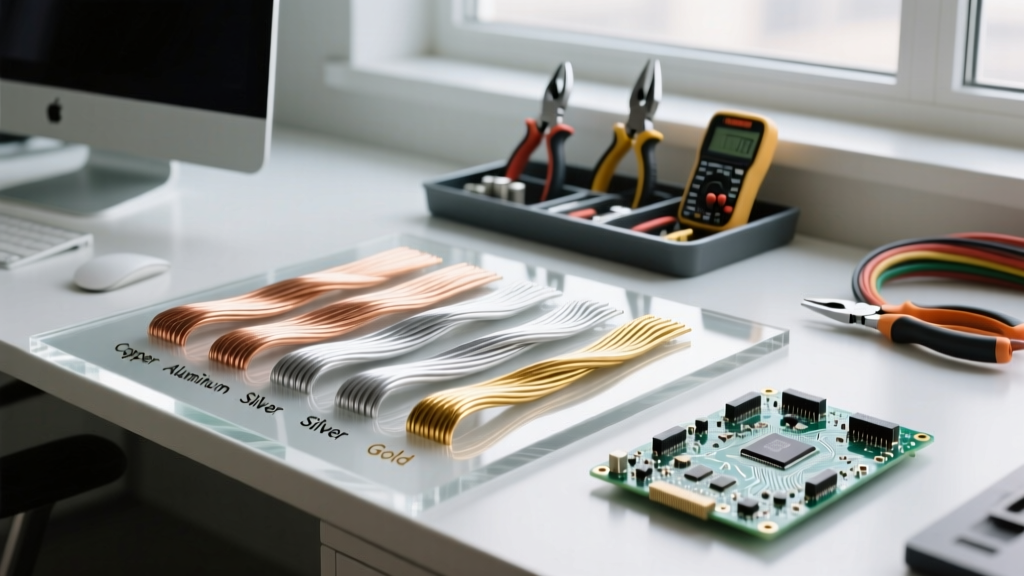
Copper is the universal standard for electrical conductivity. The International Annealed Copper Standard (IACS) sets pure annealed copper at 100% conductivity. According to the Copper Development Association, copper's high tensile strength, excellent solderability, and resistance to corrosion make it the default choice for nearly all residential and commercial branch circuits.
The NEC requires copper conductors to meet specific ASTM standards. For solid wire, ASTM B3 is the standard, while stranded copper must meet ASTM B8. Copper's low coefficient of thermal expansion means that when a copper wire is secured under a brass or steel terminal screw, the connection remains tight through thousands of heating and cooling cycles.
2. Aluminum: The AA-8000 Series Mandate (NEC 310.14)
Aluminum presents one of the most vital lessons in NEC history. In the 1960s, a spike in copper prices led to the widespread use of AA-1350 aluminum wire for residential branch circuits. This proved disastrous. AA-1350 is highly susceptible to 'creep' and possesses a high coefficient of thermal expansion. As circuits loaded and heated, the aluminum expanded, pushing against the terminal screws. When the circuit cooled, the metal contracted, leaving the connection loose. This loose connection caused high resistance, arcing, and catastrophic residential fires.
In response, the NEC was updated. Today, NEC Section 310.14 strictly mandates that aluminum conductor material must be an AA-8000 series electrical grade aluminum alloy. By adding trace amounts of iron and other elements, the AA-8000 series virtually eliminates creep and matches the thermal expansion characteristics of copper. While aluminum only has 61% of the conductivity of copper (meaning you must use a larger wire gauge for the same ampacity), its lighter weight and lower cost make it the dominant choice for heavy service entrance cables and large commercial feeders.
3. Silver and Gold: Specialty and High-Frequency Applications
Silver is technically the most conductive element on earth, boasting an IACS rating of roughly 105%. However, you will not find solid silver wire running through residential walls. The cost is prohibitive, and silver is prone to sulfur-induced tarnishing. In code-compliant electrical systems, silver is typically found as a plating on high-voltage switchgear contacts or in specialized high-frequency RF applications where the 'skin effect' dictates that current travels primarily on the outer surface of the conductor. Gold, while highly corrosion-resistant, has a much lower conductivity (roughly 70% IACS) and is reserved for low-voltage, high-reliability data contacts rather than power transmission.
Comparative Analysis: Conductors and Code Restrictions
The following table outlines how the NEC and ASTM classify the primary examples of conductors electricity infrastructure utilizes, alongside their practical applications.
| Material | IACS Conductivity | NEC / ASTM Standard | Primary Code Application | Key Code Restriction |
|---|---|---|---|---|
| Copper (Annealed) | 100% | ASTM B3 / B8 | Branch circuits, feeders, services | Must be sized per NEC Table 310.16 |
| Aluminum (AA-8000) | 61% | NEC 310.14 / ASTM B800 | Service entrance, heavy feeders | Requires larger gauge; anti-oxidant paste mandated for some terminations |
| Silver (Plated) | 105% | N/A (Equipment specific) | Switchgear contacts, busbars | Not permitted as general branch wiring |
| CCAW (Copper-Clad) | Varies (Core dependent) | UL Listed specific | Coaxial cables, data transmission | Rarely approved for standard AC power branch circuits |
Code Compliance Pitfalls: Termination Ratings and Galvanic Corrosion
Identifying the correct examples of conductors electricity codes permit is only half the battle. The most common point of failure—and the most frequent cause of failed electrical inspections—occurs at the termination point. This is governed by NEC 110.14.
The 75°C Terminal Bottleneck
Modern wire insulation, such as THHN/THWN-2, is rated for 90°C. Many DIYers and junior electricians mistakenly calculate ampacity using the 90°C column of NEC Table 310.16. However, NEC 110.14(C) dictates that the ampacity of the circuit is limited by the lowest temperature rating of any connected component. Most standard residential circuit breakers, receptacles, and switches are only rated for 75°C. Therefore, even if you pull 90°C copper wire, you must size the wire based on the 75°C ampacity column to remain code-compliant and prevent the terminal from overheating.
Combating Galvanic Corrosion
When connecting aluminum feeders to copper lugs (or vice versa), a galvanic reaction occurs in the presence of ambient moisture. Aluminum acts as an anode and corrodes rapidly, creating aluminum oxide—a highly resistive insulator that leads to voltage drop and heat. To mitigate this, NEC 110.14 requires the use of connectors specifically rated for AL/CU (Aluminum-to-Copper) connections. Furthermore, applying a UL-listed anti-oxidant compound (such as Noalox) to the aluminum strands before termination is a critical best practice to break down the micro-oxide layer and ensure a permanent, low-resistance bond.
'The reliability of any electrical system is only as strong as its weakest termination. The NEC's strict material and torque requirements in Article 110 are written in the ashes of past failures.' — Senior Electrical Inspector, NFPA 70 Handbook Commentary
Sizing, Circular Mils, and the Future of Conductors
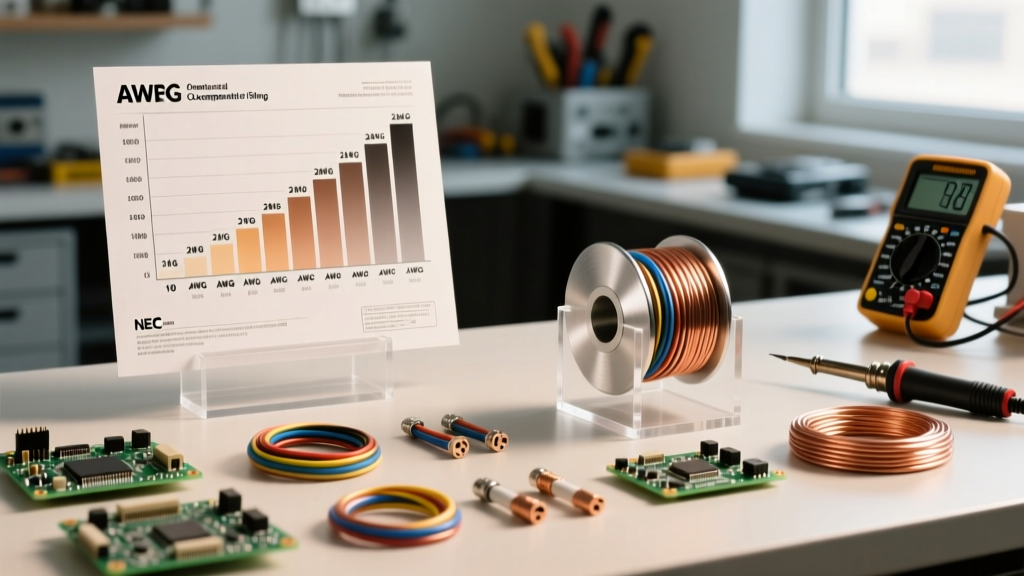
As electrical loads increase with the adoption of EV chargers and heat pumps, understanding wire sizing becomes paramount. The NEC measures wire cross-section in Circular Mils (CM) or American Wire Gauge (AWG). Because aluminum requires roughly 1.6 times the cross-sectional area of copper to carry the same current safely, conduit fill calculations (NEC Chapter 9, Table 1) become critical. Upgrading a 200-amp service to 400 amps using copper may require parallel runs of 3/0 AWG, whereas aluminum might require parallel 250 kcmil conductors, drastically altering conduit size and bending radius requirements.
Looking ahead, while advanced materials like graphene and carbon nanotubes boast theoretical conductivities far surpassing copper, they remain confined to the laboratory. For the foreseeable future, the NFPA 70 National Electrical Code will continue to rely on the proven, rigorously tested examples of conductors electricity systems demand: high-purity copper and AA-8000 series aluminum alloys. Mastering the code requirements for these two metals is the defining line between a safe, lasting electrical installation and a catastrophic fire hazard.