
The Anatomy of a Reliable Voltage Testing Kit
When troubleshooting electrical circuits, the accuracy and safety of your diagnostic gear are non-negotiable. Selecting the right multimeter for voltage test applications requires looking beyond basic continuity checks and focusing on input impedance, safety ratings, and signal conditioning. Whether you are an HVAC technician diagnosing control boards, an industrial electrician working on 480V three-phase motor feeds, or a DIY enthusiast wiring a sub-panel, the voltage testing environment dictates your tool requirements.
A high-quality voltage testing kit must prioritize the International Electrotechnical Commission (IEC) safety standards. The NFPA 70E electrical safety guidelines and IEC 61010 standards categorize multimeters into Measurement Categories (CAT I through CAT IV). For general building wiring and branch circuits, a CAT III 600V rating is the absolute minimum requirement. However, the true differentiator in a professional voltage testing kit is how the meter handles real-world electrical noise, non-linear loads, and ghost voltages.
True RMS vs. Average Responding: Why It Matters for AC Voltage
If your voltage testing involves modern electronics, variable frequency drives (VFDs), or LED lighting drivers, you are dealing with non-linear loads. These devices distort the standard AC sine wave. An average-responding multimeter assumes a perfect sine wave and will return highly inaccurate readings when faced with harmonic distortion. A True RMS (Root Mean Square) multimeter calculates the effective heating value of the complex waveform, providing the actual working voltage. For any professional kit in 2026, True RMS is a mandatory specification for AC voltage tests.
2026 Equipment Roundup: Top Multimeters for Voltage Tests
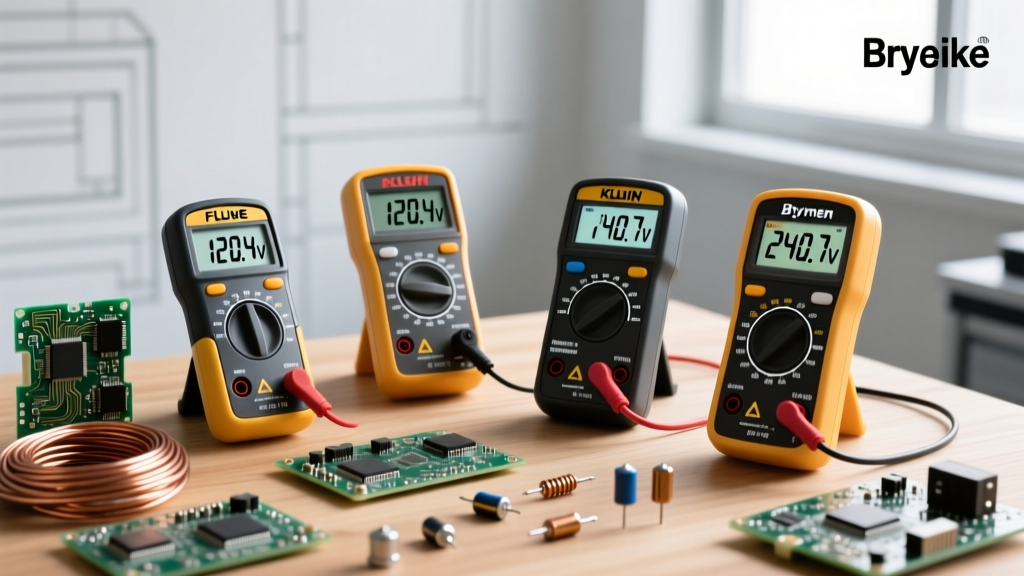
We have evaluated the current market leaders based on field durability, measurement accuracy, and specific voltage-testing features. Here is how the top contenders stack up for professionals and serious hobbyists.
1. Fluke 117: The Electrician's Gold Standard
The Fluke 117 remains the undisputed champion for commercial and residential electricians. Its standout feature for voltage testing is the integrated VoltAlert non-contact voltage (NCV) detector, which allows you to verify the presence of AC voltage before even making physical contact with a terminal. More importantly, it features AutoVolts technology. When switched to the AutoVolts mode, the meter drops its input impedance to roughly 3 kilo-ohms (LoZ mode). This is critical for dissipating capacitive ghost voltages in long, parallel cable runs, ensuring you do not chase phantom power. Priced around $210, it is a CAT III 600V workhorse that pays for itself in time saved and shocks avoided.
2. Brymen BM235: The Best Value True-RMS Contender
Brymen is the original equipment manufacturer (OEM) for several premium brands, and the BM235 is their flagship mid-tier offering. Priced aggressively at approximately $130, it delivers CAT III 600V safety, True RMS accuracy, and a remarkably fast continuity beep. For voltage testing, the Brymen excels in its build quality and probe connections. The internal high-rupturing-capacity (HRC) fuses and sand-filled chambers provide the same arc-flash protection found in meters costing twice as much. While it lacks an integrated NCV or a dedicated LoZ switch, its standard 10-megohm input impedance is highly stable, making it a phenomenal choice for bench electronics and automotive diagnostics.
3. Klein Tools MM400: The Budget-Friendly Field Tech Pick
For HVAC technicians and DIYers who need a rugged, drop-tested meter without the premium price tag, the Klein Tools MM400 is a top-tier choice. According to the Klein Tools MM400 official specifications, it survives a 1-meter drop and is rated for CAT III 600V. It offers True RMS AC voltage readings and a dedicated low-battery indicator, which is crucial since a dying battery can cause erratic voltage readings. At roughly $55, it is an excellent secondary meter or a primary tool for environments where the risk of meter destruction is high.
Comparative Analysis: Voltage Testing Specifications
To help you match the meter to your specific workflow, we have compiled a direct specification comparison focusing on voltage testing parameters.
| Model | CAT Rating | True RMS | LoZ (Low Impedance) | Input Impedance | Approx. Price |
|---|---|---|---|---|---|
| Fluke 117 | CAT III 600V | Yes | Yes (AutoVolts) | 10 MΩ / 3 kΩ | $210 |
| Brymen BM235 | CAT III 600V | Yes | No | 10 MΩ | $130 |
| Klein MM400 | CAT III 600V | Yes | No | 10 MΩ | $55 |
| Fluke 87V | CAT III 1000V | Yes | No | 10 MΩ | $450 |
Troubleshooting Ghost Voltages: The LoZ Advantage
One of the most frustrating phenomena in electrical troubleshooting is the 'ghost voltage.' This occurs when energized wires run parallel to de-energized wires in the same conduit. The capacitive coupling between the wires induces a phantom voltage on the dead wire. A standard multimeter with a 10-megohm input impedance will read this ghost voltage—sometimes as high as 80V or 100V—leading technicians to believe a circuit is live when it is actually safe to work on.
As detailed in Fluke's comprehensive guide on ghost voltage, the solution is a Low Impedance (LoZ) testing mode. By dropping the meter's internal resistance to roughly 3 kilo-ohms, the meter acts as a small load, bleeding off the capacitively coupled charge and displaying the true voltage (zero). If your daily workflow involves tracing control wiring, testing multi-conductor thermostat cables, or working in densely packed industrial cable trays, a multimeter with a dedicated LoZ function is not just a luxury; it is a critical safety requirement.
Probe Safety: HRC Fuses and Shrouded Plugs
A multimeter is only as safe as its test leads and internal protection. When performing voltage tests on high-energy panels, arc flashes are a lethal reality. Budget meters often use simple glass fuses and unshrouded banana plugs. If a technician accidentally leaves the leads in the ampere (A) jacks and connects them across a voltage source, the resulting short circuit can vaporize a glass fuse, causing the meter to explode in their hands.
Professional voltage testing kits utilize High Rupturing Capacity (HRC) ceramic fuses filled with sand. When an overcurrent event occurs, the sand absorbs the explosive energy and quenches the arc, saving the user from severe burns. Furthermore, ensure your test leads feature shrouded banana plugs and flexible silicone insulation rated for CAT III/IV environments. Silicone withstands high temperatures and will not melt or short out if it accidentally brushes against a live busbar or soldering iron.
Final Decision Framework: Matching the Meter to Your Workflow
Choosing the best multimeter for voltage test duties ultimately depends on your specific trade and environment.
- For Commercial/Residential Electricians: The Fluke 117 is the definitive choice. The AutoVolts LoZ feature eliminates ghost voltages, and the VoltAlert NCV speeds up panel diagnostics significantly.
- For HVAC and Appliance Technicians: The Klein Tools MM400 offers the perfect balance of ruggedness and affordability. It handles the rigors of crawlspace and attic work while providing reliable True RMS readings for compressor and blower motor diagnostics.
- For Electronics and Bench Work: The Brymen BM235 provides exceptional value, fast continuity, and stable 10MΩ impedance, making it ideal for PCB troubleshooting and low-voltage DC control circuits where LoZ is unnecessary.
- For Industrial and High-Energy Environments: If you are working on service entrances, utility feeds, or 480V+ three-phase systems, step up to a CAT IV 600V / CAT III 1000V meter like the Fluke 87V to ensure maximum arc-flash protection.
Investing in the correct voltage testing equipment protects both your diagnostic accuracy and your physical safety. Always verify your meter's calibration annually and inspect your test leads for cracked insulation before every single use.