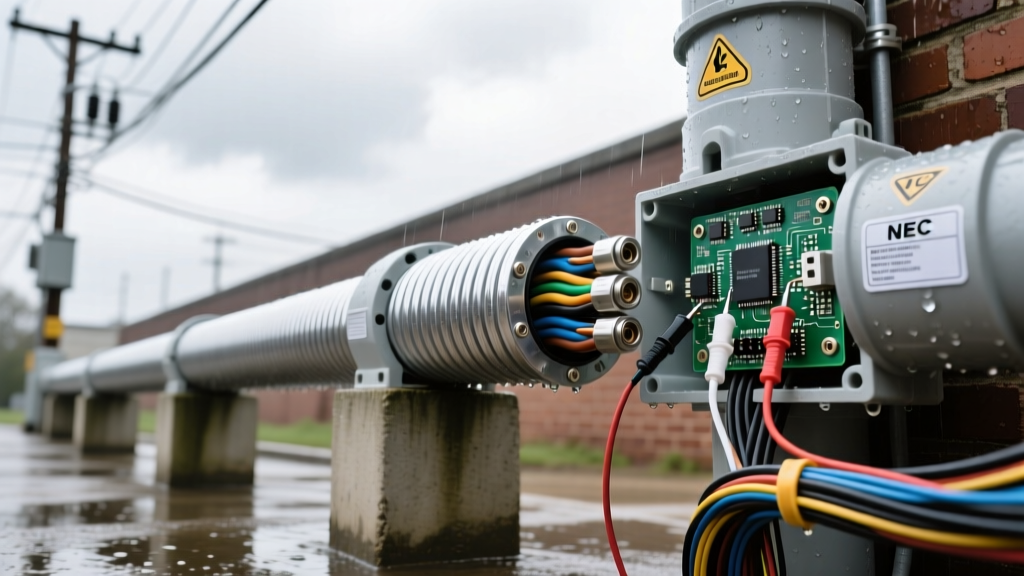

The Core Dilemma: Standard MC vs. Wet Locations
When planning exterior electrical routes for commercial lighting, HVAC disconnects, or outdoor receptacles, many contractors ask: can you run mc cable outside? The short answer is yes, but the long answer requires a strict understanding of armor types, conductor insulation, and National Electrical Code (NEC) limitations. The most common and costly mistake in exterior wiring is assuming that because Metal Clad (MC) cable has a metallic armor, it is inherently weatherproof. It is not.
Standard MC cable features an interlocking metal armor. While this provides excellent crush resistance and physical protection indoors, the interlocking spirals create microscopic gaps. When exposed to rain, snow, or high humidity, water infiltrates these gaps. Through capillary action, moisture can wick dozens of feet along the inside of the armor, eventually pooling at the lowest termination point and causing catastrophic ground faults or short circuits.
Why Standard Interlocking Armor Fails Outdoors
Standard indoor MC cable typically uses galvanized steel interlocking armor. When installed on an exterior wall or run through a damp crawlspace, the galvanized coating eventually degrades under UV exposure and constant moisture. Once the bare steel is exposed, oxidation accelerates. The armor flakes, compromising the physical protection of the cable, and the internal paper or PVC wrap degrades, exposing the conductors to the elements.
NEC Article 330: What the Code Actually Says
To install MC cable outside legally and safely, you must adhere to NEC Article 330. Specifically, NEC 330.10(A)(11) permits MC cable in wet locations only if three strict conditions are met simultaneously:
- Impervious Armor: The metallic covering must be impervious to moisture (meaning no interlocking gaps).
- Wet-Rated Conductors: The conductors inside the armor must be specifically rated for wet locations (e.g., THWN-2 or XHHW-2).
- Wet-Rated Fittings: All terminations and connectors must be listed for use in wet/raintight locations.
According to code experts at Mike Holt Enterprises, inspectors will routinely fail exterior MC installations if the contractor uses standard interlocking steel MC, even if the conductors inside are THWN-2 rated. The armor itself must be a continuous, seamless barrier.
Material Selection: Choosing the Right Outdoor MC Cable
When sourcing materials to run MC cable outside, you must specify Continuous Corrugated Aluminum Armor MC or specialized MC-HL (Hazardous Location) cable. Unlike interlocking armor, continuous corrugated armor is extruded as a single, seamless aluminum tube that is then corrugated for flexibility. There are no spiral gaps for water to enter.
| Cable Type | Armor Material | Water Resistance | Outdoor/Wet Rated? |
|---|---|---|---|
| Standard MC | Galvanized Steel (Interlocking) | Poor (Wicks water) | No (Dry locations only) |
| MC-AP | Aluminum (Interlocking) | Poor (Wicks water) | No (Dry/Damp only) |
| Continuous Corrugated MC | Aluminum (Seamless Tube) | Excellent (Impervious) | Yes (With wet-rated conductors) |
| MC-HL | Continuous Aluminum/Copper | Superior | Yes (Industrial/Wet/HazLoc) |
Conductor Insulation Matters Just as Much as Armor
Even if you buy continuous corrugated MC, you must verify the conductor printing. Standard THHN is rated for dry and damp locations only. If the cable is subjected to wet location conditions (direct exposure to weather, or buried in concrete slabs that retain moisture), the conductors must be dual-rated THHN/THWN-2 or XHHW-2. Manufacturers like AFC Cable Systems and Southwire clearly stamp 'Wet Location' on the outer jacket of approved continuous MC products.
Essential Tools for Prepping Continuous Corrugated MC
Working with continuous corrugated aluminum requires different tools than standard interlocking steel. Because the armor is a solid tube, you cannot simply use a rotary MC cutter designed for interlocking spirals. Scoring the aluminum too deeply will nick the THWN-2 insulation, creating a hidden failure point that will trip a GFCI or cause an arc fault once the cable is energized.
- Armor Scoring Tool: Use a dedicated continuous armor stripper, such as the Greenlee 1955 or Klein Tools Roto-Split (Model 104). These tools clamp onto the cable and score the corrugations precisely to the depth of the aluminum without touching the inner conductors.
- Deburring Tool: Once the armor is snapped and pulled off, the cut edge of the aluminum tube is razor-sharp. You must use an internal/external deburring tool to chamfer the edge. Failing to deburr will slice the conductor insulation when you push the cable through a wet-location fitting.
- Anti-Oxidant Paste: Because you are terminating aluminum armor to steel or copper grounding paths, applying an anti-oxidant compound (like Noalox) to the grounding bushing area prevents galvanic corrosion over time.
Fittings and Terminations: Keeping Moisture Out
The most vulnerable point in any exterior MC run is the termination. If you use a standard indoor set-screw or standard compression fitting, water will bypass the fitting and enter the junction box.
The Danger of Standard Set-Screw Fittings
Set-screw fittings are strictly prohibited for outdoor MC installations. They do not provide a watertight seal around the corrugated armor, nor do they seal the threads where the fitting enters the junction box. For exterior runs, you must use Raintight/Watertight Compression Fittings.
High-quality wet-location fittings (such as the Appleton 300 Series or Arlington Industries WT series) feature a neoprene or silicone sealing ring that compresses tightly around the continuous corrugated armor when the nut is tightened. Additionally, these fittings include a sealing gasket that presses against the exterior of the junction box, preventing water from tracking down the threads and into the enclosure. Always apply a bead of exterior-grade silicone sealant where the fitting meets the enclosure for redundant protection.
Real-World Failure Modes and Troubleshooting
When troubleshooting exterior circuits that trip breakers or exhibit ground faults, electricians often overlook the MC armor itself. Here are the most common failure modes when MC cable is installed outside:
- Galvanic Corrosion at the Box: When continuous aluminum armor is clamped tightly against a cast-iron or steel exterior junction box without a sealing/isolating gasket, dissimilar metal corrosion occurs. Over 2 to 3 years, the aluminum fitting seizes to the steel box, and the resulting oxidation expands, cracking the fitting and allowing water ingress.
- UV Degradation of the Outer Jacket: Some continuous MC cables feature a thin PVC outer jacket over the aluminum for added corrosion resistance. If this jacket is not specifically UV-rated, sunlight will cause it to become brittle, crack, and flake off within a single summer, exposing the aluminum to salt air or acid rain.
- Thermal Expansion/Contraction: Aluminum expands and contracts significantly with outdoor temperature swings. If long, straight exterior runs are installed without expansion offsets or slack, the thermal movement will pull the cable out of the compression fitting, breaking the watertight seal.
Summary Checklist for Exterior MC Installations
Before pulling the trigger on your next outdoor wiring project, verify your materials against this quick checklist:
- [ ] Armor is continuous corrugated aluminum (no interlocking spirals).
- [ ] Conductors are printed with THWN-2 or XHHW-2 (wet-location rated).
- [ ] Outer jacket (if present) is UV and sunlight resistant.
- [ ] Fittings are specifically listed for 'Wet Locations' or 'Raintight'.
- [ ] Fittings include neoprene/silicone compression seals.
- [ ] Junction boxes are NEMA 3R or 4X rated with intact gaskets.
- [ ] Armor edges are deburred before inserting into the fitting.
By treating the armor, the conductors, and the fittings as a unified waterproof system, you can successfully and legally run MC cable outside, ensuring a durable installation that will pass inspection and withstand the elements for decades.