
The Short Answer: Can MC Cable Be Used Outdoors?
When estimating the budget for an exterior wiring project, a common question arises among DIYers and junior estimators: can MC cable be used outdoors? The short answer is no. Standard Metal-Clad (MC) cable with interlocking steel or aluminum armor is strictly prohibited in wet or damp locations by the National Electrical Code (NEC). While the metallic armor looks robust enough to withstand the elements, standard MC cable is designed exclusively for dry, indoor environments.
Attempting to use standard MC cable outdoors to save on upfront material costs is a critical estimation error. It inevitably leads to failed inspections, severe safety hazards, and massive rework costs. In this comprehensive 2026 cost and code guide, we will break down exactly why standard MC fails outdoors, the hidden financial risks of code violations, and how to properly budget for NEC-compliant outdoor wiring alternatives.
Decoding the NEC: Article 330 and Wet Location Restrictions
To build an accurate project estimate, you must first understand the regulatory boundaries. NEC Article 330 governs the installation of Metal-Clad Cable. Specifically, NEC 330.12 outlines the 'Uses Not Permitted' for standard MC cable, explicitly forbidding its use in wet locations unless the cable is specifically identified for such use.
'Standard interlocking armor MC cable is not a watertight assembly. Water will infiltrate the armor gaps, wick down the internal conductors, and compromise the insulation, leading to catastrophic ground faults.' — Mike Holt Enterprises, NEC Code Forum
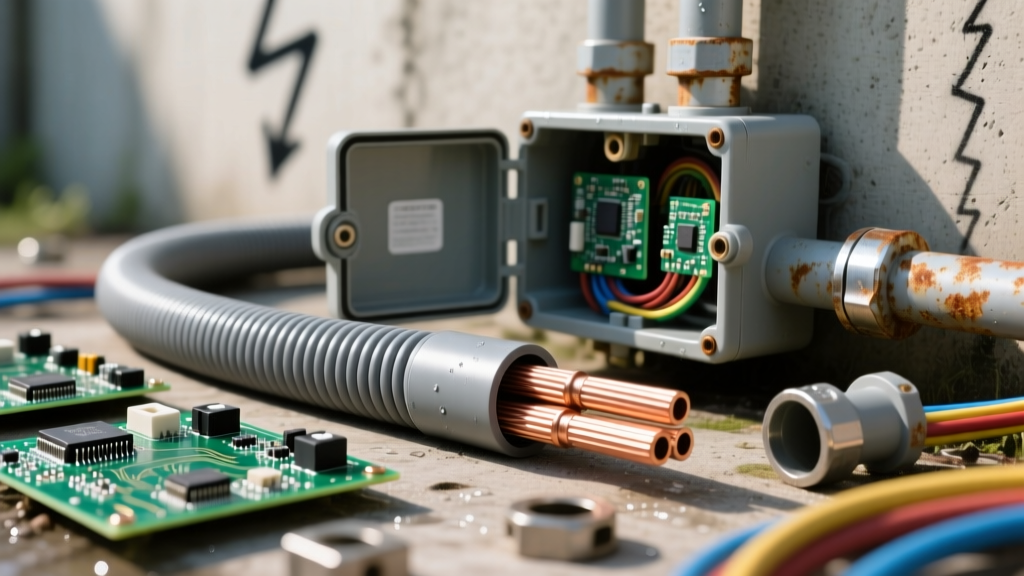
There is a highly specialized exception: Continuous Corrugated Aluminum MC (often labeled as MC-HL or wet-rated MC) features a solid, welded aluminum tube and an AEGIS water-blocking barrier. However, this is an industrial-grade product. For standard residential and commercial exterior projects, specifying wet-rated continuous MC is almost never cost-effective.
Cost Breakdown: Standard MC vs. Outdoor-Rated Alternatives
When drafting your bill of materials (BOM), it is crucial to compare the true cost of standard MC against code-compliant outdoor alternatives. Below is a 2026 market estimation for a standard 100-foot run of 12 AWG, 2-conductor with ground wiring.
| Wiring Method | Material Cost (per 100ft) | Labor Time (per 100ft) | Wet Location Rated? | Best Application |
|---|---|---|---|---|
| 12/2 Standard Interlocking MC | $95.00 | 1.5 Hours | No (Dry Only) | Indoor commercial walls |
| 12/2 UF-B (Direct Burial) | $115.00 | 3.0 Hours (incl. trench) | Yes | Underground landscape lighting |
| 3/4' Sch 40 PVC + 12 AWG THWN-2 | $75.00 | 4.0 Hours | Yes | Exterior surface mounting |
| 12/2 Continuous Corrugated MC-HL | $310.00 | 1.5 Hours | Yes | Industrial hazardous zones |
Analyzing the Material vs. Labor Trade-off
As the table illustrates, standard MC cable is relatively cheap and fast to install. However, because it cannot be used outdoors, estimators must pivot to either UF-B cable or PVC conduit with THWN-2 wire. While PVC conduit requires more labor hours to cut, glue, and pull wire through, the material cost is actually lower than standard MC cable. Conversely, UF-B cable has a higher material cost and requires expensive trenching labor, making it best reserved for underground runs where conduit would be impractical.
The Hidden Costs of Code Violations and Water Damage
Some contractors attempt to 'weatherproof' standard MC cable by wrapping it in tape or running it through exterior sleeves, assuming this bypasses the code. This is a massive financial risk. Let us calculate the true cost of failure when an estimator incorrectly specifies standard MC for an outdoor patio receptacle run.
Failure Mode Analysis: What Happens When Water Enters MC Armor
Standard MC cable features interlocking metal strips. These strips act like a series of tiny gutters. When exposed to rain, snow, or even heavy ambient humidity, moisture breaches the armor.
- Capillary Action: Water wicks along the internal paper or plastic binder tape, traveling feet or even yards inside the cable.
- Galvanic Corrosion: The steel armor rusts from the inside out. As iron oxide expands, it crushes the internal conductors, compromising the dielectric insulation.
- Insulation Breakdown: If the internal wires are THHN (not THWN-2), the insulation is not rated for water contact. It will degrade, leading to arc faults and short circuits.
The Financial Impact of Rework
If an AHJ (Authority Having Jurisdiction) inspector flags an outdoor MC cable installation, the financial penalties are immediate. Consider this real-world rework estimate:
- Failed Inspection Fee: $150
- Labor to Demolish and Remove Ruined MC: $250 (2 hours at $125/hr)
- New Compliant Materials (PVC + THWN-2): $85
- Labor to Install Compliant System: $500 (4 hours)
- Re-inspection Fee: $150
- Total Cost of Error: $1,135
By trying to save $20 on materials by using leftover indoor MC cable, the project bleeds over a thousand dollars in rework and delays.
Budgeting for Compliant Outdoor Wiring Solutions
To maintain healthy profit margins and ensure safety, estimators must specify the correct materials from the start. Here is how to budget for the two most common outdoor wiring methods.
Scenario A: The PVC Conduit and THWN-2 Route (Surface Mount)
For exterior wall runs, eave lighting, or outdoor receptacles, Schedule 40 PVC conduit is the gold standard. When estimating this method, do not forget the ancillary fittings that drive up the cost. You must budget for PVC cement, primer, expansion joints (required for long runs to prevent buckling in summer heat), and LB/LL conduit bodies for directional changes. Furthermore, you must specify THWN-2 rated copper conductors, which are dual-rated for dry and wet locations, rather than standard THHN.
Scenario B: Direct Burial UF-B Cable (Underground)
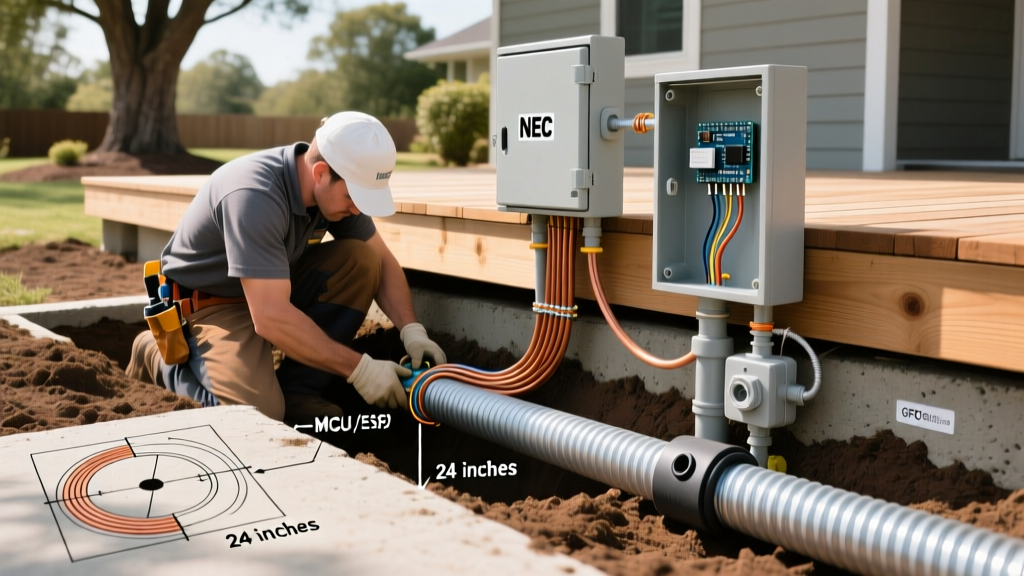
If the project requires power to a detached garden shed or landscape lighting, Underground Feeder (UF-B) cable is the correct choice. When estimating UF-B, the primary cost driver is not the wire itself, but the earthwork. Budget for manual trenching (or a mechanical trencher rental at ~$75/day) to a minimum depth of 24 inches as per NEC Table 300.5. You must also budget for warning tape ($15 per roll) to be placed 12 inches above the burial depth, and PVC conduit sleeves wherever the cable emerges from the ground to protect it from physical damage and weed whackers.
Final Verdict and Estimator Checklist
So, can MC cable be used outdoors? Absolutely not, unless you are purchasing highly specialized, wildly expensive continuous corrugated MC-HL, which is rarely appropriate for standard construction. Standard interlocking MC is an indoor-only product.
Before finalizing your next exterior electrical estimate, run through this quick compliance checklist:
- Verify all exterior conductors are rated THWN-2 or XHHW-2.
- Ensure surface-mounted exterior cables are protected by UV-rated and crush-proof conduit (PVC, RMC, or Liquidtight).
- Confirm direct burial depths meet NEC Table 300.5 requirements.
- Remove any 'leftover indoor MC' from the BOM to prevent accidental field substitutions by installation crews.
Accurate cost estimation is not just about finding the cheapest wire; it is about forecasting the total lifecycle cost of a compliant, durable installation. By specifying the right outdoor-rated materials from day one, you protect your bottom line, pass inspections on the first attempt, and ensure long-term safety for the end user.