
The Short Answer: Why Asking "Is Metal an Insulator?" Matters for Safety
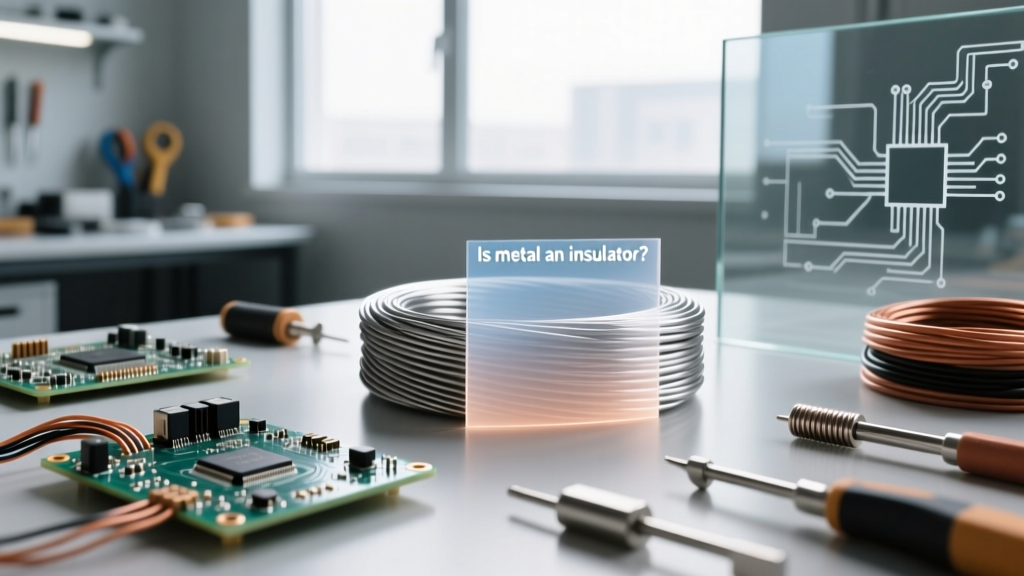
If you find yourself asking, "is metal an insulator?" you are likely grappling with a fundamental physics concept or, more dangerously, a real-world electrical anomaly. In the realm of standard electrical engineering, the baseline answer is a resounding no. Metals are the quintessential conductors of electricity. However, from a strict safety and materials science perspective, the surface of certain metals spontaneously forms highly effective insulating layers. Misunderstanding this nuance is a leading cause of high-resistance connections, arc flashes, and residential electrical fires.
For electricians, DIYers, and engineers, treating the surface of a metal as a guaranteed conductor without proper preparation is a fatal safety flaw. This guide explores the physics of metallic conduction, the dangerous exception of metal oxide insulators, and the critical safety protocols required to ensure true metal-to-metal electrical continuity.
The Physics of Conductivity vs. Insulation
To understand why metal is fundamentally a conductor, we must look at atomic structure. Insulators (like rubber, glass, and PVC) have tightly bound valence electrons that require massive amounts of energy to dislodge. Conductors, specifically metals, feature a "sea of electrons" model. The outermost electrons are loosely bound and can move freely through the atomic lattice when a voltage is applied.
Free Electrons and the Metallic Bond
Copper, silver, and aluminum possess abundant free electrons, resulting in exceptionally low bulk resistivity. When you strip a copper wire and touch it to a battery terminal, those free electrons immediately migrate, completing the circuit. Under normal conditions, the bulk metal will never act as an insulator. However, the environment interacts with the metal's surface, altering its electrical properties entirely.
The Dangerous Exception: Metal Oxide Layers
The core of the safety hazard lies in oxidation. When bare metal is exposed to oxygen in the atmosphere, a chemical reaction occurs on the surface. While some metal oxides are somewhat conductive, others are hard, impenetrable ceramic insulators.
Aluminum and the "Invisible Insulator" Effect
Aluminum is a fantastic conductor in its pure bulk form. Yet, within milliseconds of being exposed to air, aluminum forms a layer of aluminum oxide (Al2O3). Aluminum oxide is not just a poor conductor; it is a premier electrical insulator. In fact, synthetic aluminum oxide is used to manufacture spark plug insulators, high-voltage capacitor dielectrics, and semiconductor substrates. It boasts a dielectric strength of roughly 13.4 kV/mm.
While the oxide layer on a typical wire is only a few nanometers thick, it is enough to disrupt low-voltage signals and, more critically, cause immense contact resistance in high-current AC/DC power applications. If a wire lug is bolted to an aluminum busbar without piercing this insulating layer, the connection acts as a resistor. Under load, this resistance generates intense heat, leading to melted insulation, arcing, and structural fires.
CRITICAL SAFETY WARNING: Never assume a metal surface is electrically continuous simply because it looks metallic. Paint, anodization, and natural oxide layers can turn a conductive metal chassis into an isolated, shock-hazardous surface. Always verify continuity with a multimeter before working on metal enclosures.
Real-World Safety Failures: When Oxide Layers Deceive
The most infamous example of metal oxide acting as an insulator occurred during the aluminum wiring boom of the 1960s and 1970s. Due to a copper shortage, builders used solid aluminum wire for residential branch circuits. Electricians connected these wires to copper terminals and steel screws using standard twist-on wire connectors.
Over time, the aluminum oxide layer formed and expanded. Combined with the differing thermal expansion rates of aluminum and copper, the connections loosened. The insulating oxide layer increased contact resistance, causing the connections to overheat and ignite fires inside walls. According to the U.S. Consumer Product Safety Commission (CPSC), homes wired with pre-1972 aluminum wire are 55 times more likely to have a fire hazard at the connections than homes wired with copper.
Comparison of Common Metals: Conductivity vs. Oxide Insulation
| Metal | Bulk Resistivity (nΩ·m at 20°C) | Surface Oxide Properties | Safety & Connection Risk Level |
|---|---|---|---|
| Silver | 15.9 | Silver oxide and sulfide remain relatively conductive. | Very Low (Premium contacts) |
| Copper | 16.8 | Cuprous oxide (semiconductor/weak insulator). Easily broken by mechanical pressure. | Low (Standard for most wiring) |
| Gold | 22.1 | Does not oxidize in standard atmospheres. | None (Used in sensitive electronics) |
| Aluminum | 26.5 | Aluminum oxide (Al2O3) is a hard, highly insulating ceramic. | High (Requires oxide inhibitors and special termination) |
| Titanium | 420.0 | Titanium dioxide is a strong dielectric insulator. | Extreme (Rarely used for power conduction) |
Proper Bonding and Grounding: Piercing the Insulator
The National Electrical Code (NEC / NFPA 70) mandates that grounding and bonding paths must be permanent, reliable, and capable of safely conducting fault currents. If you are bonding a grounding wire to a painted or oxidized metal chassis, you are essentially bonding to an insulator. To ensure safety, you must physically or chemically eliminate the surface insulation.
1. Mechanical Abrasion and Star Washers
When attaching a grounding lug to a metal electrical box or chassis, never rely solely on the clamping force of a standard flat washer. You must use a tooth lock washer (star washer) placed directly between the lug and the metal surface. As the screw is torqued, the sharp teeth of the washer bite through the paint, anodization, or metal oxide layer, establishing a true metal-to-metal conductive path. Always sand away heavy paint or rust from the contact area before applying the lug.
2. Chemical Oxide Inhibitors (e.g., Noalox)
When terminating aluminum wire, mechanical pressure alone is insufficient because the oxide layer will immediately reform if exposed to air. You must apply an approved oxide inhibitor compound, such as Noalox. These compounds contain microscopic zinc or copper particles suspended in a non-drying grease. When the connection is torqued, the metal particles embed themselves into the aluminum, piercing the insulating oxide layer, while the grease seals out oxygen to prevent future oxidation.
3. Bimetallic Connectors and Anti-Oxidant Pastes
If connecting aluminum to copper, you must use connectors specifically rated for "AL/CU" and pre-fill them with anti-oxidant paste. Furthermore, modern OSHA electrical safety guidelines emphasize that all connections must be torqued to the manufacturer's exact specifications using a calibrated torque screwdriver. Under-torquing fails to pierce the oxide insulator; over-torquing can snap the screw or deform the soft aluminum, creating a new high-resistance hotspot.
Summary Checklist for Electricians and DIYers
To ensure your metal connections never fall victim to the "invisible insulator" effect, follow this strict safety protocol:
- Never assume conductivity: Always test metal enclosures for voltage and continuity before touching them or using them as a ground reference.
- Prep the surface: Scrape, sand, or wire-brush paint, rust, and heavy oxidation from metal surfaces before attaching grounding lugs.
- Use the right hardware: Always use internal-tooth lock washers for grounding connections to bite through surface oxides.
- Use chemical inhibitors: Apply AL/CU rated antioxidant pastes to all aluminum wire terminations to prevent ceramic oxide formation.
- Torque to spec: Use a calibrated torque tool to ensure the mechanical force is sufficient to maintain a permanent, low-resistance metallic bond.
Ultimately, while the bulk of a metal is an excellent conductor, its surface can easily become an insulator. Recognizing this duality is what separates a dangerous amateur from a safety-conscious electrical professional.