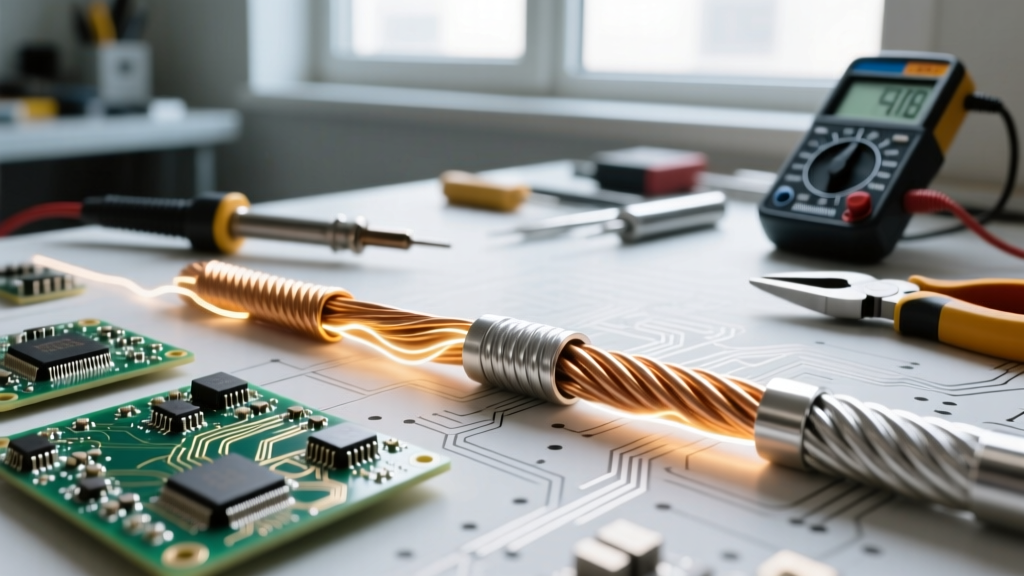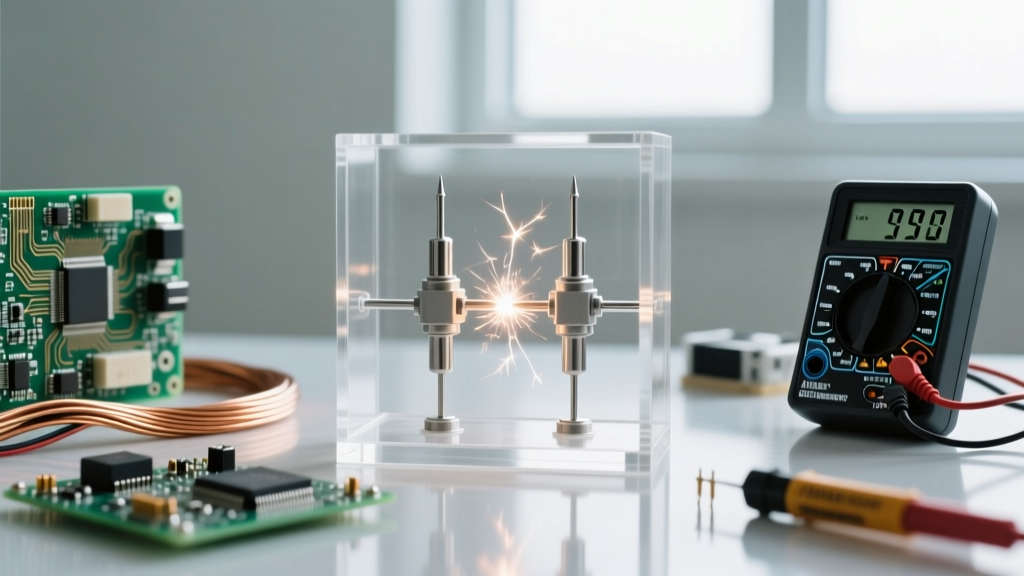

The Short Answer: Air's Dual Electrical Nature
When electrical engineers, physicists, and DIY hobbyists ask, is air an insulator or a conductor, the most scientifically accurate answer is that air is a conditional insulator. Under standard temperature and pressure (STP), dry air is an exceptional dielectric material, meaning it resists the flow of electric current. This insulating property is the only reason bare overhead high-voltage transmission lines and exposed busbars do not instantly short-circuit to the ground.
However, air's insulating capability is not infinite. When subjected to a sufficiently high electric field—typically around 3 kilovolts per millimeter (kV/mm) at sea level—the gas molecules undergo dielectric breakdown. The electric field strips electrons from their atomic nuclei, creating a cascade of free ions and electrons. In this ionized state, air transforms into a highly conductive plasma channel, allowing current to flow freely in the form of a spark or an electrical arc. Therefore, air acts as an insulator by default, but becomes a conductor when its dielectric threshold is exceeded.
Comparative Analysis: Air vs. Solid and Liquid Dielectrics
To understand where air excels and where it fails as an insulator, we must compare its dielectric strength to other common electrical materials. Dielectric strength is defined as the maximum electric field a material can withstand before breaking down and becoming conductive.
| Material | Dielectric Strength (kV/mm) | Relative Permittivity | Physical State | Self-Healing? |
|---|---|---|---|---|
| Air (Dry, STP) | ~3.0 | 1.00059 | Gas | Yes |
| Transformer Oil | 10.0 - 15.0 | 2.2 | Liquid | Partial |
| FR-4 (PCB Substrate) | ~14.0 | 4.5 | Solid | No |
| Glass (Borosilicate) | ~13.0 | 4.7 | Solid | No |
| PTFE (Teflon) | ~60.0 | 2.1 | Solid | No |
| Mica | ~118.0 | 5.4 | Solid | No |
While air has the lowest dielectric strength on this chart, it possesses a unique advantage: it is self-healing. When a spark jumps through an air gap, the plasma channel dissipates almost instantly once the voltage drops, and the air returns to its insulating state. Solid dielectrics like FR-4 or PTFE, once punctured by an arc, suffer permanent carbon tracking and structural damage, requiring component replacement.
When Air Becomes a Conductor: The Physics of Breakdown
The transition of air from an insulator to a conductor is governed by a phenomenon known as electron avalanche or Townsend discharge. A single free electron, accelerated by a strong electric field, collides with a neutral air molecule (primarily nitrogen and oxygen), knocking loose additional electrons. These new electrons are then accelerated, causing further collisions, resulting in an exponential multiplication of charge carriers.
Paschen's Law and the Pressure Anomaly
A common misconception is that reducing air pressure (creating a partial vacuum) will always increase its insulating properties by removing conductive molecules. In reality, the breakdown voltage is governed by Paschen's Law, which states that breakdown voltage is a function of the product of gas pressure and gap distance.
According to Paschen's Law, there is a specific 'danger zone' at low pressures where air becomes more conductive, not less. For air, the minimum breakdown voltage is approximately 327 volts, occurring at a pressure-distance product of about 0.567 Torr·cm.
This anomaly is a critical design constraint for aerospace engineers. High-altitude drones, satellites, and aircraft operating in the upper atmosphere experience partial vacuums that can cause high-voltage avionics to arc at much lower voltages than they would at sea level. To prevent air from becoming a conductor in these environments, engineers must either hermetically seal components, increase gap distances significantly beyond the Paschen minimum, or pot the electronics in solid epoxy resins.
Real-World Engineering: Designing with Air Gaps
Because air is a free, lightweight, and self-healing insulator, electrical designers rely on it heavily. However, specifying air gaps requires strict adherence to safety standards to prevent catastrophic arcing.
Clearance vs. Creepage in PCB Design
In printed circuit board (PCB) design, engineers must distinguish between two critical air-related measurements, as outlined in the IPC-2221 standard:
- Clearance: The shortest distance through the air between two conductive parts. This relies entirely on air's dielectric strength to prevent arcing.
- Creepage: The shortest distance along the surface of a solid insulating material (like the FR-4 PCB itself) between two conductive parts.
While air might easily insulate a 2mm gap at 500V, dust and humidity settling on the PCB surface can create a conductive path along the board. Therefore, creepage distances are almost always specified to be larger than clearance distances. Applying a conformal coating (like acrylic or silicone) effectively replaces the air and bare FR-4 surface with a superior solid dielectric, drastically reducing the required spacing.
High-Voltage Transmission Line Spacing
For overhead power lines operating at 115 kV to 765 kV, air is the primary insulator. Engineers use massive ceramic or polymer insulator strings to maintain the necessary air clearance between the energized conductors and the grounded steel towers. To prevent the electric field at the edges of the conductors from exceeding air's 3 kV/mm limit—which would cause continuous energy loss—designers install corona rings. These toroidal metal rings distribute the electric field gradient evenly, ensuring the surrounding air remains an insulator rather than ionizing into a conductor.
Troubleshooting Air Insulation Failures in the Field
When air unexpectedly transitions from an insulator to a conductor in electrical equipment, it usually presents in three distinct failure modes. Identifying these is crucial for high-voltage troubleshooting:
- Corona Discharge: This is a localized, partial breakdown of air, usually occurring near sharp edges or points where the electric field is highly concentrated. It manifests as a faint purple glow, a hissing sound, and the distinct smell of ozone. While not a full short circuit, corona discharge degrades nearby polymers and causes continuous power loss.
- Sparkover (Flashover): A complete, temporary conductive plasma channel bridging an air gap. This often happens during lightning strikes or switching surges. If the power source cannot sustain the arc current, the air will de-ionize and return to its insulating state (a self-clearing fault).
- Surface Tracking: While technically a surface failure, it compromises the air gap. If moisture and industrial pollution accumulate on an insulator, a leakage current flows. This current heats the moisture, creating dry bands. The voltage then concentrates across these dry air gaps, causing micro-arcs that eventually burn a permanent conductive carbon track into the underlying solid insulator.
Final Verdict: Specifying Air Gaps in Modern Electronics
So, is air an insulator or a conductor? It is fundamentally an insulator, but one with a strict, quantifiable voltage limit. When designing circuits, switchgear, or high-voltage systems, you must treat air as a highly sensitive dielectric material whose insulating properties fluctuate with humidity, altitude, temperature, and electrode geometry.
For low-voltage DIY projects and standard household wiring (120V-240V), standard air clearances are more than sufficient, as the voltage is far below the 327V Paschen minimum required to initiate a breakdown in small gaps. However, for high-voltage power supplies, EV battery management systems, and aerospace electronics, relying solely on air is a liability. In these advanced applications, air gaps must be meticulously calculated using IEC safety standards, and frequently supplemented with solid dielectrics, insulating gases (like SF6), or vacuum chambers to guarantee operational safety.