
The Core Electrical Conductors Meaning: Defined
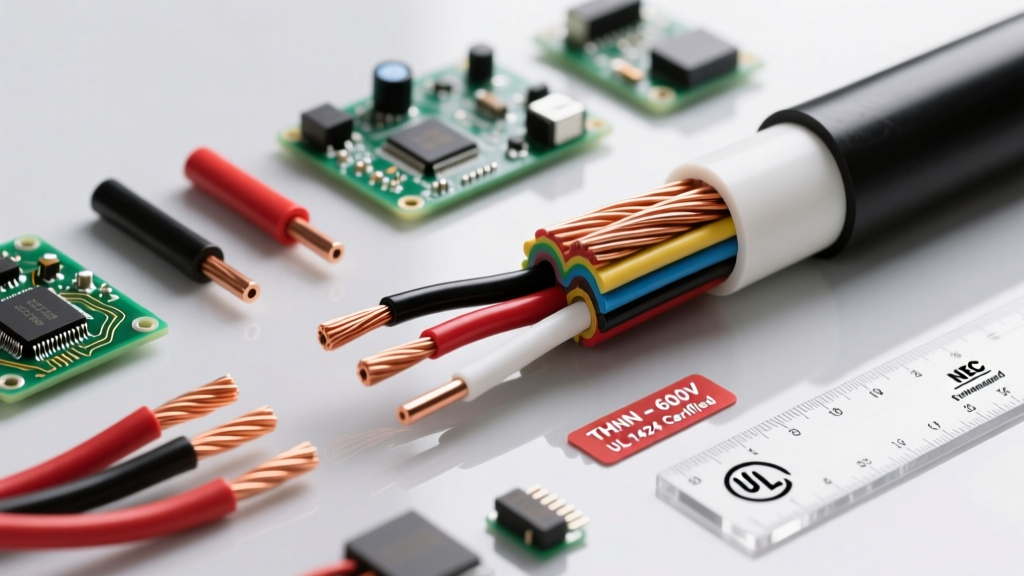
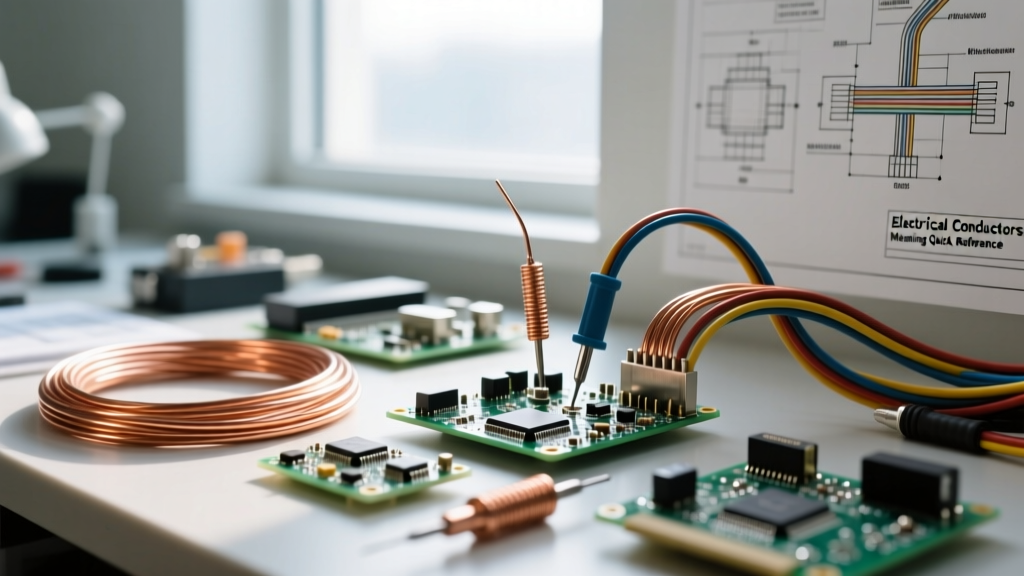
When engineers, electricians, and DIYers search for the electrical conductors meaning, they are looking for more than a simple dictionary definition. In materials science and electrical engineering, an electrical conductor is defined as a substance, body, or device that readily conducts heat, electricity, sound, or light. Specifically, in the context of wiring and circuitry, it is a material containing a high density of free charge carriers—typically electrons in metals, or ions in electrolytes—that can move macroscopically under the influence of an applied electric field.
Unlike insulators, which possess tightly bound valence electrons, conductors feature an atomic structure that allows electrons to detach and flow. This fundamental property is quantified by electrical conductivity ($\sigma$), measured in Siemens per meter (S/m), or its inverse, resistivity ($\rho$). According to Encyclopedia Britannica's principles of electrical conduction, the ease with which a material conducts is directly tied to its crystalline lattice structure and the mobility of its electron gas.
Quick Reference: Conductor Material Properties Matrix
To apply the electrical conductors meaning to practical wire sizing and component selection, you must understand the baseline physical properties of common metals. The table below serves as a quick reference for the most ubiquitous conductive materials used in modern electrical systems, ranked by their conductivity relative to the International Annealed Copper Standard (IACS).
| Material | Conductivity (MS/m) | Resistivity ($\mu\Omega\cdot$cm) | Temp. Coefficient (/°C) | Primary Application |
|---|---|---|---|---|
| Silver | 63.0 | 1.59 | 0.0038 | RF contacts, high-end audio, aerospace |
| Copper (Annealed) | 58.0 | 1.72 | 0.0039 | Standard building wire, PCB traces, busbars |
| Gold | 45.2 | 2.44 | 0.0034 | Corrosion-resistant connectors, IC bonding |
| Aluminum | 37.7 | 2.65 | 0.0043 | Overhead transmission, heavy feeder cables |
| Tungsten | 18.9 | 5.28 | 0.0045 | Incandescent filaments, high-temp environments |
Data sourced from standard metallurgical references and the Georgia State University HyperPhysics database.
Quantum Mechanics & Band Theory: The "Why" Behind Conduction
To truly grasp the electrical conductors meaning, one must look at the atomic level through the lens of Band Theory. In solid-state physics, electrons occupy specific energy bands.
- Valence Band: The highest range of electron energies in which electrons are normally present at absolute zero.
- Conduction Band: The lowest range of vacant electronic states.
In a true conductor like copper, the valence band and the conduction band overlap. There is no "band gap" (forbidden energy zone) preventing electrons from transitioning into a mobile state. When a voltage potential is applied, these delocalized electrons—often described as a "Fermi sea"—drift toward the positive terminal. This drift velocity is surprisingly slow (often less than a millimeter per second in DC circuits), but the electromagnetic wave propagating through the conductor travels at a significant fraction of the speed of light, which is why a light turns on instantly.
Real-World Application Matrix: Matching Material to Environment
Knowing the electrical conductors meaning is only half the battle; selecting the right conductor for a specific environment dictates system longevity and efficiency.
High-Voltage Overhead Transmission
Aluminum (specifically AAC, AAAC, or ACSR) is the standard. While its conductivity is only 61% that of copper, its high strength-to-weight ratio drastically reduces the structural load on transmission towers. For the same resistance, an aluminum wire will be twice as thick but half the weight of a copper wire.
The AC Penalty: Skin and Proximity Effects
In alternating current (AC) systems, current does not distribute evenly across the conductor's cross-section. Due to the skin effect, high-frequency AC currents travel primarily on the outer surface of the wire. At 60Hz, the skin depth in copper is about 8.5mm, meaning massive solid busbars are underutilized in the center. To mitigate this in high-frequency applications, engineers use Litz wire—a bundle of individually insulated thin strands woven together to maximize surface area.
Aerospace & High-Vibration Terminals
Beryllium Copper (BeCu) is heavily utilized here. While its bulk conductivity is lower (approx. 20-50% IACS), its exceptional fatigue resistance and spring properties make it the undisputed choice for battery contacts, pogo pins, and socket connectors where mechanical memory is critical.
Advanced Failure Modes: When Conductors Stop Conducting
Conductors are not immortal. Understanding how they fail bridges the gap between theoretical physics and practical troubleshooting.
- Electromigration: In microelectronics and high-density PCBs, high current densities physically "push" metal atoms out of place. Over time, this creates voids (open circuits) or hillocks (short circuits). This is governed by Black's Equation and is a primary limiting factor in modern CPU trace design.
- Thermal Creep: Aluminum wire, notorious in 1970s residential wiring, is susceptible to creep. Under the constant pressure of a screw terminal and the thermal cycling of daily load, aluminum slowly deforms, loosening the connection. This increases contact resistance, leading to arcing and catastrophic fires. This is why modern aluminum terminations require specific torque sequences and anti-oxidant pastes (like Noalox).
- Oxide Layer Dynamics: When copper oxidizes, the resulting copper oxide is still somewhat conductive. However, when aluminum oxidizes, it forms aluminum oxide—a hard, highly insulating ceramic layer that must be mechanically broken through wire brushing and sealed with antioxidant compound before termination.
- Galvanic Corrosion: When two dissimilar metals (e.g., copper and aluminum) meet in the presence of an electrolyte (humidity), a galvanic cell forms. The more anodic metal corrodes rapidly, creating a high-resistance barrier that blocks current flow and generates immense localized heat.
Field Testing: Verifying Conductor Integrity
How do you prove a conductor is still acting like a conductor? Standard multimeters are insufficient for detecting micro-faults or high-resistance joints in heavy infrastructure.
4-Wire Kelvin Measurement
To measure the true milliohm resistance of a thick busbar or long cable run, you must separate the current-forcing leads from the voltage-sensing leads. This eliminates the resistance of the test leads themselves, allowing technicians to detect loose terminal connections that a standard DMM would read as a dead short (0.0 ohms).
Time-Domain Reflectometry (TDR)
Used for long runs of coaxial, twisted-pair, or underground cables. A TDR sends a fast-rise-time pulse down the conductor and measures the reflection. By calculating the time delay and knowing the velocity factor of the dielectric, technicians can pinpoint the exact distance to a break, short, or severe impedance mismatch without digging up the cable.
For a deeper dive into electrical metrology and testing standards, refer to the guidelines published by the National Institute of Standards and Technology (NIST) Physical Measurement Laboratory.
"The reliability of any electrical system is ultimately bottlenecked by the integrity of its weakest conductive junction. A conductor is only as good as its termination."