
The Physics and Code: What Insulates Electricity?
When engineers, electricians, and inspectors ask what insulates electricity in modern infrastructure, the answer extends far beyond simple plastic coatings. In the realm of electrical fundamentals, an insulator is a dielectric material characterized by extremely high electrical resistivity (typically greater than 1012 ohm-meters), which restricts the free flow of electrons. However, from a regulatory and safety perspective, the National Electrical Code (NEC) and Underwriters Laboratories (UL) define insulation not just by its chemical composition, but by its verified ability to contain voltage, withstand thermal stress, and resist environmental degradation over decades of use.
Understanding what insulates electricity requires a dual approach: mastering the material science of dielectric polymers and strictly adhering to the code-mandated classifications outlined in NFPA 70 (National Electrical Code), specifically Article 310. This guide breaks down the exact materials, testing standards, and failure modes that dictate how we safely contain electrical current.
NEC Article 310: Insulation Identification and Standards
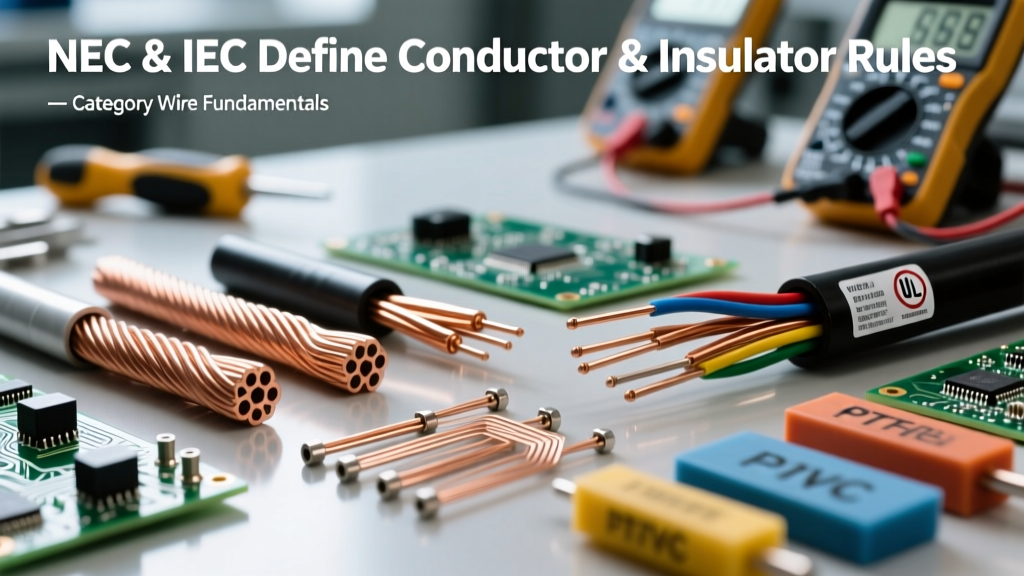
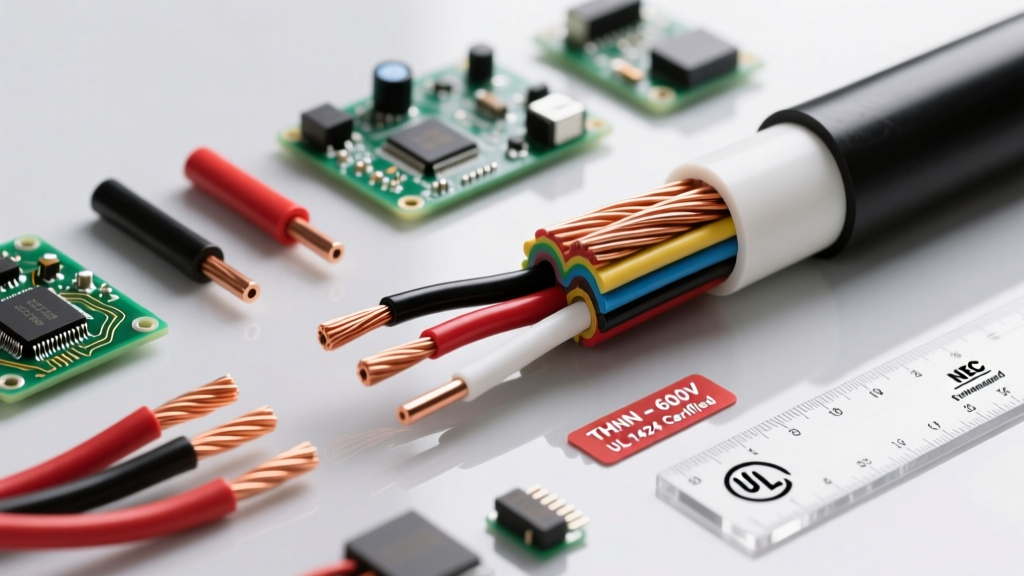
The NEC does not micromanage the chemical formulas of wire insulation; instead, it relies on rigorous third-party testing standards (like UL 83 for thermoplastics and UL 44 for rubber) and mandates strict surface identification. According to NEC Article 310.104, conductor insulations must be durably marked to indicate the manufacturer, wire size (AWG or kcmil), and the specific letter designations that denote its thermal and environmental limits.
Decoding the Alphabet: THHN, THWN, and XHHW
To understand what insulates electricity in residential and commercial branch circuits, you must decode the standard letter designations:
- T (Thermoplastic): Indicates a base polymer like PVC (Polyvinyl Chloride) that melts when heated and hardens when cooled.
- H (Heat Resistant): Rated for a maximum operating temperature of 75°C (167°F).
- HH (High Heat Resistant): Rated for a maximum operating temperature of 90°C (194°F).
- W (Water Resistant): The insulation is approved for wet locations, a critical distinction for underground conduits or outdoor runs.
- N (Nylon Jacket): An outer layer of nylon added for mechanical protection and resistance to gasoline, oil, and solvents.
Today, the vast majority of copper building wire is dual-rated as THHN/THWN-2. This means the PVC and nylon composite insulates electricity safely up to 90°C in dry locations and 90°C in wet locations, providing maximum flexibility for electrical contractors while maintaining strict code compliance.
Dielectric Strength: Measuring Insulation Failure
Dielectric strength is the definitive metric for what insulates electricity effectively under high voltage stress. It is measured in kilovolts per millimeter (kV/mm) and represents the maximum electric field a material can withstand before experiencing dielectric breakdown (a catastrophic failure where the insulator becomes conductive, resulting in an arc or short circuit).
Expert Insight: While air has a dielectric strength of roughly 3 kV/mm, solid wire insulators must perform exponentially better. However, dielectric strength is not static; it degrades with thermal aging, moisture ingress (water treeing), and continuous exposure to corona discharge.
Cross-Linked Polyethylene (XLPE) has largely overtaken standard PVC in medium-voltage and demanding low-voltage applications because its cross-linked molecular structure provides superior dielectric strength and thermal stability. Unlike thermoplastics, XLPE is a thermoset material; it will char and burn at extreme temperatures, but it will not melt and drip, preventing catastrophic phase-to-phase faults in cable trays.
Comparative Table: Common Insulating Materials & NEC Ratings
The following table synthesizes material science data with NEC code applications, illustrating exactly what insulates electricity across various demanding environments.
| Material Compound | Dielectric Strength (kV/mm) | Max Temp Rating (°C) | NEC Letter Designation | Primary Application & Code Use Case |
|---|---|---|---|---|
| Polyvinyl Chloride (PVC) | 15 - 20 | 90 (Dry) / 75 (Wet) | THHN / THWN | Standard residential/commercial branch wiring in conduit. |
| Cross-Linked Polyethylene (XLPE) | 20 - 25 | 90 (Dry & Wet) | XHHW-2 | Industrial feeders, solar PV wiring, high-fill conduit runs. |
| Ethylene Propylene Rubber (EPR) | 18 - 22 | 90 | RHW / USE-2 | Underground direct burial, mining, and high-flex applications. |
| Polytetrafluoroethylene (PTFE / Teflon) | 25 - 60 | 250+ | Specialty / Mil-Spec | Aerospace, high-temperature industrial ovens, avionics. |
| Paper (Oil-Impregnated) | 40 - 60 | 85 | PILC (Legacy) | Legacy underground utility distribution (largely replaced by XLPE). |
Temperature, Bundling, and Code Derating
Knowing what insulates electricity is only half the battle; understanding how that insulation behaves under thermal duress is where many electrical installations fail inspection. The NEC mandates ampacity derating when multiple current-carrying conductors are bundled in a single raceway (NEC 310.15(C)(1)).
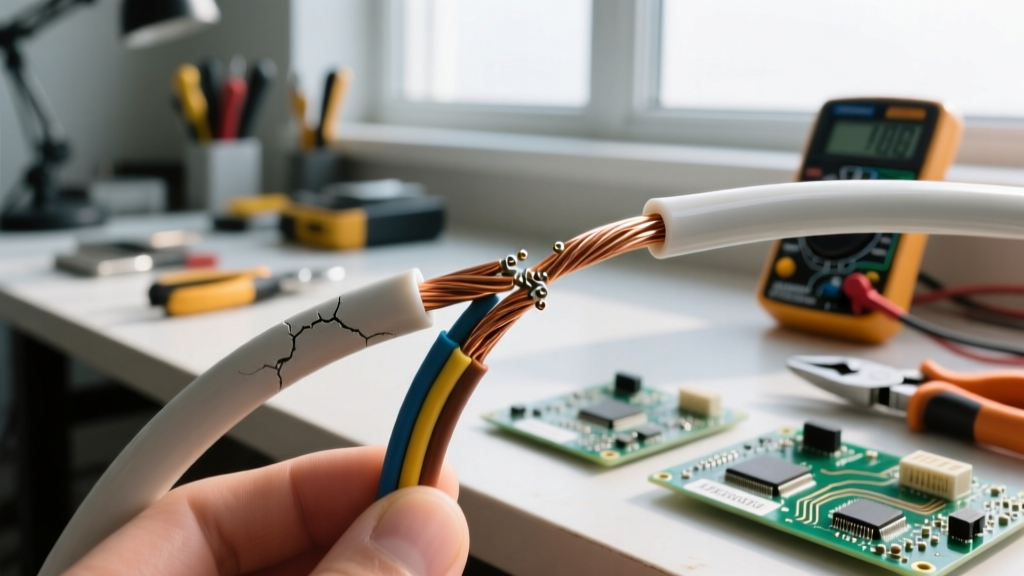
When you pull nine current-carrying THHN conductors through a single EMT conduit, the ambient heat generated by the I²R losses of the wires compounds. The insulation must dissipate this heat. If it cannot, the PVC plasticizers begin to migrate and volatilize. The insulation becomes brittle, cracks upon the next physical disturbance, and exposes bare copper, leading to ground faults.
Because XHHW-2 (XLPE) lacks the volatile plasticizers found in PVC and has a thinner insulation wall for the same dielectric protection, it dissipates heat more efficiently and allows for more conductors to be pulled into a given conduit size while maintaining code-compliant thermal margins.
Real-World Failure Modes: When Insulation Breaks Down
- Water Treeing in XLPE: In older formulations of underground XLPE cables, microscopic moisture ingress combined with alternating electric fields created dendritic "trees" inside the dielectric. Over years, these trees bridged the gap between the conductor and the ground shield, causing catastrophic medium-voltage faults. Modern "TR-XLPE" (Tree-Retardant) compounds have largely solved this.
- UV Degradation of THHN: Standard PVC THHN is not rated for continuous sunlight exposure. UV radiation breaks the polymer chains on a molecular level, causing the insulation to chalk, crack, and flake off within 12 to 18 months. For outdoor, exposed runs, the NEC requires insulation marked with "SUN RES" (Sunlight Resistant), which incorporates specialized carbon black and UV stabilizers.
- Corona Discharge in Voids: In high-voltage terminations, if the insulation is improperly stripped or contains microscopic air voids, the localized electric field can exceed the 3 kV/mm breakdown voltage of air. This causes partial discharges (corona) that slowly erode the solid dielectric from the inside out, eventually leading to a complete phase-to-ground fault.
Insulation Resistance Testing (Megger Testing) and Maintenance
Once the wire is installed, how do we verify that the material is still doing its job? Electrical maintenance professionals rely on Insulation Resistance (IR) testing, commonly referred to as "Megger testing." This test applies a high DC voltage (typically 500V or 1000V for low-voltage systems) to measure the leakage current through the dielectric material.
According to guidelines supported by the InterNational Electrical Testing Association (NETA), newly installed low-voltage cables should exhibit insulation resistance values in the hundreds of Megohms. If a 480V feeder cable tests below 1 Megohm, the insulation is considered compromised by moisture, severe thermal aging, or physical damage, and the code requires remediation or replacement before the system can be safely energized.
Summary Checklist for Code-Compliant Insulation Selection
When specifying materials for your next project, use this quick framework to ensure the dielectric barriers you select meet both the physics requirements and the legal code mandates:
- Verify the Location: Is it a wet, damp, or dry location? Select THWN-2 or XHHW-2 for any potential moisture exposure.
- Check the Conduit Fill: If conduit fill exceeds 40% or you are bundling more than three current-carrying conductors, prioritize XHHW-2 for its superior thermal dissipation and thinner dielectric wall.
- Inspect for Markings: Never install unmarked wire. The NEC requires continuous surface printing detailing the wire gauge, material type, and voltage rating (e.g., 600V).
- Confirm Third-Party Listing: Ensure the wire bears a UL, CSA, or ETL mark, verifying it has passed the rigorous National Electrical Manufacturers Association (NEMA) and UL dielectric breakdown and flame tests.
Ultimately, what insulates electricity is a highly engineered synthesis of chemistry and physics, but what keeps your installation safe, legal, and functional is a rigorous adherence to the testing standards and environmental ratings defined by the NEC.