
Defining the Core: What Are Electrical Conductors?
At the most fundamental level, answering the question what is electrical conductors requires a deep dive into atomic physics and metallurgy. An electrical conductor is any material that permits the free flow of electric charge (electrons) when subjected to a potential difference. In the "electron sea" model of metallic bonding, atoms release their outermost valence electrons into a shared, delocalized cloud. These electrons move freely through the crystalline lattice, creating an electric current when a voltage is applied.
The efficiency of this flow is measured by conductivity (Siemens per meter, S/m) or its inverse, resistivity (Ohm-meters). In the electrical industry, we benchmark materials using the International Annealed Copper Standard (IACS), where pure annealed copper is defined as 100% conductive. But not all conductors are created equal. When designing circuits, winding transformers, or wiring a subpanel, choosing the wrong conductive material can lead to catastrophic thermal failures, severe voltage drops, or galvanic corrosion.
The Big Four: Comparing Standard Conductive Materials
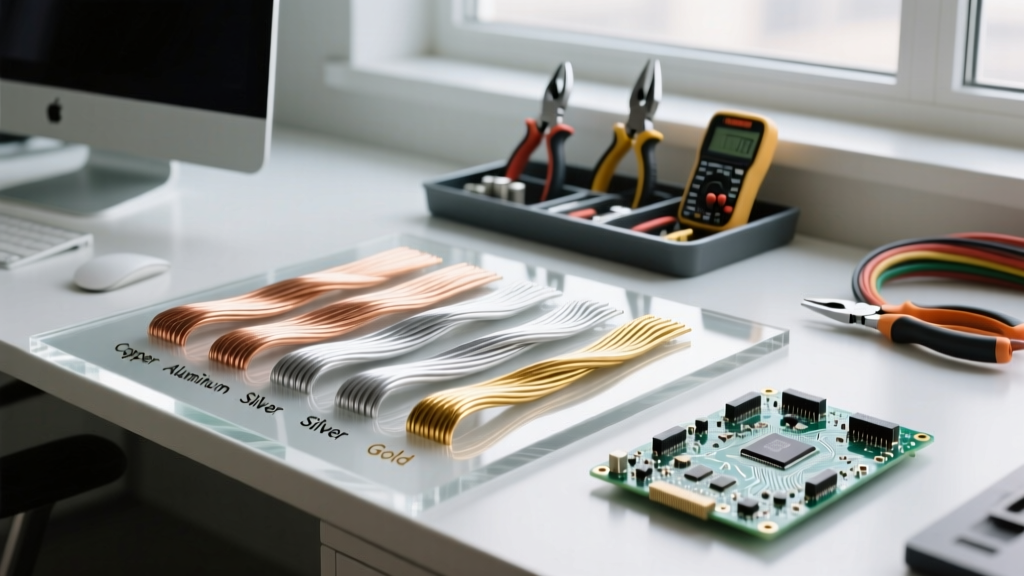
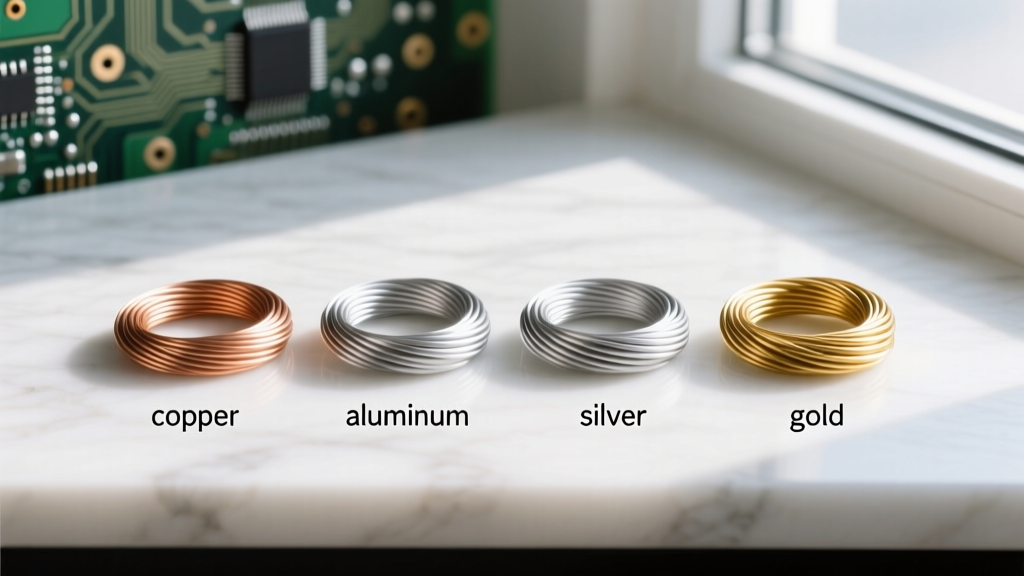
While the periodic table contains dozens of conductive elements, practical electrical engineering and DIY electronics rely almost exclusively on four metals. Here is how they stack up in real-world applications.
Silver (Ag) - The Benchmark
Silver possesses the highest electrical conductivity of all metals (approx. 6.30 × 10^7 S/m, or 105% IACS). Its electron structure allows for minimal scattering, making it the ultimate conductor. However, its prohibitive cost restricts its use to highly specialized applications: RF (radio frequency) contacts, high-end audio crossover networks, aerospace relays, and critical satellite components. A major drawback in humid environments is tarnishing; silver reacts with sulfur to form silver sulfide, which is poorly conductive and can increase contact resistance in low-voltage signal paths.
Copper (Cu) - The Industry Workhorse
Copper (5.96 × 10^7 S/m, 100% IACS) is the undisputed king of general-purpose wiring. It offers an optimal balance of high conductivity, ductility, and thermal stability. Because copper is highly ductile, it can be drawn into extremely fine AWG gauges (down to 40 AWG or smaller for specialized winding wire) without fracturing. For DIYers and professionals, you will typically encounter two grades:
- ETP (Electrolytic Tough Pitch): Contains about 0.04% oxygen. Standard for building wire (THHN/THWN) and general electronics.
- OFHC (Oxygen-Free High Conductivity): Processed to remove oxygen, preventing embrittlement at high temperatures. Used in high-vacuum environments and premium audio cables.
Aluminum (Al) - The Lightweight Alternative
Aluminum operates at roughly 61% of copper's conductivity (3.77 × 10^7 S/m) but weighs only 30% as much. This makes it the mandatory choice for overhead utility transmission lines where weight-to-strength ratio is critical. In residential and commercial wiring, aluminum is heavily used for service entrance cables and large feeder wires (e.g., 4/0 AWG) due to massive cost savings. However, the National Electrical Code (NEC) strictly mandates the use of AA-8000 series aluminum alloys for branch circuit wiring to mitigate historical issues with pure aluminum's mechanical instability. Article 310 of the NEC outlines the specific ampacity adjustments required for aluminum, which generally requires the wire to be sized one or two AWG steps larger than copper for the exact same ampacity.
Gold (Au) - The Corrosion Champion
Gold's conductivity (4.10 × 10^7 S/m, roughly 70% IACS) is actually lower than both copper and aluminum. So why use it? Gold is entirely immune to oxidation and corrosion. In electronics, gold is rarely used as a bulk wire; instead, it is applied as a micro-thin plating over copper or nickel on edge connectors, PCB pads, and audio jacks to ensure a reliable, low-resistance contact point over decades of use.
Material Showdown: Conductivity, Weight, and Cost Matrix
| Material | Conductivity (% IACS) | Density (g/cm³) | Cost Relative to Cu | Primary Use Case |
|---|---|---|---|---|
| Silver | 105% | 10.49 | ~70x Higher | RF contacts, aerospace, precision instruments |
| Copper | 100% | 8.96 | Baseline (1x) | Branch wiring, PCB traces, motor windings |
| Gold | 70% | 19.30 | ~100x Higher | Connector plating, IC bonding wires |
| Aluminum | 61% | 2.70 | ~0.4x (Cheaper) | Utility transmission, heavy feeder cables |
Real-World Failure Modes: When Conductors Fail
Understanding the physics of conductors is only half the battle; knowing how they fail separates novices from experts. When sizing wire or terminating connections, you must account for material-specific failure modes.
1. Aluminum Cold Creep and Thermal Expansion
Pure aluminum (and inferior alloys) exhibits "cold creep"—a tendency to slowly deform and flow away from pressure under a screw terminal. Combined with a higher coefficient of thermal expansion than copper or steel, aluminum wires expand when heated by load, and contract when cooled. Over hundreds of thermal cycles, the connection loosens, increasing resistance, generating excessive heat, and potentially causing an arc fault or fire. This is why modern codes require specific torque screwdrivers and CO/ALR rated terminals.
2. Galvanic Corrosion at Bi-Metallic Junctions
When copper and aluminum touch in the presence of an electrolyte (even ambient humidity), a galvanic cell is created. Aluminum, being more anodic, corrodes rapidly, forming a highly resistive aluminum oxide layer. If you must pigtail aluminum feeder wires to copper breaker lugs, you must use an anti-oxidant compound like Noalox and approved bi-metallic connectors. The Aluminum Association provides extensive guidelines on safe termination practices for their AA-8000 series alloys.
3. High-Frequency Skin Effect
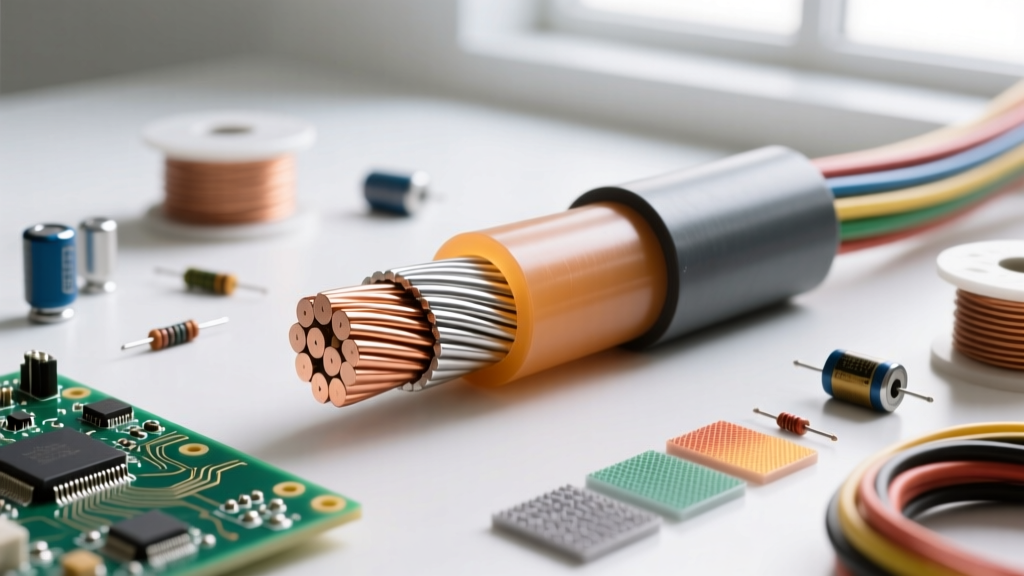
In AC circuits, especially at radio frequencies (RF), current tends to travel exclusively on the outer surface of the conductor—a phenomenon known as the skin effect. Because the core of the wire carries almost no current, engineers use silver-plated copper wire for high-frequency applications. The silver provides a highly conductive, low-resistance surface path, while the copper core maintains the wire's mechanical tensile strength and keeps costs down compared to solid silver.
Decision Framework: Selecting the Right Conductor for Your Build
Use this practical framework to select your conductor material for your next electrical or electronics project:
- For Residential Branch Circuits (15A/20A): Always use solid Copper (THHN/THWN-2). The material cost savings of aluminum do not outweigh the termination risks and larger conduit fill requirements at small gauges.
- For Heavy Feeders (100A+ Subpanels): Aluminum (AA-8000 series, XHHW-2) is the smart choice. It is significantly lighter, easier to pull through conduit, and costs roughly 40% less than equivalent ampacity copper. Just ensure you torque terminals to manufacturer specs.
- For Low-Voltage Audio/Video Signals: Use Oxygen-Free Copper (OFC). Avoid Copper-Clad Aluminum (CCA) for Cat6 or speaker wire, as CCA is brittle, possesses higher DC resistance, and is notorious for breaking at RJ45 crimps.
- For Micro-Controller I/O Pins: Standard ETP copper with tin or gold flash plating is sufficient. Gold plating prevents the "whisker" oxidation that can cause high-impedance faults in 3.3V logic circuits.
Expert Insight: Never assume a wire is copper just because it looks copper-colored. Scrap yards and DIYers frequently encounter Copper-Clad Aluminum (CCA). If you scrape the wire with a knife and see silver underneath, it is CCA. It must be sized differently and cannot be used for standard NEC branch circuits. Always source from reputable suppliers like the members listed in the Copper Development Association.
Summary
Ultimately, answering the question of what electrical conductors are goes beyond basic physics. It requires a practical understanding of metallurgy, economics, and safety codes. By matching the specific mechanical and electrical properties of silver, copper, gold, or aluminum to your exact application, you ensure maximum efficiency, longevity, and safety in your electrical systems.