
The Atomic Secret: Defining What Material Is a Conductor
When beginners in electronics or home wiring ask, "what material is a conductor," the answer is usually a simple list: copper, aluminum, silver, and gold. But to truly master electrical fundamentals, you must look past the surface and understand the atomic physics that dictate why these specific elements allow electricity to flow while others block it entirely.
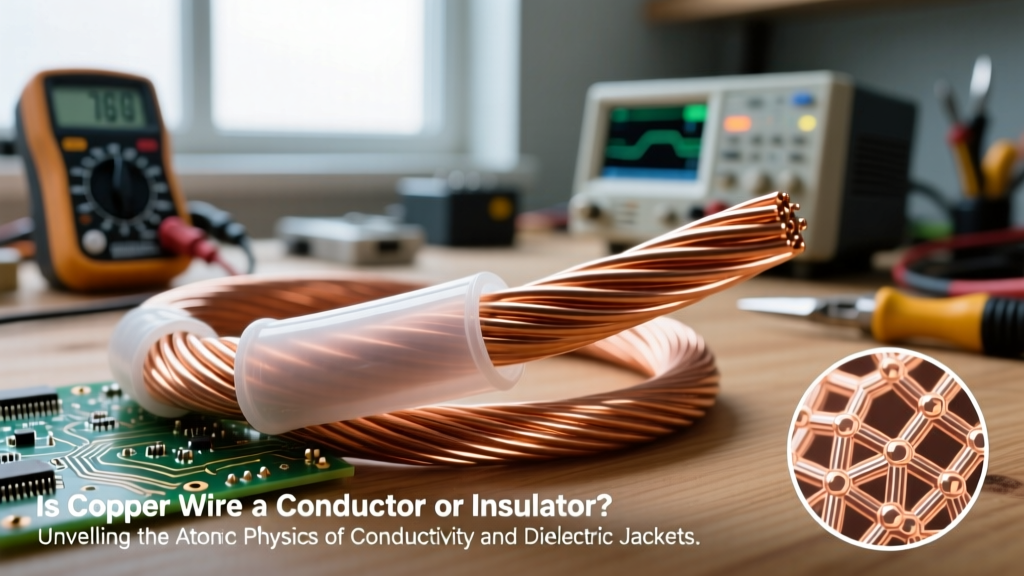
At the subatomic level, electrical conductivity is governed by a material's electron configuration, specifically the behavior of its valence electrons. In conductive materials, the outermost electrons are loosely bound to their parent atoms. According to the "electron sea" model of metallic bonding, these valence electrons detach and form a shared, mobile cloud around a lattice of positive metal ions. When a voltage (electromotive force) is applied across the material, this sea of free electrons drifts in a unified direction, creating an electrical current.
In solid-state physics, this is explained through Band Theory. Conductors have overlapping valence and conduction bands. There is no "bandgap" (an energy barrier that electrons must overcome to move freely). Because the bands overlap, even a minuscule amount of thermal or electrical energy is enough to push electrons into the conduction band, resulting in high conductivity at room temperature.
The Big Four: Standard Conductors in Electrical Wiring
While the periodic table contains dozens of metals, practical electrical engineering relies almost exclusively on four specific materials. Each is chosen based on a matrix of conductivity, tensile strength, weight, and cost.
Copper (The Undisputed Standard)
Copper is the baseline against which all other conductors are measured. The Copper Development Association designates Electrolytic Tough Pitch (ETP) copper, alloy C11000, as the standard for 100% conductivity on the International Annealed Copper Standard (IACS) scale. Copper's face-centered cubic crystal structure allows for excellent ductility, meaning it can be drawn into incredibly thin wires (down to AWG 40 and smaller) without snapping. For DIYers and electricians, copper's high melting point (1,085°C) and excellent thermal conductivity make it highly resistant to melting under short-circuit conditions.
Aluminum (The Utility & Feeder Workhorse)
Aluminum possesses roughly 61% of the conductivity of copper by volume, but it is less than a third of the weight. This makes it the undisputed king of overhead utility transmission lines. In residential wiring, aluminum is heavily used for large feeder cables (e.g., 2/0 AWG for 200-amp service panels). However, pure aluminum is too soft and prone to "creep" under pressure. Modern electrical codes require the use of AA-8000 series aluminum alloys for branch circuit wiring, which incorporate iron and copper to stabilize the metal's mechanical properties under terminal screws.
Silver (The High-Frequency Specialist)
Silver is the most electrically conductive element on Earth, rating at roughly 105% IACS. Despite its superior conductivity, its high cost relegates it to niche applications. In high-frequency RF (Radio Frequency) circuits and audio equipment, the "skin effect" forces alternating current to travel exclusively on the outer surface of the wire. To capitalize on this without the cost of solid silver, engineers use silver-plated copper wire, combining the tensile strength of copper with the ultra-low surface resistance of silver.
Gold (The Precision Contact)
Gold is actually a relatively poor conductor compared to copper (about 70% IACS). So why is it ubiquitous in electronics? The answer is corrosion resistance. Unlike silver, which forms silver sulfide (tarnish), or copper, which forms copper oxide, gold is a noble metal. It does not oxidize in normal atmospheric conditions. This makes it the mandatory choice for low-voltage, low-current applications like PCB edge connectors, HDMI pins, and audio jacks, where even a microscopically thin layer of oxide would block the signal entirely.
Conductivity vs. Reality: A Material Comparison Matrix
Understanding the theoretical conductivity of a material is only half the battle. The table below illustrates how real-world physical properties dictate material selection in electrical engineering.
| Material | IACS Conductivity | Resistivity (nΩ·m at 20°C) | Density (g/cm³) | Primary Application |
|---|---|---|---|---|
| Silver (Ag) | 105% | 15.9 | 10.49 | RF coaxial cables, high-end audio contacts |
| Copper (Cu) | 100% (Baseline) | 17.2 | 8.96 | Branch wiring, PCB traces, motor windings |
| Gold (Au) | 70% | 22.4 | 19.30 | Low-voltage data connectors, IC bonding wires |
| Aluminum (Al) | 61% | 28.2 | 2.70 | Utility transmission, heavy residential feeders |
| Tungsten (W) | 31% | 52.8 | 19.25 | Incandescent filaments, high-temp environments |
Why Insulators and Semiconductors Behave Differently
To fully grasp what material is a conductor, you must understand its opposites. In insulators (like PVC, rubber, and glass), the valence electrons are tightly bound to their atoms. In Band Theory terms, insulators possess a massive bandgap (typically greater than 5 electron volts). Normal voltages cannot provide enough energy to push electrons across this gap, resulting in effectively zero current flow.
Semiconductors (like silicon and germanium) sit in the middle. They have a small bandgap (around 1.1 eV for silicon). At absolute zero, they act as insulators. But at room temperature, ambient thermal energy is enough to excite some electrons into the conduction band. More importantly, by "doping" the material with specific impurities (like phosphorus or boron), engineers can precisely control its conductivity, forming the basis of all modern transistors and microcontrollers.
Real-World Failure Modes: When Good Conductors Go Bad
Even the best conductive materials will fail if installed incorrectly. As a DIYer or technician, you must be aware of the chemical and mechanical vulnerabilities of these metals.
Aluminum Creep and Cold Flow
Historically, aluminum wiring in the 1970s caused widespread house fires. This was due to "cold flow" or "creep"—the tendency of pure aluminum to slowly deform and shrink away from terminal screws over time when subjected to heat cycles and constant pressure. This loosening created high-resistance arcing faults. Modern AA-8000 series alloys and CO/ALR (Copper/Aluminum Revised) rated terminals have largely solved this, but torque screwdrivers are now strictly mandated by the National Electrical Code (NFPA 70) to ensure exact terminal pressure.
The Aluminum Oxide Barrier
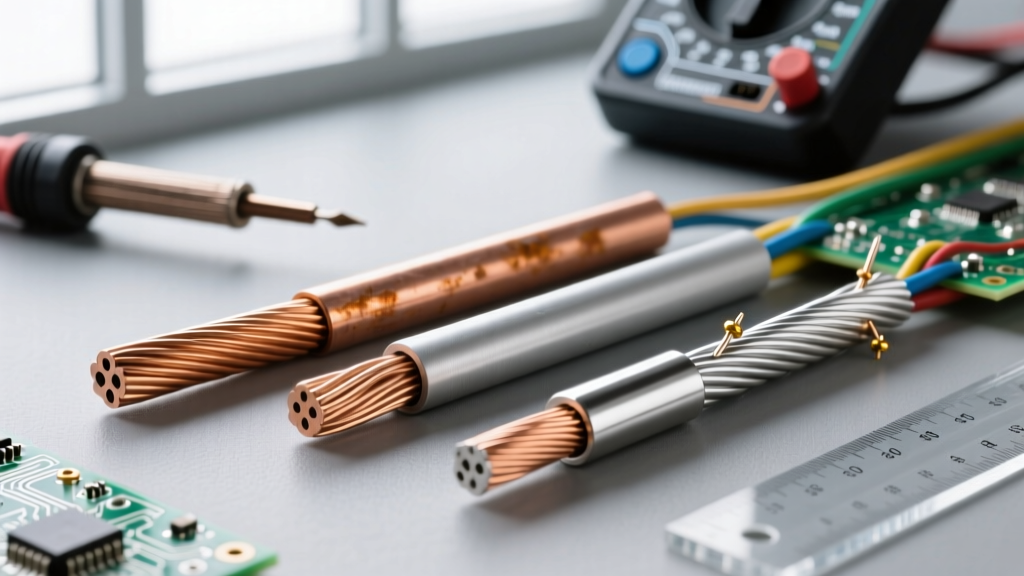
When bare copper is exposed to air, it forms copper oxide, which is still mildly conductive. When aluminum is exposed to air, it instantly forms aluminum oxide (Al2O3). Aluminum oxide is a hardcore electrical insulator (it is literally used as a ceramic insulator in spark plugs). If you strip an aluminum wire and let it sit before terminating it, the insulating oxide layer will cause severe voltage drop and heating at the connection. This is why wires must be cleaned and immediately coated with an antioxidant inhibitor paste (like Noalox) before termination.
Galvanic Corrosion at Bimetallic Junctions
Connecting copper and aluminum directly together in the presence of moisture creates a galvanic cell. Because aluminum is much higher on the anodic index than copper, the aluminum will rapidly corrode and dissolve, leading to catastrophic connection failure. You must never splice copper and aluminum directly; always use a listed bimetallic lug or a specialized connector rated for CU/AL splicing.
Practical Sizing and Selection Rules for DIYers
When designing a circuit or repairing a device, follow these fundamental selection rules:
- For standard indoor branch circuits (15A to 60A): Always use solid or stranded copper (THHN/THWN-2). It is the most reliable, easiest to terminate, and requires the smallest physical wire gauge.
- For heavy feeders (100A to 200A+): XHHW-2 insulated aluminum is highly recommended. It is significantly cheaper and lighter than copper, and perfectly safe when torqued to manufacturer specifications.
- For high-frequency or RF applications: Look for silver-plated copper wire with PTFE (Teflon) insulation to minimize dielectric losses and skin effect resistance.
- For low-voltage data/signal connectors: Ensure contact surfaces are gold-plated to prevent signal degradation from microscopic oxidation over time.
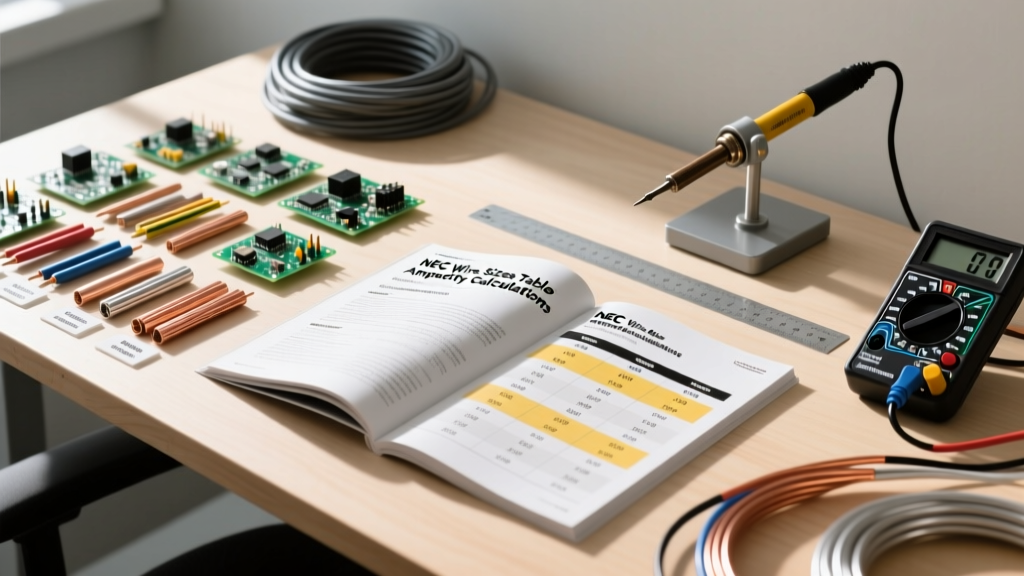
Expert Insight: Never size a conductor based solely on its theoretical conductivity. Real-world ampacity is dictated by the insulation material's thermal rating, the ambient temperature of the installation environment, and the number of current-carrying conductors bundled in a raceway. Always consult NEC Table 310.16 for final derating calculations.
Understanding what material is a conductor is the first step toward mastering electrical design. By respecting the atomic properties, mechanical limits, and chemical vulnerabilities of copper, aluminum, silver, and gold, you ensure your projects are not only functional but safe and built to last.