
When designing electrical circuits, selecting the right conductive material is just as critical as calculating the correct wire gauge. The flow of electrical current relies on the movement of free valence electrons, and different metals offer vastly different levels of resistance, thermal dissipation, and mechanical durability. While many DIYers and junior engineers default to standard copper, a deeper understanding of material science reveals that alternative metals often provide superior solutions for specific high-voltage, high-frequency, or weight-sensitive applications.
In this comprehensive comparison guide, we will evaluate some examples of conductors that dominate the electrical industry. By analyzing their atomic properties, real-world failure modes, and cost-to-performance ratios, you will be equipped to make data-driven decisions for your next wiring or PCB design project.
The Physics of Conductivity and the IACS Standard
Before comparing specific metals, we must establish a baseline for measurement. Electrical conductivity is determined by a material's atomic lattice structure and the availability of free electrons in its outermost shell. In metals, these electrons form a 'sea' that moves freely when an electromotive force (voltage) is applied.
To standardize comparisons, the electrical engineering industry uses the International Annealed Copper Standard (IACS). Established in 1913, the IACS defines the conductivity of annealed copper as exactly 100%. Consequently, a material with an IACS rating of 61% conducts electricity at 61% of the efficiency of pure annealed copper. This metric is vital when calculating voltage drop and sizing conductors for specialized applications.
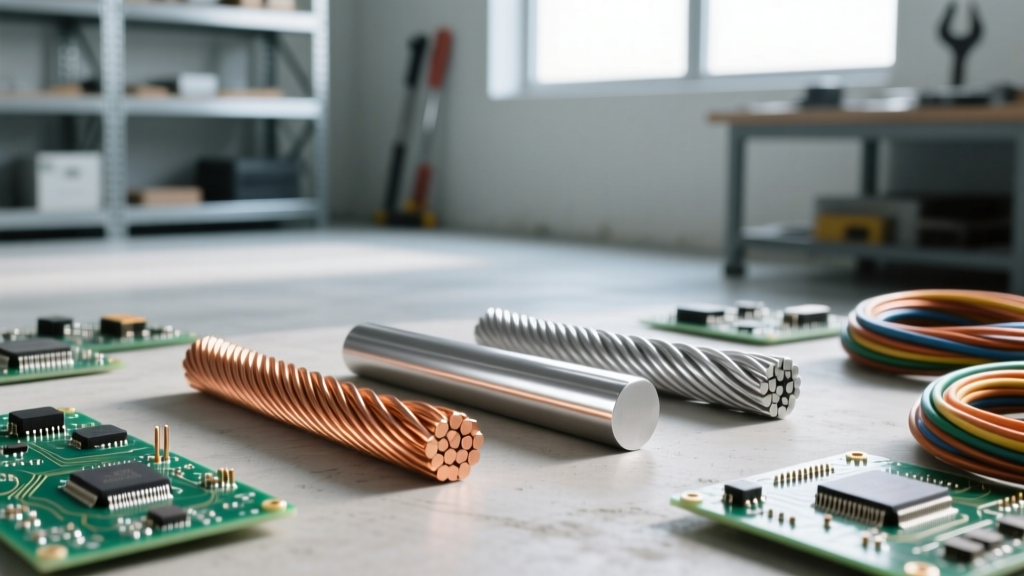
Evaluating Some Examples of Conductors: The Core Trio
Copper (Cu): The Uncompromising Baseline
Copper remains the undisputed king of general-purpose electrical wiring, boasting an IACS rating of 100% (with some oxygen-free variants reaching 101%). Its face-centered cubic crystal lattice allows for exceptional electron mobility. In commercial and residential wiring, Electrolytic Tough Pitch (ETP) copper, specifically alloy C11000, is the standard.
However, copper is not without drawbacks. It is heavy (density of 8.96 g/cm³) and subject to significant price volatility tied to global mining outputs. Furthermore, at high radio frequencies (RF), copper is susceptible to the skin effect, where alternating current is forced to the outer periphery of the conductor, effectively increasing its AC resistance compared to its DC resistance.
Aluminum (Al): The High-Voltage and Feeder Specialist
Aluminum offers an IACS rating of approximately 61%, meaning it is a poorer conductor than copper by volume. However, aluminum is roughly 30% lighter than copper. This yields a superior conductivity-to-weight ratio, making it the mandatory choice for overhead high-voltage transmission lines where structural tower load is a primary concern.
In building wire applications, the National Fire Protection Association (NFPA 70 / NEC) strictly requires the use of AA-8000 series aluminum alloys for branch circuits and feeders. Pure aluminum suffers from 'cold creep' (gradual deformation under pressure) and high thermal expansion, which historically caused loose connections and fires. Modern AA-8000 alloys incorporate iron and copper trace elements to stabilize the metal, mitigating creep while maintaining cost advantages for large-gauge feeders (typically 2/0 AWG and larger).
Silver (Ag): The High-Frequency and Aerospace Elite
Silver is the most electrically and thermally conductive element on the periodic table, with an IACS rating of roughly 106%. Despite its superior performance, its exorbitant cost restricts its use to highly specialized applications. Silver is frequently used in aerospace wiring, high-end RF coaxial cables, and critical switchgear contacts.
A unique advantage of silver is its oxidation profile. While copper oxide is a stubborn electrical insulator that causes high contact resistance, silver sulfide (the tarnish that forms on silver) remains highly conductive. This makes silver-plated copper wire ideal for environments where micro-voltage drops across connections can ruin signal integrity.
Material Showdown: Technical Specifications Matrix
The following table compares the fundamental electrical and physical properties of the most common conductive metals used in electrical engineering.
| Material | IACS Rating | Resistivity at 20°C (nΩ·m) | Density (g/cm³) | Relative Cost | Primary Application |
|---|---|---|---|---|---|
| Silver (Ag) | 106% | 15.9 | 10.49 | $$$$$ | RF circuits, aerospace, switch contacts |
| Copper (Cu) | 100% | 16.8 | 8.96 | $$$ | Branch wiring, PCB traces, motors |
| Gold (Au) | 70% | 24.4 | 19.30 | $$$$$ | Edge connectors, IC bonding wires |
| Aluminum (Al) | 61% | 26.5 | 2.70 | $ | Transmission lines, heavy feeders |
| Tungsten (W) | 31% | 52.8 | 19.25 | $$ | Filaments, high-heat environments |
Niche Conductors in Specialized Electrical Engineering
Gold (Au) and Contact Resistance
While gold's IACS rating of 70% makes it a mediocre bulk conductor, it is entirely immune to oxidation and corrosion. In low-voltage, low-current digital electronics (such as HDMI connectors, PCIe slots, and audio jacks), the signal must pass through mating surfaces. Even a microscopic layer of copper oxide can block a 3.3V logic signal. Gold plating ensures near-zero contact resistance over thousands of mating cycles. According to the Copper Development Association, gold is almost never used for bulk wire, but rather as a micro-thin protective finish over a copper or beryllium-copper substrate.
Tungsten and Nichrome for Thermal Applications
Sometimes, high conductivity is undesirable. In heating elements, toasters, and industrial furnaces, engineers require materials with high resistivity that will not melt or oxidize at extreme temperatures. Nichrome (an alloy of nickel and chromium) and Tungsten are utilized specifically because they resist electron flow, converting electrical energy into thermal energy while maintaining structural integrity at glowing red-hot temperatures.
Real-World Failure Modes and Material Degradation
Understanding how conductors fail is paramount for long-term system reliability. Each metal degrades differently under electrical and environmental stress:
- Aluminum Creep and Galvanic Corrosion: When aluminum wire is terminated under a copper lug, the dissimilar metals create a galvanic cell in the presence of atmospheric moisture. The aluminum acts as an anode and corrodes rapidly. This is why bi-metallic lugs and antioxidant pastes (like Noalox) are mandatory for Al-to-Cu terminations.
- Copper Oxidation: Cupric oxide (CuO) is a semiconductor, and cuprous oxide (Cu2O) is an insulator. In high-temperature environments, un-tinned copper busbars will develop an oxide layer that increases joint resistance, leading to thermal runaway and eventual melting.
- Silver Migration: In high-humidity, high-voltage DC environments (such as photovoltaic solar arrays), silver can undergo electromigration. Silver ions dissolve in moisture and plate out toward the cathode, eventually forming a conductive dendrite that causes a short circuit across the PCB or panel.
Engineering Maxim: 'A conductor is only as reliable as its termination.' The vast majority of electrical fires attributed to 'bad wiring' are actually the result of improper termination techniques, incorrect torque values, or failure to account for the thermal expansion coefficients of dissimilar metals.
Practical Decision Framework for Wire Sizing
When designing a system or sizing wire for a DIY project, use this decision matrix to select the appropriate conductive material:
- Choose Copper when: You are wiring residential branch circuits (14 AWG to 6 AWG), designing compact PCBs, building high-efficiency motors, or working in environments where space is at a premium and voltage drop must be minimized.
- Choose Aluminum when: You are running long, heavy-gauge feeder cables (e.g., 2/0 AWG to 500 kcmil) to a detached garage or sub-panel. The cost savings on the wire and the reduced weight will vastly outweigh the requirement to step up one or two gauge sizes to compensate for the 61% IACS rating.
- Choose Silver-Plated Copper when: You are designing RF transmission lines, aerospace harnesses, or high-fidelity audio interconnects where the skin effect dictates that high-frequency currents will only travel on the extreme outer edge of the wire.
Ultimately, evaluating some examples of conductors reveals that there is no single 'perfect' metal. Electrical engineering is the art of compromise—balancing the atomic realities of electron flow against the practical constraints of budget, weight, and environmental exposure. By matching the material's inherent properties to your specific application requirements, you ensure maximum efficiency, safety, and longevity for your electrical systems.