
The Fundamental Chemistry of DIY Power Sources
Every DIY electronics project, from a simple blinking LED to a complex IoT sensor network, relies on a stable DC power source. While wall adapters work for bench testing, portable projects demand batteries. Understanding the different types of batteries is a core electrical fundamental that bridges the gap between basic circuit theory and real-world deployment.
At their core, batteries are electrochemical cells that convert stored chemical energy into electrical energy. They consist of an anode (negative terminal), a cathode (positive terminal), and an electrolyte that allows ions to flow between them. When you connect a load—like an Arduino or a DC motor—a chemical reaction forces electrons through your external circuit, creating current. However, not all chemistries behave the same way under load, and choosing the wrong type can lead to premature project failure, voltage brownouts, or even thermal runaway.
Primary vs. Secondary Cells: The Great Divide
Before diving into specific chemistries, it is crucial to understand the two main categories of batteries:
- Primary Cells (Non-Rechargeable): The electrochemical reaction is irreversible. Once the reactants are depleted, the battery is dead. They offer high energy density and long shelf life but are wasteful for high-drain DIY projects.
- Secondary Cells (Rechargeable): The chemical reaction is reversible. By applying an external electrical current, the battery's chemical state is restored. These are the backbone of modern portable electronics and robotics.
Deep Dive: The Most Common Types of Batteries in Electronics
1. Lithium-Ion (Li-ion) Cylindrical Cells (18650, 21700)
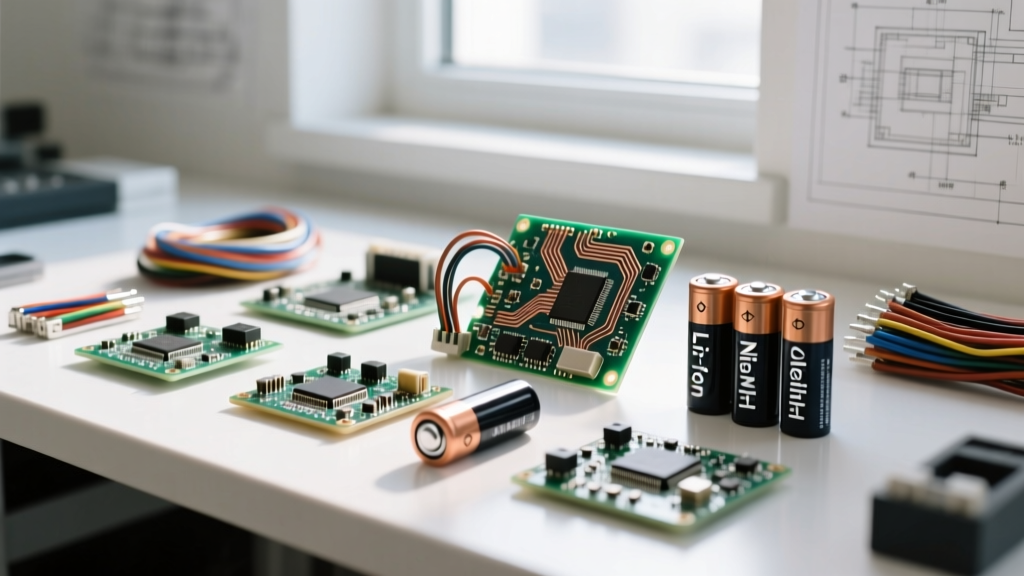
Lithium-ion batteries dominate the DIY space, particularly in the 18650 (18mm diameter, 65mm length) and 21700 form factors. They boast a nominal voltage of 3.7V, a maximum charge voltage of 4.2V, and a safe discharge cutoff around 3.0V.
DIY Application: Powering high-draw projects like Raspberry Pi clusters, motorized robotics, and high-lumen flashlights. According to Battery University, Li-ion cells offer one of the highest energy densities among commercial chemistries, making them ideal when weight and space are at a premium.
Expert Tip: Always use a dedicated charging IC like the TP4056 for single-cell Li-ion charging. Never attempt to charge a Li-ion cell with a standard constant-voltage bench supply without strict current limiting and voltage cutoffs.
2. Lithium Polymer (LiPo) Pouch Cells
LiPo batteries use a polymer gel electrolyte and are housed in flexible foil pouches. They share the same 3.7V nominal voltage as Li-ion but can be manufactured in virtually any flat shape. They are also capable of massive discharge rates, measured in 'C-ratings'.
DIY Application: FPV drones, RC cars, and ultra-slim wearable electronics. A 50C, 1500mAh LiPo can theoretically deliver 75 Amps continuously without voltage sag, which is essential for brushless ESCs.
3. Nickel-Metal Hydride (NiMH)
NiMH cells are the standard for rechargeable AA and AAA batteries. They have a nominal voltage of 1.2V (compared to 1.5V for alkaline). While older NiMH cells suffered from high self-discharge, modern Low Self-Discharge (LSD) variants, like the Panasonic Eneloop, retain 85% of their charge after a year in storage.
DIY Application: Low-cost sensor nodes and 5V logic circuits. Four NiMH cells in series provide 4.8V, which is perfect for feeding directly into a 5V Arduino Nano without needing a complex boost converter.
4. Lithium Coin Cells (CR2032)
These primary (non-rechargeable) lithium metal cells provide a stable 3.0V. They have excellent shelf lives (up to 10 years) but suffer from high internal resistance, meaning they cannot supply high burst currents.
DIY Application: Real-Time Clock (RTC) modules, CMOS memory backup, and ultra-low-power deep-sleep ESP32 sensor nodes that only wake up for a few milliseconds to transmit a BLE beacon.
Battery Chemistry Comparison Chart
| Chemistry | Nominal Voltage | Energy Density | Rechargeable? | Best DIY Use Case |
|---|---|---|---|---|
| Alkaline (AA) | 1.5V | Low | No | Low-drain prototyping, basic LED circuits |
| NiMH (AA) | 1.2V | Medium | Yes | 5V Microcontrollers, basic robotics |
| Li-ion (18650) | 3.7V | High | Yes | High-power projects, Pi, motors |
| LiPo (Pouch) | 3.7V | High | Yes | Drones, wearables, high burst-current |
| Lithium Coin | 3.0V | Low (Volumetric) | No | RTC backup, deep-sleep IoT sensors |
Voltage Regulators and Battery Discharge Curves
One of the most common mistakes beginners make when evaluating types of batteries is ignoring the discharge curve. A battery's voltage is not static; it drops as it discharges.
For example, an Alkaline AA cell starts at roughly 1.6V but quickly drops to 1.2V, eventually dying at 0.9V. If you are using a standard Low Dropout (LDO) regulator to step down to 3.3V for an ESP8266, three alkaline cells in series (4.8V down to 2.7V) will cause your microcontroller to brownout and reset once the pack drops below 4.0V, leaving 40% of the battery's capacity completely unusable.
Conversely, a Li-ion cell holds a relatively flat curve around 3.7V for 80% of its discharge cycle before dropping off a cliff. This makes it vastly superior for modern 3.3V logic boards when paired with a high-efficiency buck-boost converter.
How to Size a Battery for Your Microcontroller Project
To calculate your required battery capacity, use the fundamental runtime formula:
Runtime (Hours) = Battery Capacity (mAh) / Average Load Current (mA)
Real-World Example: You are building a weather station using an ESP32. In active Wi-Fi transmission mode, it draws roughly 240mA. If you use a 2000mAh 18650 cell, the naive math suggests 8.3 hours of runtime. However, you must account for the efficiency of your DC-DC buck converter (typically 85%).
Adjusted Runtime = (2000mAh * 0.85) / 240mA = 7.08 hours.
If you need the project to run for a month, you must utilize the ESP32's deep sleep modes, reducing the average current draw to microamps, which fundamentally changes the battery chemistry requirement toward primary Lithium cells due to their micro-amp self-discharge profiles.
Crucial Safety Protocols for Lithium Chemistries
When working with secondary lithium chemistries, safety is non-negotiable. According to technical safety data from Energizer and independent testing labs, mishandling Li-ion and LiPo cells can result in catastrophic thermal runaway.
- Never Over-Discharge: Dropping a Li-ion cell below 2.5V can cause copper shunt dissolution inside the cell. If you recharge it, internal short circuits can form, leading to fires.
- Use a BMS: Always integrate a Battery Management System (BMS) or a protection PCB (featuring a DW01A IC and FS8205A MOSFETs) to physically disconnect the cell during over-current, over-charge, or under-voltage events.
- Physical Damage: Puncturing a LiPo pouch introduces oxygen and moisture to the reactive lithium and electrolyte, resulting in immediate venting of toxic, highly flammable gases.
Final Thoughts on Selecting Your Power Source
Mastering the different types of batteries elevates your DIY projects from fragile prototypes to robust, field-ready devices. For high-current robotics and single-board computers, stick to protected 18650 Li-ion cells. For ultra-slim wearables, leverage LiPo pouches. And for low-power, set-and-forget environmental sensors, rely on the stable, long-lasting chemistry of CR2032 lithium coin cells. Always match the battery's internal resistance and discharge curve to your specific microcontroller's voltage regulator requirements for optimal efficiency.