
The 'Single Face' Misnomer: Understanding Single-Phase Power
If you have ever used voice search or encountered a translation error, you might have searched for "single face electricity." In the electrical trade, the correct terminology is single-phase electricity. This is the standard alternating current (AC) power delivered to residential homes and light commercial buildings across the globe. Whether you are wiring a 120V receptacle in North America or a 230V outlet in Europe, understanding the physics, safety hazards, and National Electrical Code (NEC) requirements of single-phase power is a matter of life and death.
Unlike three-phase power, which uses three offset sine waves to deliver continuous, high-density power to industrial motors, single-phase power relies on a single alternating voltage sine wave. In a 60Hz system (standard in the US), the voltage crosses zero and peaks 120 times per second. This pulsing nature dictates how we size wires, manage arc flashes, and design grounding systems.
The Lethality of RMS vs. Peak Voltage
A critical safety concept often overlooked by DIYers is the difference between RMS (Root Mean Square) voltage and Peak voltage. When you measure a standard North American wall outlet with a multimeter, it reads 120V RMS. However, the actual peak voltage of that sine wave reaches approximately 170V (120V x √2).
Why does this matter for safety? Because the dielectric breakdown of human skin and the insulation on older wiring is tested against the peak voltage, not the RMS. A shock from a 120V single-phase circuit is a 170V peak shock. This is more than enough to induce ventricular fibrillation if the current path crosses the chest. Always treat single-phase circuits with the same respect as higher-voltage systems.
Anatomy of a Single-Phase Circuit: Hot, Neutral, and Ground
To safely troubleshoot or install single-phase circuits, you must intimately understand the conductor roles as defined by NFPA 70 (NEC).
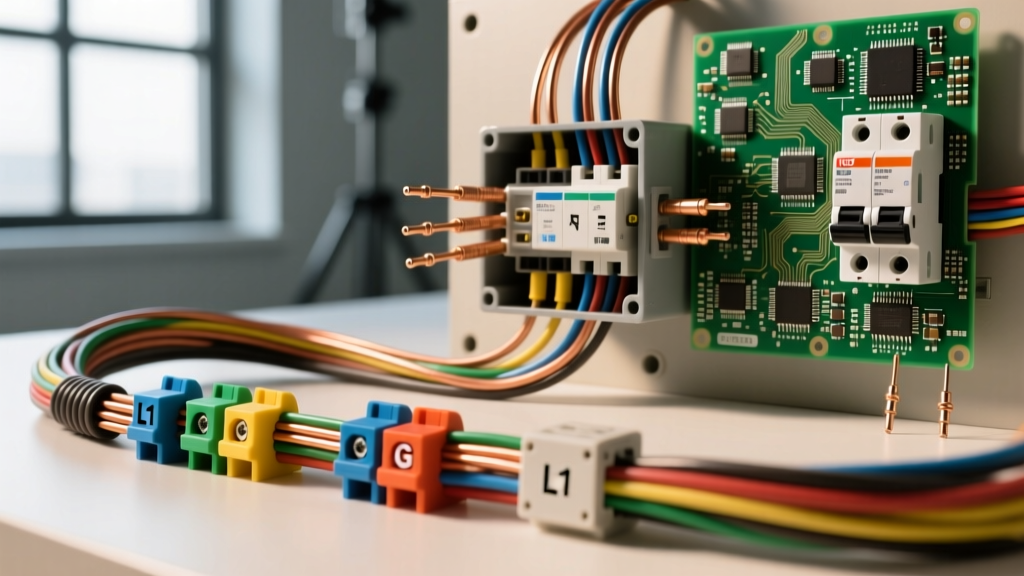
- Ungrounded Conductor (Hot): Typically black or red. This carries the alternating current from the source to the load. It is the primary shock hazard.
- Grounded Conductor (Neutral): Strictly white or gray per NEC Article 200.6. This provides the return path to the transformer. Safety Warning: A disconnected neutral can become energized, making it just as lethal as the hot wire.
- Equipment Grounding Conductor (EGC): Bare copper or green. This is your silent lifesaver. It does not carry current under normal operation; it exists solely to clear faults by providing a low-impedance path back to the panel, tripping the breaker instantly.
Critical Safety Protocols: Testing and Lockout/Tagout
Before touching a single-phase wire, you must verify the absence of voltage. Relying solely on a non-contact voltage tester (NCVT) is a fatal mistake. NCVTs detect capacitive coupling and can give false negatives on shielded cables or false positives from adjacent live wires.
Expert Safety Directive: Always use a True-RMS digital multimeter rated for the environment. For residential single-phase panels, a CAT III 600V rated meter (like the Fluke 117) is mandatory. Read more about measurement categories and arc flash safety to ensure your meter will not explode in your hands during a short circuit.
Furthermore, adhere strictly to OSHA's Lockout/Tagout (LOTO) procedures. Turn off the breaker, apply a physical lock, and test your meter on a known live source (Prove-Test-Prove method) before assuming a circuit is dead.
Wire Sizing and Breaker Matching Matrix
Overheating and electrical fires in single-phase systems are almost always the result of mismatched wire gauges and overcurrent protection devices (OCPDs). The following matrix is based on NEC Table 310.16 for 60°C rated terminations (standard for most residential breakers and receptacles).
| Wire Gauge (AWG) | Copper Ampacity (60°C) | Max Breaker Size | Common Single-Phase Application |
|---|---|---|---|
| 14 AWG | 15 Amps | 15A | General lighting, standard 120V receptacles |
| 12 AWG | 20 Amps | 20A | Kitchen/bathroom small appliance circuits, window AC units |
| 10 AWG | 30 Amps | 30A | Electric water heaters, 120V RV hookups, dryers (if 30A rated) |
| 8 AWG | 40 Amps | 40A | Heavy-duty 240V single-phase loads, EV Level 2 chargers |
Note: Never use a 20A breaker on 14 AWG wire. Even if the load only draws 16A, a fault condition could melt the 14 AWG insulation before the breaker trips, causing a concealed wall fire.
The Silent Killer: Open Neutral Hazards on MWBCs
One of the most dangerous scenarios in single-phase residential wiring involves Multi-Wire Branch Circuits (MWBCs). An MWBC uses two hot wires (on opposite phases of a split-phase system) sharing a single neutral wire.
If the shared neutral becomes disconnected (an "open neutral") at the panel or a junction box, the two 120V circuits no longer return to ground independently. Instead, they form a series 240V circuit across the connected loads. If you have a 10W LED bulb on one leg and a 1500W space heater on the other, the massive resistance imbalance will push nearly the full 240V through the LED bulb, causing it to explode or ignite surrounding materials. Always use a handle-tie or a 2-pole breaker to ensure both hot legs of an MWBC are disconnected simultaneously, preventing open-neutral shock hazards during servicing.
Grounding vs. Bonding: Clearing the Fault
Many confuse grounding with bonding, but in single-phase safety, they serve distinct roles. Grounding connects the electrical system to the earth (via ground rods or ufer grounds) to stabilize voltage from lightning and utility surges. Bonding connects all metallic, non-current-carrying parts together.
If a hot single-phase wire frays and touches the metal casing of a washing machine, bonding ensures the metal casing has a low-impedance path back to the neutral bus bar. This creates a massive, instantaneous short circuit (hundreds of amps), which forces the magnetic trip in the breaker to snap open in milliseconds. Without proper bonding, the metal casing remains energized at 120V, waiting for a person to touch it and complete the circuit to the earth.
Final Troubleshooting Checklist for Single-Phase Receptacles
When diagnosing a faulty 120V single-phase outlet, use your multimeter to measure these three points:
- Hot to Neutral: Should read 115V - 125V. (Lower indicates voltage drop or loose connection).
- Hot to Ground: Should read 115V - 125V. (Confirms the EGC is intact back to the panel).
- Neutral to Ground: Should read less than 2V. If this reads high (e.g., 5V to 10V), you have a loose neutral, an overloaded circuit suffering from severe voltage drop, or an illegal neutral-ground bond downstream of the main panel.
Mastering these single-phase fundamentals ensures that your electrical projects remain safe, code-compliant, and functional for decades.