
In commercial electrical construction and industrial control panel manufacturing, terminology can sometimes blur the lines between handheld tools and permanent components. When panel builders, HVAC technicians, and building automation systems (BAS) integrators refer to a 'wire strip,' they are typically talking about a terminal strip, barrier block, or DIN-rail terminal block assembly. When engineering heavy-duty commercial HVAC control panels or complex lighting distribution boards, understanding exactly why the multiple positions on a wire strip are required for specific circuit distributions is the difference between a clean, UL-listed panel and a chaotic, dangerous fire hazard.
Decoding the Commercial Terminal Strip
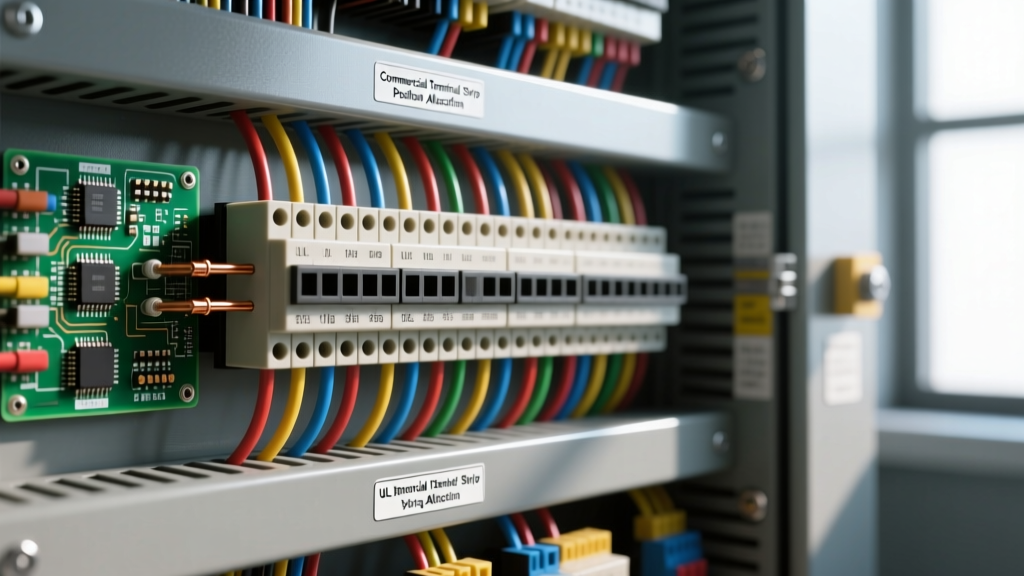
A commercial terminal strip (often colloquially called a wire strip or barrier strip) is a modular block of electrically isolated termination points. Unlike residential wire nuts or push-in connectors, commercial strips are designed for high-vibration environments, frequent maintenance access, and strict voltage separation. The 'positions' (or poles/ways) on these strips are not merely redundant connection points; they serve highly specific architectural roles within a control enclosure.
According to the NFPA 70 (NEC) Article 409 regarding Industrial Control Panels, wiring within an enclosure must be arranged to prevent overheating, allow for proper bending radii, and maintain strict isolation between different voltage classes. The multiple positions on a wire strip are required for achieving this physical and electrical segregation while allowing for necessary signal branching.
Strategic Position Allocation in a 480V/24V Commercial Panel
To understand why a single continuous strip requires dozens of individual positions, we must look at how a commercial HVAC control panel (e.g., for a 20-ton Rooftop Unit) is wired. A standard 12-position or 24-position barrier strip is divided into functional zones.
| Position(s) | Function | Voltage Class | Wire Gauge / Type |
|---|---|---|---|
| 1 - 3 | Line Voltage Incoming (L1, L2, L3) | 480V AC | 10 AWG THHN |
| 4 | Safety Ground (PE) Bus | Ground | 10 AWG Green |
| 5 - 6 | Control Transformer Primary | 480V AC | 14 AWG THHN |
| 7 | Isolation Barrier (Empty/Jumper) | N/A | N/A |
| 8 - 9 | Control Voltage Distribution (24VAC) | 24V AC | 18 AWG MTW |
| 10 - 12 | BAS Signal / Sensor Returns (Common) | 0-10V DC / 24V AC | 18 AWG Shielded |
The Necessity of Signal Branching and Jumpers
One of the primary reasons the multiple positions on a wire strip are required for commercial wiring is signal branching. A single 24VAC control signal from a transformer might need to feed a thermostat, a contactor coil, and a BAS relay simultaneously. By utilizing multiple positions linked together via a jumper bar (such as the Phoenix Contact FBS 2-5 cross-connector), electricians can create a secure, vibration-resistant distribution bus without daisy-chaining wires under a single screw terminal, which violates most manufacturer specifications and UL listings.
UL 508A Spacing: Creepage and Clearance Requirements
When working with mixed-voltage commercial panels, the physical spacing between positions on a wire strip becomes a matter of life safety and code compliance. The UL 508A Standard for Industrial Control Panels dictates strict creepage (surface distance) and clearance (air distance) requirements between different voltage potentials.
- Over 300V to Ground: Requires significantly larger barrier walls between positions to prevent arc tracking across dust or moisture.
- Pollution Degree 2 & 3: In harsh commercial environments (like wastewater treatment plants or commercial kitchens), terminal strips must feature deep grooves and high barriers between positions to increase the creepage distance, preventing short circuits caused by conductive debris.
- Isolation Positions: Often, an empty position on a wire strip is intentionally left blank to serve as a physical air gap between a 480V line position and a 24V control position.
Real-World Product Specs: Marathon vs. Phoenix Contact
Choosing the right multi-position strip depends heavily on the application. Let us compare two industry standards used in commercial wiring:
Marathon 8TB Series (Class CC & J Power Terminal Blocks)
Marathon barrier strips are the workhorses of heavy commercial power distribution. A 12-position Marathon block rated for 115A features massive phenolic barriers between each position. These multiple positions are required for landing heavy-gauge feeder wires (up to 1/0 AWG) and distributing them to multiple branch circuit breakers. The deep wire wells and robust M8 screws ensure that high-strand-count copper wires are fully captured without fraying.
Phoenix Contact CLIPLINE UTTB 2.5 (Multi-Level DIN Blocks)
For high-density commercial BAS panels, space is at a premium. The UTTB 2.5 series offers double-level terminal blocks. Here, the multiple positions are required for maximizing termination density on a standard 35mm DIN rail. A single 6mm wide block provides four connection points across two levels, allowing panel builders to route 48 individual control signals in the space that a traditional barrier strip would use for just 12.
Torque Specifications and Cold Flow Failures
A critical, often overlooked aspect of multi-position terminal strips is the termination torque. When landing wires on positions 1 through 12 of a commercial barrier strip, electricians frequently rely on 'feel' rather than a calibrated torque screwdriver. This leads to catastrophic failure modes.
"Over-torquing a terminal strip screw can strip the brass threading or damage the wire strands, while under-torquing leads to thermal expansion and contraction cycles that eventually loosen the connection, causing arcing and panel fires."
For standard M4 screws on a commercial control terminal strip, the manufacturer typically specifies a torque of 1.5 to 2.0 Nm. For larger power terminal blocks (M8 screws), torque values can exceed 12 Nm. Furthermore, if aluminum wire is used in commercial feeders, the multiple positions on a wire strip are required for accommodating the 'cold flow' (creep) of aluminum, necessitating periodic re-torquing or the use of spring-cage terminal technology (like Wago TOPJOB S) which maintains constant pressure regardless of thermal cycling.
Troubleshooting Multi-Position Strip Failures
When a commercial system fails, the terminal strip is often the first place to investigate. Here are the most common failure modes associated with multi-position strips:
- MWBC Neutral Lift: In Multi-Wire Branch Circuits, sharing a single neutral position on a barrier strip for two different phase legs is highly dangerous. If that single position loosens, the 120V circuits become a 208V/240V series circuit, destroying connected commercial electronics. Multiple dedicated neutral positions with secure bus bars are required to prevent this.
- Jumper Bar Overheating: Using a jumper bar to bridge five positions for a 20A control circuit, but only feeding it with a 14 AWG wire on position one. The jumper bar may be rated for 20A, but the localized heat at position one will degrade the insulation over time.
- Arc Tracking Across Barriers: In environments with high humidity or conductive dust, carbon tracking can form across the top of the barrier strip between adjacent positions. Utilizing strips with higher, shrouded barriers or applying a conformal dielectric grease to the termination points mitigates this risk.
Final Thoughts on Commercial Panel Architecture
The architecture of a commercial electrical panel relies entirely on the disciplined use of termination components. The multiple positions on a wire strip are required for maintaining voltage isolation, facilitating safe signal branching, and ensuring that maintenance technicians can trace circuits without encountering a rat's nest of spliced wires. By adhering to UL 508A spacing rules, utilizing calibrated torque tools, and selecting the appropriate barrier or DIN-rail technology for the specific voltage class, electrical professionals ensure the longevity and safety of critical commercial infrastructure.
For further reading on commercial terminal block selection and safety standards, refer to the Marathon Special Products Terminal Block Guide and your local Authority Having Jurisdiction (AHJ) guidelines on industrial control panel wiring.