
Why Field Technicians Need a Dedicated Portable Scope
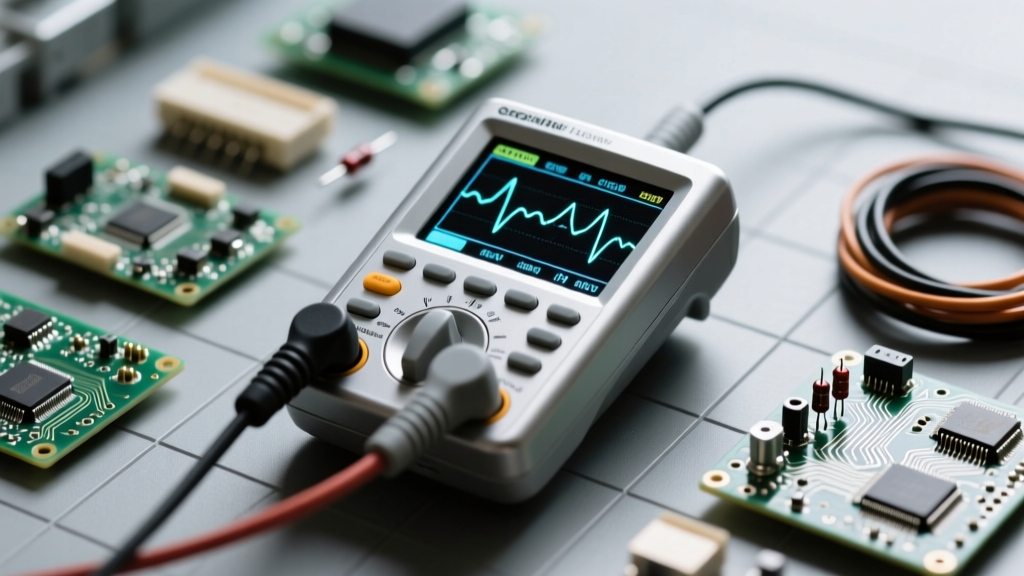
When troubleshooting industrial motor drives, automotive CAN bus networks, or solar inverter arrays, dragging a fragile 30-pound benchtop oscilloscope into the field is not just impractical—it is a liability. The best handheld oscilloscope bridges the gap between the deep analytical power of a lab instrument and the rugged portability of a digital multimeter. However, not all portable scopes are created equal. The market is flooded with cheap, repackaged hobbyist toys masquerading as industrial tools. For professional electrical engineers, HVAC technicians, and field service engineers, selecting the right equipment requires a strict evaluation of safety isolation, analog front-end noise floors, and true real-time sampling rates.
Unlike benchtop units that rely on a grounded earth pin for safety, handheld scopes must manage complex ground potential differences. According to Fluke's comprehensive guide on oscilloscope safety, using a non-isolated scope on floating or high-voltage circuits can result in catastrophic equipment failure or severe electrical shock. In this 2026 roundup, we dissect the top contenders for the best handheld oscilloscope, focusing on real-world performance, specific hardware limitations, and the exact failure modes you need to watch out for in the field.
Critical Specs: Bandwidth vs. Sample Rate in the Field
Before diving into specific models, it is vital to separate marketing fluff from engineering reality. Many budget manufacturers advertise '200 MHz Equivalent Time Sampling' (ETS), which is useless for capturing single-shot transients like a relay bounce or an IGBT switching spike. You must look for Real-Time Sample Rate. To accurately reconstruct a waveform without aliasing, the Nyquist theorem dictates a sample rate at least twice the bandwidth, but in practice, digital scopes require a 5x to 10x ratio to capture fast edge transitions accurately.
- Bandwidth: Determines the highest frequency sine wave the analog front-end can pass before attenuating by -3dB. For 480V VFD (Variable Frequency Drive) troubleshooting, 100 MHz is usually sufficient to see the PWM carrier waveforms.
- Sample Rate: The speed of the Analog-to-Digital Converter (ADC). A 1 GS/s (Giga-samples per second) rate yields a 1-nanosecond resolution between data points.
- ADC Resolution: Standard scopes use 8-bit ADCs (256 vertical levels). Modern premium handhelds are shifting to 12-bit hardware ADCs (4096 levels), which is a game-changer for resolving millivolt-level ripple on top of a 400V DC bus.
Top Contenders for the Best Handheld Oscilloscope in 2026
Fluke 190-204 Series III ScopeMeter (The Industrial Standard)
The Fluke 190-204 Series III remains the undisputed heavyweight champion for heavy industrial environments. Featuring 4 galvanically isolated channels, a 200 MHz bandwidth, and a blistering 2.5 GS/s real-time sample rate, this scope is built for CAT III 1000V and CAT IV 600V environments. The IP51 rating means it can withstand heavy dust ingress and vertical water drips—common conditions in mining and marine applications.
Real-World Insight: The isolation between channels is its biggest selling point. You can safely measure the high-side and low-side gate drive signals of a half-bridge MOSFET circuit simultaneously without shorting the DC bus through the scope's ground. However, be aware of the battery ecosystem. The proprietary BP290 lithium-ion batteries are expensive (often exceeding $150 each), and if left completely discharged in a hot service van for several months, the internal BMS (Battery Management System) can permanently lock the battery, requiring a costly replacement.
Siglent SHS810X (The High-Resolution Mid-Range Champion)
Siglent disrupted the market by bringing 12-bit hardware ADC technology to the portable space. The SHS810X offers 100 MHz bandwidth and a 1 GS/s sample rate, but its true advantage is the SPO (Super Phosphor Oscilloscope) technology paired with the 12-bit ADC. This provides 256 levels of intensity grading, allowing you to instantly spot rare anomalous glitches that an 8-bit scope would average out into the noise floor.
Real-World Insight: The user interface relies heavily on a rotary encoder for menu navigation. While precise, field technicians wearing heavy leather arc-flash gloves will find the encoder difficult to manipulate. Additionally, while the BNC inputs are isolated from the earth ground, the USB host port on the side shares a common ground plane with the internal logic. Never plug a USB thumb drive into this scope while probing live mains circuits; a transient spike could fry the USB controller and short to the chassis.
Owon HDS272S (The Budget 3-in-1 Multitool)
For automotive diagnostics, HVAC repair, and advanced hobbyists, the Owon HDS272S offers an incredible value proposition at roughly $149. It combines a 72 MHz, 250 MS/s dual-channel oscilloscope, a 20,000-count digital multimeter, and a 25 MHz arbitrary waveform generator (AWG) into a single, compact chassis.
Real-World Insight: The HDS272S utilizes a resistive touch screen rather than a capacitive one. This means it requires physical pressure to register a touch, which is highly frustrating when wearing standard nitrile work gloves. Furthermore, the AWG function is limited to 10 MHz for square waves due to output driver slew-rate limitations, a spec detail often omitted in basic marketing materials but critical if you are trying to inject clock signals into a microcontroller circuit.
Head-to-Head Comparison Chart
| Model | Bandwidth | Sample Rate | ADC Resolution | Safety Rating | Approx. Price (2026) |
|---|---|---|---|---|---|
| Fluke 190-204 III | 200 MHz | 2.5 GS/s | 8-bit / 10-bit Hi-Res | CAT III 1000V / CAT IV 600V | $3,800 |
| Siglent SHS810X | 100 MHz | 1 GS/s | 12-bit Hardware | CAT II 300V | $399 |
| Owon HDS272S | 72 MHz | 250 MS/s | 8-bit | CAT II 300V (Scope) / CAT III 600V (DMM) | $149 |
Real-World Failure Modes and Troubleshooting Field Scopes
Understanding how portable scopes fail in the field is just as important as knowing their specifications. The most common cause of catastrophic failure in handheld scopes is the Floating Ground Fallacy. Many technicians mistakenly believe that because a handheld scope runs on battery power, its ground reference is completely isolated from the environment. While the BNC input shields on high-end models like the Fluke are isolated, the external charging ports, USB interfaces, and SD card slots often share a common ground with the scope's internal digital logic.
Warning: Connecting a laptop to a handheld oscilloscope via USB while the scope is probing a non-isolated 480V 3-phase circuit can create a deadly ground loop. A voltage transient can travel through the scope's USB isolator, instantly destroying the laptop's motherboard and posing a severe shock hazard to the user. Always use optical or galvanically isolated USB adapters when downloading waveforms in high-voltage environments.
Another frequent issue is Analog Front-End Saturation. When measuring small AC ripple on a large DC offset (such as a 12V automotive alternator ripple test), budget scopes with poor input amplifiers will clip the signal before the ADC can digitize it, resulting in a flat-lined waveform. To troubleshoot this, always utilize AC coupling mode to block the DC offset, or use an external active differential probe to reject the common-mode voltage before it hits the scope's BNC connector. For a deeper dive into probe compensation and grounding techniques, All About Circuits provides an excellent primer on not blowing up your scope through improper grounding.
Final Verdict: Matching the Scope to Your Workbench
Choosing the best handheld oscilloscope ultimately depends on your specific work environment and safety requirements. If you are a field service engineer working on high-voltage industrial drives, renewable energy grids, or heavy machinery, the Fluke 190-204 Series III is a mandatory investment. Its robust CAT IV isolation and 4-channel capability justify the premium price tag by ensuring your safety and providing uncompromising signal fidelity.
For automotive technicians, robotics engineers, and solar installers who need high-resolution signal analysis without the industrial price tag, the Siglent SHS810X is the standout performer of 2026. Its true 12-bit ADC allows for precision measurements that 8-bit scopes simply cannot achieve. Finally, for mobile repair techs, HVAC troubleshooters, and students, the Owon HDS272S offers unparalleled versatility, combining three essential instruments into one pocket-sized unit, provided you can work around its interface limitations in rugged conditions.