
The Legacy Bottleneck: Why Your Current Arduino Cam is Failing
For years, the quintessential entry point into microcontroller vision was pairing an 8-bit AVR board with an Arducam shield or wiring up a raw OV7670 sensor. While these setups taught a generation of makers how to configure I2C registers and manage basic SPI FIFO buffers, they are fundamentally obsolete for modern computer vision tasks. The primary bottleneck lies in SRAM limitations and bus bandwidth. An Arduino Uno possesses a mere 2KB of SRAM, meaning it cannot hold even a single QVGA (320x240) frame in memory without relying on external FIFO memory chips. Furthermore, reading from these FIFO chips over a standard SPI bus caps your frame rate at a dismal 1 to 2 FPS, making real-time video streaming or edge AI inference impossible.
Even the wildly popular first-generation ESP32-CAM, utilizing the OV2640 sensor, is beginning to show its age in 2026. While it introduced DVP (Digital Video Port) parallel interfacing and Wi-Fi streaming, its single-core processing limitations, lack of native AI vector instructions, and reliance on inefficient linear voltage regulators (LDOs) lead to frequent thermal throttling and brownout resets during high-resolution JPEG compression or Wi-Fi transmission spikes.
Hardware Migration Matrix: Selecting Your Next Sensor
When planning your Arduino cam migration, you must align your sensor choice with your target microcontroller's peripheral interfaces. Below is a comparison matrix to guide your hardware upgrade.
| Sensor Module | Interface | Max Resolution | Target MCU Architecture | Primary Use Case |
|---|---|---|---|---|
| OV7670 (Legacy) | I2C Config / 8-bit DVP | VGA (640x480) | 8-bit AVR (with external FIFO) | Basic timelapse, low-res motion |
| OV2640 (Classic) | SCCB / 8-bit DVP | UXGA (1600x1200) | ESP32 (Xtensa LX6) | IoT streaming, basic QR reading |
| OV5640 (Modern) | SCCB / 8-bit DVP / MIPI | 5MP (2592x1944) | ESP32-S3, STM32H7 | Edge AI, detailed inspection |
| GC2145 (Budget) | I2C / 8-bit DVP | FHD (1920x1080) | ESP32-S3, Pico | High-res stills, budget streaming |
Path A: The ESP32-S3 and Edge AI Vision
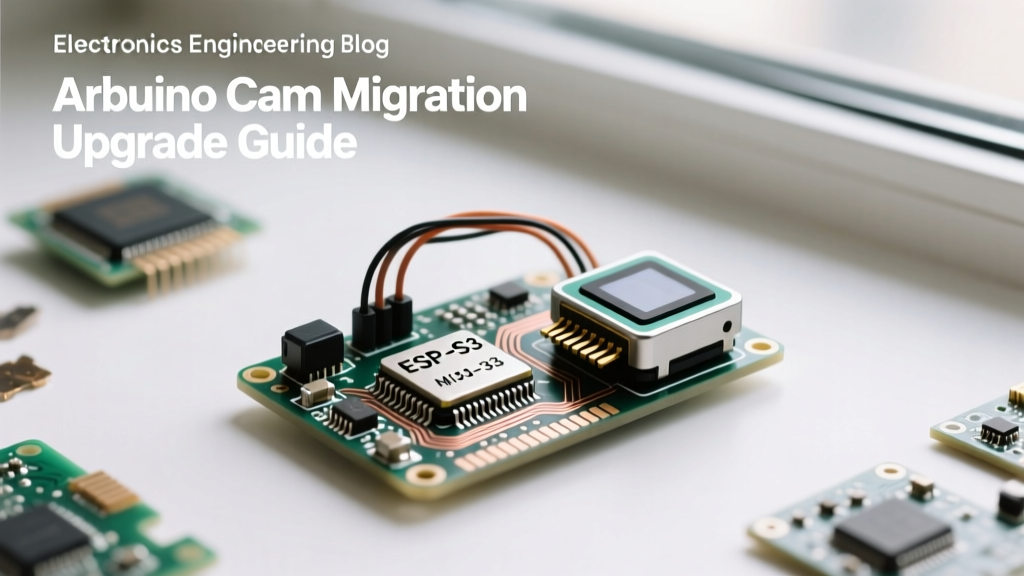
If your goal is to migrate from a standard ESP32-CAM to a system capable of running TensorFlow Lite Micro models locally, the Espressif ESP32-S3 is the definitive upgrade path. Boards like the Seeed Studio XIAO ESP32S3 Sense or the Freenove ESP32-S3 WROVER CAM utilize the S3's Xtensa 32-bit LX7 dual-core processor, which includes vector instructions specifically designed to accelerate neural network computations.
Crucially, the S3 architecture natively supports up to 8MB of Octal PSRAM. When migrating your codebase, this allows you to allocate massive frame buffers directly in PSRAM, enabling the capture of 5MP stills from an OV5640 sensor or maintaining a rolling buffer of 10+ VGA frames for motion-detection algorithms. Unlike the legacy ESP32, which struggled to route DVP pins without conflicting with internal flash SPI, the ESP32-S3 features a dedicated LCD/Camera peripheral controller, ensuring clean, high-speed 8-line parallel data transfers without DMA contention.
Path B: Industrial Machine Vision via MIPI CSI-2
For makers migrating toward industrial automation, robotics, or high-speed defect inspection, DVP parallel interfaces are no longer sufficient due to signal integrity issues over long ribbon cables. The upgrade path here involves moving to MIPI CSI-2 (Camera Serial Interface) and adopting 32-bit ARM Cortex-M7 architectures.
The Arduino Portenta H7 paired with the Vision Shield represents this tier of migration. Utilizing high-speed MIPI lanes, the Portenta can interface with advanced sensors like the STMicroelectronics MP5496 or Sony IMX series. The dual-core nature of the STM32H7 allows you to dedicate the Cortex-M7 core entirely to image processing pipelines (like OpenMV firmware integration or color-blob tracking), while the Cortex-M4 handles motor control or MQTT telemetry. This architectural separation is a massive leap from the interrupt-driven bottlenecks of older Arduino cam setups.
Protocol Migration: SPI vs. DVP vs. MIPI
Understanding the physical layer migration is critical for debugging hardware failures during your upgrade.
- SPI FIFO (Legacy): Relies on an intermediary chip (like the AL422B) to buffer the camera's parallel output into a serial stream. Maximum throughput rarely exceeds 2 Mbps, resulting in severe motion blur and latency.
- DVP (Digital Video Port): Uses 8 data lines (D0-D7) alongside HREF, VSYNC, and PCLK. Capable of 20-40 Mbps depending on the XCLK input. Requires precise PCB trace length matching to prevent clock skew, which is why flexible ribbon cables longer than 15cm often cause corrupted frames on DVP setups.
- MIPI CSI-2: Uses differential signaling (D-PHY) over paired lanes. This provides immense noise immunity and bandwidth (up to 2.5 Gbps per lane), allowing for uncompressed RAW10/RAW12 video streams necessary for advanced machine vision algorithms.
Refactoring the Codebase: Memory and Buffer Management
Migrating hardware requires significant refactoring of your C++ firmware. If you are moving from an OV2640 on an ESP32 to an OV5640 on an ESP32-S3, your camera_config_t struct must be updated to leverage external memory correctly.
On legacy boards, developers often relied on CONFIG_SPIRAM_USE_CAPTASK to force the camera driver into PSRAM. On modern ESP-IDF and Arduino core versions for the S3, you should utilize CONFIG_SPIRAM_USE_MALLOC combined with specific heap capabilities. Furthermore, when dealing with 5MP sensors, attempting to grab a RAW frame will instantly cause a panic. You must configure the sensor's internal JPEG compressor via SCCB registers to output compressed frames, reducing a 15MB raw buffer down to a manageable 300KB JPEG payload.
Expert Insight: When migrating to 5MP sensors like the OV5640, thermal throttling is a silent killer. These sensors draw upwards of 180mA during active capture and generate significant heat on small 24x24mm PCB modules. If your frame rate suddenly drops by 50% after three minutes of operation, the sensor's internal thermal management is aggressively down-clocking the PCLK. Upgrading to a module with an integrated heatsink or applying a copper foil thermal pad to the sensor's ground plane is mandatory for sustained operation.
Power Delivery Upgrades for High-Res Sensors
The most common point of failure during an Arduino cam upgrade is inadequate power delivery. The classic ESP32-CAM utilizes an AMS1117-3.3 LDO. When the Wi-Fi radio transmits (spiking to ~350mA) simultaneously with the camera sensor initializing (spiking to ~200mA), the voltage drops below the 3.0V brownout threshold, triggering an endless reboot loop.
When migrating to high-performance camera boards, ensure your custom PCB or chosen dev board utilizes a DC-DC buck converter (such as the MP2307 or TPS62160) for the 3.3V rail. Buck converters maintain high efficiency and can deliver 1A+ continuous current without the massive thermal dissipation and voltage dropout associated with linear LDOs. Additionally, modern camera modules require a clean, low-ripple 2.8V rail for the analog pixel array and a 1.5V or 1.2V rail for the digital core. Verify that your target board's PMIC (Power Management IC) is sequencing these rails correctly, as bringing up the digital core before the analog rail can permanently latch the sensor into an unresponsive state, requiring a hard power cycle to reset.
Conclusion: Future-Proofing Your Vision Pipeline
Upgrading your Arduino cam ecosystem is no longer just about chasing higher megapixel counts; it is about shifting the paradigm from simple image capture to intelligent edge processing. By migrating to ESP32-S3 architectures with PSRAM-backed DVP interfaces, or stepping into the MIPI CSI-2 domain with ARM Cortex-M7 boards, you unlock the ability to run real-time object detection, optical character recognition (OCR), and predictive maintenance algorithms directly on the silicon. Evaluate your bandwidth requirements, redesign your power delivery networks, and leverage the Arducam hardware integration guides to ensure your next vision project is built on a robust, modern foundation.