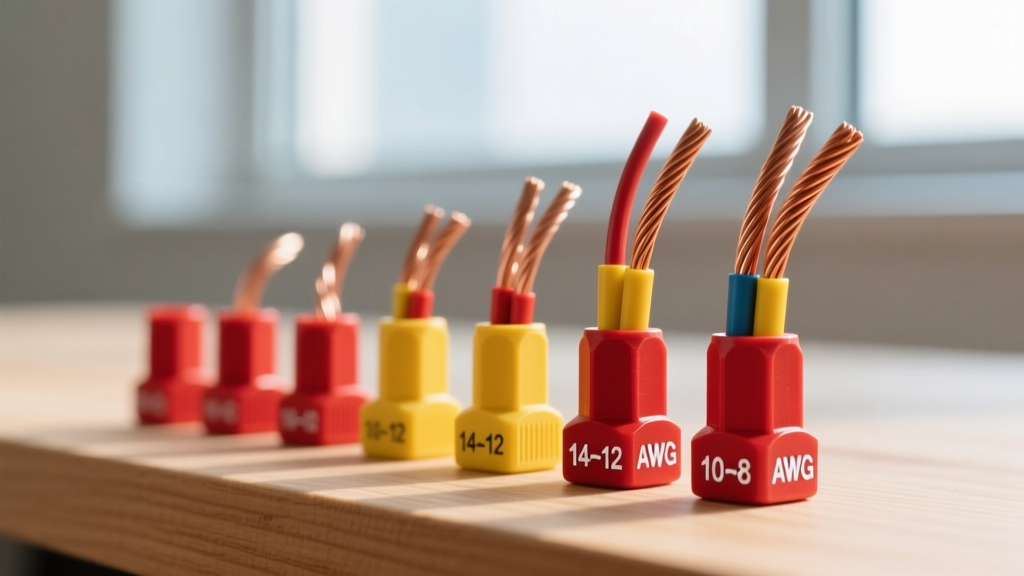

Red and yellow wire nuts are UL-listed twist-on wire connectors color-coded to indicate their specific minimum and maximum copper wire gauge combinations for secure electrical splices. If you are joining three 12 AWG wires in a standard outlet box, you need a red connector; if you are joining three 10 AWG wires for a 30A dryer circuit, you step up to yellow. Using the wrong size doesn't just make the job harder—it changes the physical grip of the internal steel coil, risking a high-resistance connection that can melt the insulation or start a fire. In this guide, we break down the exact capacity matrices, real-world applications, and the physics that make color-coding critical for NEC compliance.
The Physics of the Twist: Why Color Coding Matters
Inside every standard thermoplastic wire nut is a tapered, square-cut steel coil. As you twist the connector clockwise over a bundle of stripped wires, the coil acts like a stepped hose clamp on a water line: if the hose (wire bundle) is too narrow for the clamp's minimum diameter, tightening it just deforms the hose without creating a secure seal. Conversely, if the hose is too thick, the clamp strips the threads or cracks before achieving full compression.
In a real circuit, this physical grip dictates the electrical resistance of the splice. When the steel coil properly embeds into the copper conductors, it creates a gas-tight seal that prevents oxidation. If you use a yellow wire nut on a bundle that falls below its minimum capacity, the coil rides over the wires without biting. This changes the circuit by introducing a high-resistance joint. Under a continuous 15A or 20A load, a loose splice will drop voltage and generate localized heat, eventually melting the PVC shell and causing an arcing fault. The UL 486C standard strictly tests these connectors for pull-force and temperature rise, which is why manufacturers color-code them to match specific wire combinations.
A common point of confusion on the jobsite is the assumption that wire nut colors correspond to wire insulation colors or circuit phases. You will often see apprentices trying to use red wire nuts for red traveler wires in a 3-way switch, or yellow nuts for yellow high-leg delta conductors. The shell color has absolutely nothing to do with the wire's function or voltage; it strictly indicates the connector's physical capacity.
Red vs. Yellow: The Exact Capacity Matrix
While different manufacturers (like Ideal, 3M, and Gardner Bender) have slight variations in their exact model numbers, the industry standard for red and yellow connectors is heavily based on the Ideal Industries Wire-Nut specifications. Below is the exact capacity matrix for the most common standard-wing connectors.
| Attribute | Red (e.g., Ideal 72B) | Yellow (e.g., Ideal 73B) |
|---|---|---|
| Minimum Capacity | 2 #16 AWG | 2 #12 AWG |
| Maximum Capacity | 3 #10 AWG | 3 #8 AWG |
| Common Combinations | 3 #12, 4 #12, 2 #10, 3 #10 | 3 #10, 4 #10, 2 #8, 3 #8 |
| Strip Length Required | 3/4 inch (19mm) | 1 inch (25mm) for #8; 3/4 inch for #10/#12 |
| Primary Use Case | 15A/20A receptacles, lighting pigtails | 30A/40A appliances, AC disconnects |
Worked Numeric Example: The Mixed-Gauge Pigtail
Let's look at a real-world scenario where choosing between red and yellow is critical. You are wiring a 20A bathroom GFCI and need to pigtail the line, load, and two downstream feeds. That is four 12 AWG THHN wires. Both the red (72B) and yellow (73B) are UL-listed for four 12 AWG wires, so either works here.
However, suppose you are bonding a metal junction box and need to splice three 12 AWG hot wires alongside one 14 AWG equipment grounding conductor (EGC). You must use the red 72B. The red connector is rated for combinations that include smaller gauges (minimum 2 #16). The yellow 73B has a hard minimum threshold of two 12 AWG wires; its internal coil will not reliably bite into a single 14 AWG wire surrounded by larger 12 AWG conductors. Using the yellow nut here violates the UL listing and NEC 110.14 requirements for electrical connections, leaving the ground path compromised.
Where You Meet This in Practice
Understanding where to deploy each size speeds up your workflow and keeps your inspector happy.
- Red Wire Nuts (The Workhorse): You will use these constantly in residential rough-ins. They are the default for daisy-chaining 15A and 20A receptacles (joining 2 or 3 #12 or #14 wires), creating pigtails for 3-way and 4-way switch loops, and splicing lighting circuits in ceiling fan canopies. If you are working with standard NM-B (Romex) 12/2 or 14/2 cable, the red nut is usually in your pouch.
- Yellow Wire Nuts (The Heavy Duty): You reach for yellow when moving into dedicated appliance circuits. They are required for splicing 10 AWG wires in 30A dryer receptacles, 40A electric range pigtails, and connecting the whips inside an outdoor AC disconnect box where #8 or #10 THHN is common. They are also frequently used in commercial lighting retrofits where multiple 12 AWG or 10 AWG fixture whips are gathered into a single junction box.
Installation Technique and Torque Verification
The physical installation of red and yellow connectors requires attention to strip length and torque. A common myth passed down through older tradesmen is that you must pre-twist the wires with lineman's pliers before applying the nut. Modern UL-listed connectors from major manufacturers are explicitly designed to be twisted directly onto parallel, un-twisted wires. Pre-twisting can actually cause the wires to splay outside the steel coil, reducing the bite depth.
- Strip to the exact length: Use the gauge built into your wire strippers. For red nuts on #12 wire, strip exactly 3/4 inch. For yellow nuts on #8 wire, strip 1 inch. Exposed copper below the skirt of the nut is a shock hazard and an immediate code violation.
- Align and twist: Hold the wires parallel (do not pre-twist). Push the wire nut onto the ends and twist clockwise until you feel significant resistance.
- The Tug Test: This is your mandatory verification step. Grip the wire nut in one hand and pull sharply on each individual wire with the other. If any wire slides out, the coil didn't bite. Cut the ends off, re-strip, and use a fresh connector.
- Wrap (Optional but recommended): While UL-listed wire nuts do not require electrical tape to function, wrapping 3M Super 33+ tape around the base of the nut and the wire insulation prevents the wires from pulling apart when stuffed tightly into a crowded junction box.
Frequently Asked Questions
Can I use a yellow wire nut on 12 gauge wire?
Yes, but only if you are joining at least two 12 AWG wires. The yellow connector (like the Ideal 73B) is UL-listed for combinations ranging from two 12 AWG wires up to three 8 AWG wires. However, if you are only joining a single 12 AWG wire to a smaller 14 AWG wire, the yellow nut is too large; its minimum capacity requires at least two 12 AWG wires to ensure the internal coil engages properly. In that mixed-gauge scenario, use a red wire nut.
What happens if I use a wire nut that is too big?
If you use an oversized wire nut (e.g., a yellow nut on two 14 AWG wires), the tapered steel coil will bottom out on the plastic skirt before it can bite into the copper. The splice will feel tight on the outside, but the wires will not be compressed together. This creates a high-resistance connection that will generate excessive heat under load, potentially melting the connector, damaging the wire insulation, and creating a fire hazard inside the wall cavity.
Are red and yellow wire nuts rated for aluminum wire?
Standard red and yellow wire nuts are tested and UL-listed for copper-to-copper connections only. If you are splicing aluminum branch circuit wiring (common in homes built between 1965 and 1973), you must use specialized connectors like the Alumiconn or specific purple wire nuts that contain an antioxidant compound (like Noalox) to prevent galvanic corrosion and the high-resistance oxide layer that aluminum naturally forms. Never use standard red or yellow nuts on aluminum without checking the manufacturer's specific AL/CU rating.
Do I need to pre-twist wires before applying a red or yellow wire nut?
No. According to manufacturer installation instructions for modern connectors like the Ideal Wire-Nut and 3M Performance Plus, you should not pre-twist the wires with pliers. The square-cut steel coil is designed to bite into parallel wires and twist them together as you turn the shell. Pre-twisting the wires can cause them to wrap unevenly, leaving the outer wires outside the grip of the coil and reducing the overall pull-out strength of the splice.