
Decoding NEC Article 330: The Foundation of Metal Clad Cable
When transitioning from standard residential wiring to commercial projects, industrial facilities, or high-end custom homes, electricians quickly encounter the necessity of metal clad cable (commonly referred to as MC cable). Governed by NEC Article 330, Type MC cable is a factory assembly of one or more insulated circuit conductors enclosed in a flexible, interlocked metal armor or a smooth corrugated metallic sheath. While it offers superior physical protection compared to standard non-metallic (NM-B) cable, it also introduces a complex web of code requirements that frequently trip up even seasoned journeymen during rough-in inspections.
At ElectricalFlux, we believe that understanding the 'why' behind the National Electrical Code (NEC) is just as important as memorizing the rules. In this comprehensive code and standards explainer, we will dissect the critical installation parameters for metal clad cable, debunk common grounding myths, and provide a practical framework for passing your next commercial rough-in inspection.
Critical NEC Rules for Metal Clad Cable Installation
The physical installation of metal clad cable requires strict adherence to spacing, support, and bending parameters. Failure to meet these standards doesn't just result in a failed inspection; it can lead to catastrophic insulation failure and hidden ground faults.
Securing and Supporting (NEC 330.30)
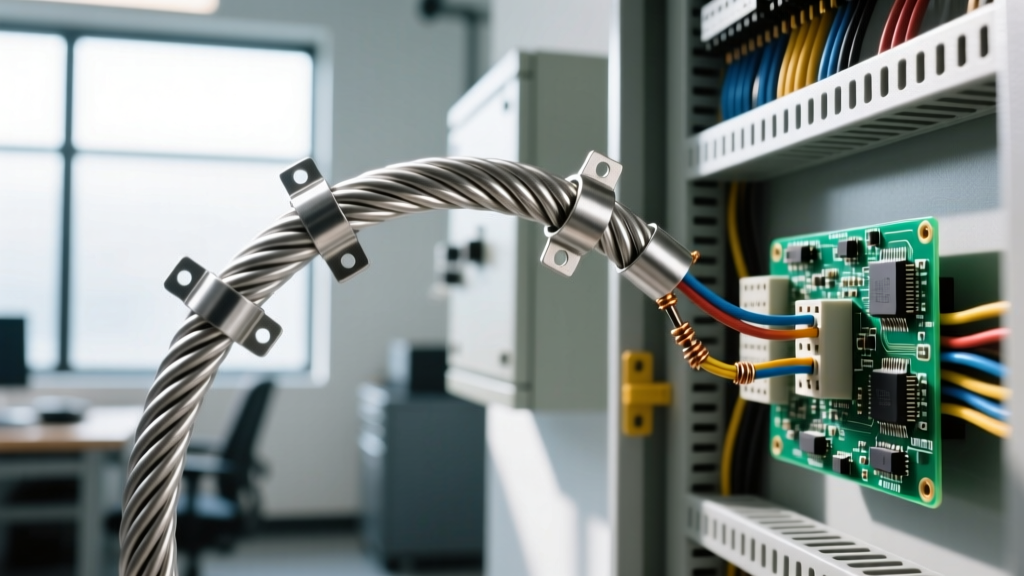
Unlike NM-B cable, which can be fished through walls with minimal support, metal clad cable must be rigorously secured. According to NEC Section 330.30, MC cable must be secured and supported at intervals not exceeding 6 feet (1.8 meters). Furthermore, the cable must be secured within 12 inches of every outlet box, junction box, cabinet, or fitting.
- Prohibited Fasteners: Never use standard NM-B cable staples on metal clad cable. The driving force of a staple gun can crush the interlocked aluminum or steel armor, pinching the internal THHN/THWN-2 insulation and creating an immediate short-circuit hazard.
- Approved Fasteners: Use listed MC cable straps (such as those manufactured by Gardner Bender or Arlington) that feature a wider, rounded profile designed to cradle the armor without deforming it.
- Concealed Spaces Exception: When fishing MC cable through concealed spaces in finished buildings where supporting every 6 feet is impractical, the code allows the cable to be unsupported, provided it is securely fastened at the termination boxes.
Bending Radius Restrictions (NEC 330.24)
The most common reason for failed MC cable installations is violating the minimum bending radius. When you bend interlocked metal armor too sharply, the inner edge of the metal spiral acts like a serrated knife, slicing into the wire insulation. NEC 330.24 dictates the following minimum bending radii based on the cable construction:
- Interlocked Armor (Standard MC): Minimum bend radius is 7 times the external diameter of the cable.
- Smooth Sheath (Corrugated Tube): Minimum bend radius is 5 times the external diameter for unshielded conductors, and 10 times for shielded conductors.
Real-World Application: If you are pulling a 3/4-inch trade size Southwire 12/4 MC cable with an outer diameter of roughly 0.65 inches, your minimum bending radius is 4.55 inches. Using a mechanical bender or a specialized MC cable bending spring is highly recommended for tight 90-degree turns into junction boxes.
The Grounding Conundrum: Armor vs. EGC
One of the most persistent and dangerous myths in the electrical trade is the belief that the metal armor of MC cable can serve as the Equipment Grounding Conductor (EGC). This is categorically false for standard Type MC cable.
Code Alert: Under NEC Article 330, the internal green (or bare) insulated/bare copper wire is the only recognized Equipment Grounding Conductor in standard MC cable. The armor itself is not listed as an EGC.
This is where electricians frequently confuse Type MC with Type AC (Armor-Clad) cable, which is governed by NEC Article 320. Type AC cable contains a specialized internal aluminum bonding strip that runs in direct contact with the steel armor, allowing the armor/bonding strip combination to serve as the EGC. Standard MC cable lacks this bonding strip. Therefore, when terminating MC cable, you must land the internal green/bare wire on the grounding bus or pigtail it to the box. Relying on the armor for fault-current return will result in an open ground condition and a guaranteed inspection failure.
Fittings, Terminations, and the 'Redhead' Myth
Terminating metal clad cable into metal junction boxes requires listed fittings that ensure both a secure mechanical pull-out resistance and a reliable electrical bond between the armor and the box.
Do You Need Anti-Short Bushings?
When cutting Type AC cable, the jagged, exposed edge of the steel armor poses a severe laceration risk to the wire insulation. NEC 320.40 requires the use of an insulating anti-short bushing (affectionately known as a 'redhead' due to its standard color) to protect the wires.
However, NEC Article 330 does not require anti-short bushings for Type MC cable. MC cable is manufactured with a smooth internal separator wrap, or the factory cutting process leaves a safe edge. While many veteran inspectors still demand redheads on MC cable out of decades-old habit, they are not code-mandated. That said, using them as a best practice can prevent friction damage during the pull-through and appease overzealous inspectors.
Selecting the Right Connectors
For commercial applications, compression-style MC connectors (such as the Arlington MC900 series) are the industry gold standard. Unlike set-screw connectors that rely on a single dimple biting into the armor, compression fittings draw the armor tightly into the fitting body, creating a continuous, low-impedance ground path between the cable armor and the metal junction box. This is critical for high-availability circuits and sensitive electronic equipment.
Comparative Analysis: MC vs. AC vs. NM-B
To fully grasp where metal clad cable fits into the broader wiring ecosystem, review this structural and code-based comparison:
| Feature | Type MC (Metal Clad) | Type AC (Armor Clad) | NM-B (Romex) |
|---|---|---|---|
| Governing NEC Article | Article 330 | Article 320 | Article 334 |
| Outer Jacket Material | Interlocked Aluminum/Steel or Corrugated Tube | Interlocked Galvanized Steel | PVC / Nylon Jacket |
| EGC Method | Internal Green/Bare Wire ONLY | Armor + Internal Bonding Strip | Internal Bare Copper Wire |
| Wet Location Rating | Only if specifically marked (e.g., PVC jacketed) | Not Permitted | Not Permitted |
| Primary Use Case | Commercial, Industrial, High-End Residential | Commercial branch circuits, retrofits | Standard residential dry locations |
Environmental Limitations: Where You CANNOT Use MC Cable
Standard metal clad cable is rated for dry, indoor locations. According to NEC 330.12, standard MC cable is prohibited in the following environments unless it features specific, listed modifications:
- Embedded in Concrete: Unless the armor is made of corrosion-resistant stainless steel or features a continuous PVC jacket.
- Subject to Physical Damage: While MC is tough, it cannot be used as a substitute for rigid metal conduit (RMC) or intermediate metal conduit (IMC) in areas subject to severe impact (e.g., the bottom 8 feet of an exposed warehouse wall where forklifts operate).
- Corrosive Environments: Standard galvanized steel or aluminum armor will rapidly degrade in areas exposed to corrosive fumes, vapors, or direct saltwater spray.
If your project requires running cable through a concrete slab or outdoors, you must specify Wet-Location MC Cable. As detailed in Southwire's MC cable specifications, wet-rated MC utilizes THWN-2 or XHHW-2 conductors and features either a sunlight-resistant PVC outer jacket or a specialized impervious gas/vapor barrier to prevent moisture from wicking through the armor spirals.
Final Thoughts on Code Compliance
Mastering the installation of metal clad cable requires moving beyond the 'pull and staple' mentality of residential wiring. By strictly adhering to the 6-foot support rule, respecting the 7x bending radius, properly terminating the internal EGC, and utilizing compression fittings, you ensure a system that is not only code-compliant but built for decades of reliable service. For the most up-to-date code cycles and local amendments, always consult the National Fire Protection Association (NFPA) and your local Authority Having Jurisdiction (AHJ) before beginning any commercial rough-in.