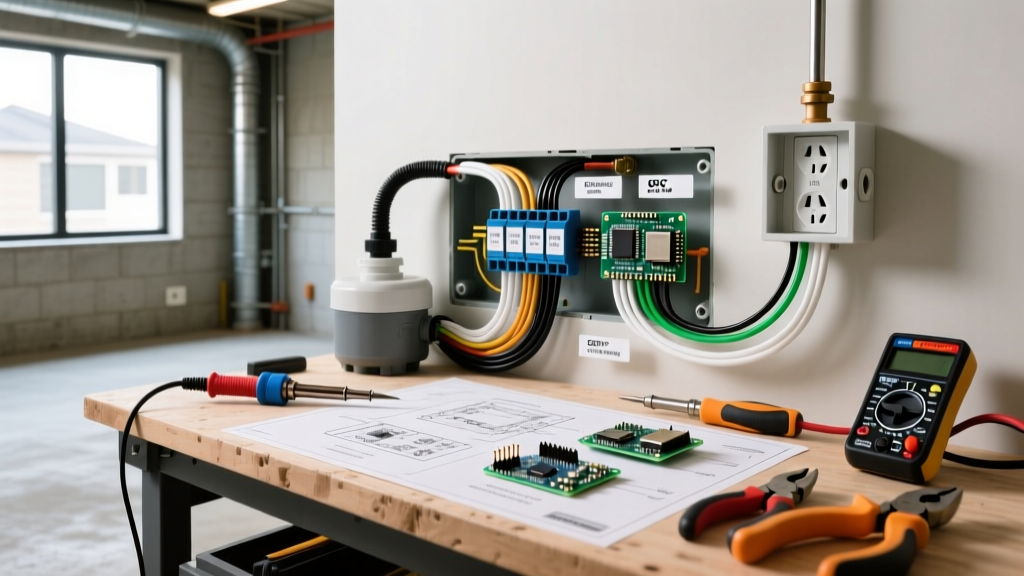

The Core Question: Why Is Copper Used for Most Electrical Wiring?
Walk into any residential basement or commercial utility closet, and you will inevitably see a sea of copper conductors. Whether you are a weekend DIYer pulling Romex through attic joists or a master electrician terminating a 400-amp switchgear, the material of choice remains remarkably consistent. But why is copper used for most electrical wiring despite the aggressive price fluctuations of the global commodities market?
The answer is not simply 'because it conducts electricity.' The reality is a complex intersection of metallurgy, physics, building codes, and practical job-site ergonomics. To truly understand copper's dominance, we must analyze it through two distinct lenses: the DIY enthusiast focused on branch-circuit workability, and the licensed professional focused on long-term reliability, feeder economics, and National Electrical Code (NEC) compliance.
The Physics of Conductivity: Beyond the Basics
At the atomic level, copper possesses a single valence electron in its outermost shell. This electron is loosely bound, allowing it to move freely through the metallic lattice when a voltage is applied. The Copper Development Association establishes the International Annealed Copper Standard (IACS), where pure copper is assigned a baseline conductivity of 100%.
While silver is technically more conductive (roughly 105% IACS), its cost makes it entirely unviable for general wiring. Aluminum, the closest alternative, sits at approximately 61% IACS. This means an aluminum conductor must be physically larger—typically two AWG sizes up—to carry the exact same current as a copper wire without exceeding safe temperature thresholds.
The DIY Perspective: Workability, Cost, and Big-Box Availability
For the residential DIYer tackling a kitchen remodel or a garage sub-panel, copper is the undisputed champion of convenience. The focus here is primarily on 14 AWG, 12 AWG, and 10 AWG solid-core Non-Metallic (NM) sheathed cables, such as Southwire ROMEX SIMpull.
Ergonomics and Tooling
Copper's ductility allows for tight bending radii without risking conductor fracture. A DIYer can strip a 12/2 NM-B cable using a standard Klein 11055 wire stripper, bend a precise shepherd's hook for a receptacle terminal, and push it into a crowded junction box with minimal physical fatigue. Furthermore, copper's memory and stiffness help maintain neat, organized panels—a crucial factor when navigating tight stud bays.
The 2026 Cost Reality
Copper is undeniably expensive. In early 2026, a 250-foot coil of 12/2 NM-B copper cable hovers between $195 and $215 (roughly $0.82 per foot). While this represents a significant material cost for a whole-house rewire, DIYers rarely run feeders large enough to feel the true financial sting of copper. For branch circuits under 60 amps, the premium paid for copper is easily justified by the elimination of specialized termination tools and anti-oxidant compounds.
The Professional Electrician's View: Code, Creep, and Terminations
When you transition from DIY branch circuits to professional commercial build-outs and heavy residential service entrances, the analysis shifts. Master electricians respect copper not just for its conductivity, but for its mechanical stability under thermal stress.
Cold Flow and Thermal Cycling
The primary reason professionals avoid aluminum for smaller branch circuits is a metallurgical phenomenon known as 'creep' or 'cold flow.' When aluminum is placed under the mechanical pressure of a terminal screw, it slowly deforms over time. When the circuit is loaded, the wire heats up and expands; when unloaded, it cools and contracts. Over hundreds of thermal cycles, aluminum creeps away from the screw, resulting in a loose connection, arcing, and potentially catastrophic fires. Copper exhibits virtually zero creep under standard termination pressures, ensuring a gas-tight connection that lasts for decades.
NEC Compliance and Torque Specifications
The NFPA 70 National Electrical Code (specifically Article 110.14(D)) mandates that terminations be torqued to the manufacturer's specifications using calibrated tools. While this applies to both metals, copper is far more forgiving of minor torque deviations. Standard 15A and 20A copper terminations typically require between 12 and 16 inch-pounds of torque. A professional using a Klein 32500TORQ torque screwdriver can rapidly terminate dozens of copper receptacles with absolute confidence in the connection's longevity.
Where Professionals Actually Prefer Aluminum
It is a misconception that professionals use copper for everything. For service entrances and heavy feeders (e.g., 200-amp residential panels or 400-amp commercial switchgears), licensed electricians almost exclusively use compact-stranded aluminum (like XHHW-2 or SER cable). In 2026, 4/0 AWG aluminum is roughly $4.50 per foot, whereas the copper equivalent exceeds $14.00 per foot and is so stiff it requires hydraulic benders. Professionals use aluminum where its physical size is manageable, and copper where termination reliability is paramount.
Material Showdown: Copper vs. Aluminum vs. CCA
How do the primary wiring metals stack up when evaluated by both DIYers and Pros? The following matrix breaks down the practical realities of each material in modern electrical installations.
| Material | Conductivity (% IACS) | DIY Friendliness | Primary Pro Use Case | 2026 Approx Cost (12 AWG Eq.) |
|---|---|---|---|---|
| Pure Copper | 100% | Excellent (Highly ductile, easy to strip/terminate) | Branch circuits, sensitive electronics, high-vibration areas | $0.82 / ft (12/2 NM-B) |
| Aluminum (AA-8000) | 61% | Poor (Requires larger lugs, anti-oxidant paste, strict torque) | Service entrances, heavy feeders (>60A), utility drops | $0.45 / ft (Equivalent ampacity) |
| Copper-Clad Aluminum (CCA) | ~63% (Overall) | Moderate (Stripping risks removing copper cladding) | NEC prohibited for most standard branch wiring; telecom only | $0.55 / ft (Not code compliant for power) |
Real-World Failure Modes: When Copper Goes Wrong
While copper is the gold standard, it is not immune to installation errors. Both DIYers and professionals must be aware of specific failure modes unique to copper wiring.
- Galvanic Corrosion at Bi-Metallic Junctions: When a DIYer attempts to splice an existing aluminum feeder to a copper branch circuit without proper preparation, galvanic corrosion occurs. Moisture acts as an electrolyte, causing the aluminum to rapidly oxidize and increase resistance. Professionals mitigate this by using AlumiConn lug connectors or applying Noalox (a zinc-dust polybutene paste) to specialized CO/ALR rated wire nuts.
- Over-Torquing and Strand Shearing: Copper is soft. If an electrician uses an uncalibrated impact driver or exceeds the manufacturer's torque rating on a stranded copper THHN wire, the terminal screw can shear the outer strands of the conductor. This reduces the effective cross-sectional area of the wire, creating a localized hot spot under heavy continuous loads.
- Insulation Degradation from Overheating: Copper itself will not melt until it reaches 1,984°F (1,084°C). However, the PVC or XLPE insulation wrapped around it will fail much earlier. Standard THHN copper wire is rated for 90°C, but NEC ampacity tables require derating based on the 60°C or 75°C column depending on the termination equipment. Ignoring bundling derating factors (NEC Chapter 9, Table 1) leads to insulation breakdown, regardless of the copper's integrity.
The Skin Effect and Commercial Harmonics
In advanced commercial environments, the 'why' of copper extends into high-frequency physics. Modern buildings are saturated with non-linear loads—variable frequency drives (VFDs), LED drivers, and server power supplies. These devices generate triplen harmonics (3rd, 9th, 15th) that accumulate on the neutral conductor.
Due to the 'skin effect,' high-frequency harmonic currents travel primarily on the outer surface of the conductor. Copper's superior thermal dissipation and the professional practice of installing oversized copper neutrals (often 200% the size of the phase conductors) prevent neutral busbars from melting down in data centers and hospitals. Aluminum's lower thermal mass and higher resistance make it a risky choice for these specific harmonic-heavy applications.
Final Verdict: The Right Metal for the Right Application
Ultimately, answering the question of why is copper used for most electrical wiring requires looking past simple conductivity. For the DIYer, copper offers unmatched workability, visual ease of inspection, and forgiveness during termination. For the professional electrician, copper provides the mechanical stability required to survive decades of thermal cycling without cold-flowing or loosening under the screw head.
However, true electrical expertise lies in knowing when not to use copper. By reserving copper for branch circuits, sensitive terminations, and high-harmonic environments, and utilizing modern AA-8000 series aluminum for heavy feeder cables, installers can achieve a system that is both economically viable and exceptionally safe. Always consult the latest manufacturer technical data and local AHJ (Authority Having Jurisdiction) amendments before selecting your conductor material for any 2026 wiring project.