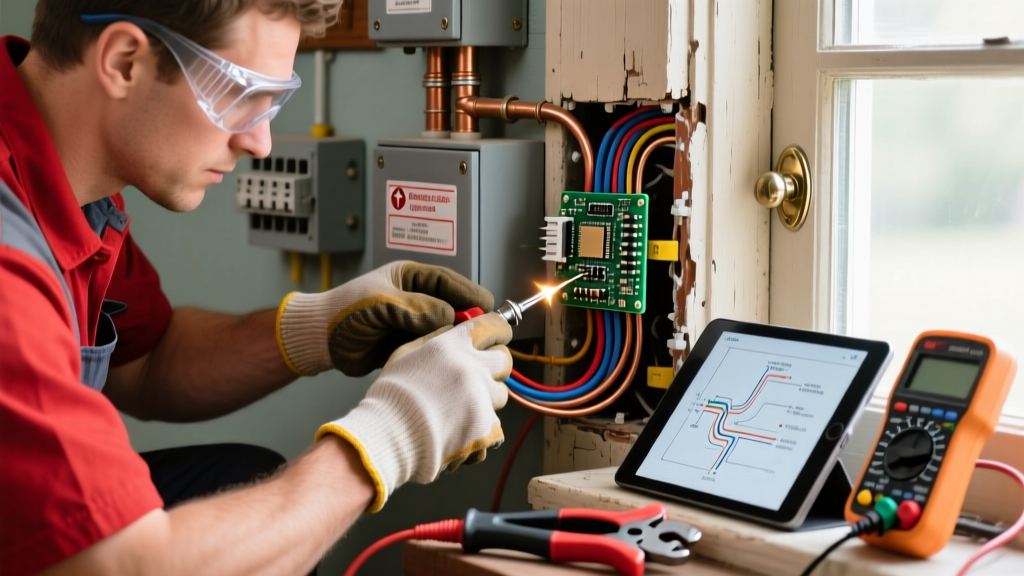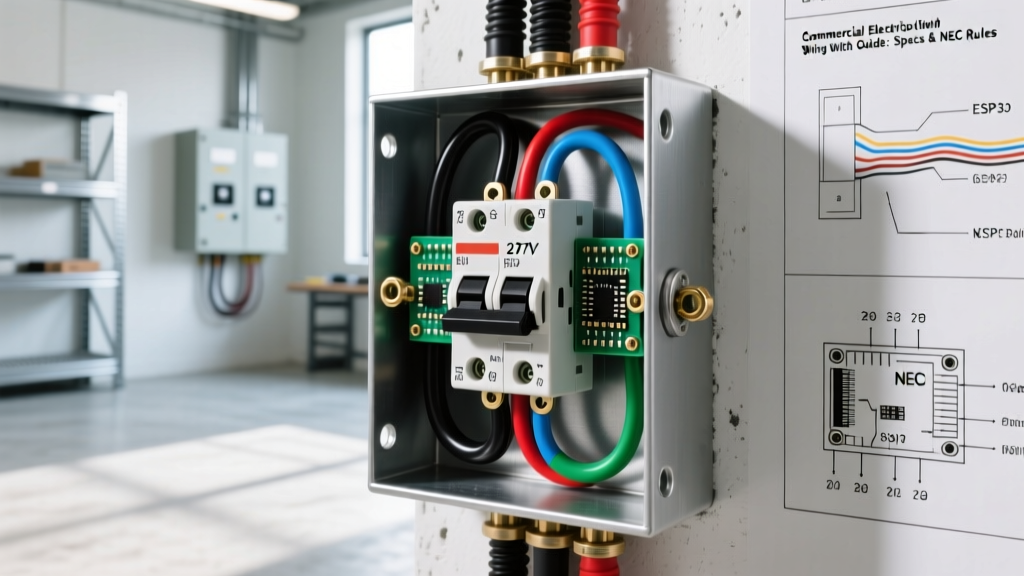

Why Commercial Switches Demand a Different Approach
When outfitting a warehouse, office complex, or retail space, the standard residential toggle is entirely inadequate. A commercial electrical wiring switch must handle higher voltages (typically 277V for lighting or 480V for heavy machinery), rigorous duty cycles, and strict adherence to the National Electrical Code (NEC). Unlike residential 120V/15A circuits, commercial environments often utilize 277V/480V 3-phase wye systems, meaning an arc flash or contact failure can be catastrophic.
In this comprehensive commercial wiring guide, we break down exact product specifications, NEC torque requirements, and step-by-step installation protocols for heavy-duty environments. Whether you are pulling THHN wire through EMT conduit for a new LED high-bay lighting array or installing a NEMA-rated motor disconnect, precision and code compliance are non-negotiable.
Core Commercial Switch Types & 2026 Market Specs
Selecting the correct hardware is the first critical step. Below are the primary switch categories used in commercial buildouts, complete with specific 2026 market models and pricing.
1. Heavy-Duty 277V AC Toggle Switches
Used primarily for commercial lighting circuits (fluorescent, HID, and high-voltage LED drivers). These switches feature heavier internal contacts and larger arc chutes to extinguish the high-voltage arc generated when breaking a 277V circuit.
- Top Model: Leviton 1221-2W (20A, 277V AC, Single Pole, Heavy Duty)
- Average Price: $14.50 - $16.00 per unit
- Key Spec: Back-wired with side wire clamps for secure 12 AWG or 10 AWG solid/stranded wire termination.
2. NEMA-Rated Motor Disconnect Switches
Required by NEC Article 430 for motorized equipment (HVAC compressors, exhaust fans, industrial pumps). These provide a visible blade break and are housed in rugged enclosures.
- Top Model: Eaton DH221NRK (30A, 240V, 2-Pole, NEMA 3R Rainproof)
- Average Price: $285.00 - $320.00
- Key Spec: NEMA 3R rating ensures protection against falling dirt, rain, sleet, and snow, making it ideal for rooftop RTU (Rooftop Unit) installations.
3. Smart Networked Commercial Switches (PoE & 0-10V)
Modern commercial spaces utilize Power over Ethernet (PoE) or 0-10V dimming protocols integrated into occupancy-sensing wall switches to meet ASHRAE 90.1 energy codes.
- Top Model: Lutron Vive PowrPak (0-10V Dimming Switch with Integrated Sensor)
- Average Price: $185.00 - $220.00
- Key Spec: Requires a dedicated low-voltage sensor wire alongside the standard 120V/277V line and load conductors.
Comparison Matrix: Commercial vs. Residential Switches
| Feature | Residential Switch | Commercial Switch |
|---|---|---|
| Standard Voltage | 120V AC | 277V AC / 480V AC |
| Amperage Rating | 15A | 20A, 30A, 60A+ |
| Load Type | Resistive / Tungsten | Inductive / Ballast / Motor |
| Enclosure / Mounting | Plaster ring / Drywall | EMT Conduit / Masonry / NEMA |
| Wire Termination | Push-in / Side wire | Screw terminal with pressure plate |
Step-by-Step: Wiring a 277V Heavy-Duty Lighting Switch
Wiring a commercial electrical wiring switch inside an EMT conduit system requires strict attention to wire management and torque specifications. Below is the professional workflow for a standard 20A 277V single-pole lighting circuit.
CRITICAL SAFETY WARNING: Always adhere to OSHA Lockout/Tagout (LOTO) procedures before opening any commercial junction box or panelboard. Verify the absence of voltage using a CAT IV rated multimeter (e.g., Fluke 87V) on the line and load conductors. Read more on OSHA's hazardous energy control standards.
- Conduit & Box Prep: Ensure the commercial switch box (typically a 4-inch square, 2-1/8 inch deep steel box) is securely fastened to the structural framing. Remove all knockouts and install EMT connectors with insulated bushings to prevent wire chafing.
- Pulling Conductors: Pull 12 AWG THHN/THWN-2 conductors. For a 277V circuit, you will use a Brown (Line), Yellow or Orange (Load), and Green (Ground) wire, plus a White or Gray neutral if the lighting driver requires it. Use wire pulling lubricant for runs exceeding 40 feet.
- Stripping & Prepping: Strip exactly 3/4 inch of insulation from the conductors using a precision wire stripper. Do not nick the copper, as this creates a micro-fracture that will fail under thermal cycling.
- Termination: Loop the wire clockwise around the terminal screw, or insert straight under the pressure plate. Ensure no bare copper is exposed outside the terminal, and no insulation is trapped under the plate.
- Torque Application: This is where most commercial failures occur. Use a calibrated torque screwdriver (e.g., CDI 401SM) to tighten the terminal screws to the manufacturer's exact specification. For the Leviton 1221-2W, this is 14 in-lbs.
- Grounding & Bonding: Terminate the green equipment grounding conductor to the green grounding screw in the steel box, and run a separate bonding jumper to the switch's green ground screw. Metal boxes and conduit must form a continuous low-impedance fault path.
Crucial NEC Code Requirements for Commercial Installations
The National Fire Protection Association (NFPA) updates the NEC every three years, and commercial inspectors strictly enforce these rules. According to the official NFPA NEC guidelines, you must adhere to the following when installing commercial switches:
- NEC Article 404.14 (Snap Switches Over 20 Amperes): Standard snap switches cannot be used to control loads exceeding their ampere rating. For commercial HVAC or large lighting arrays drawing over 20A, you must use a heavy-duty motor-rated switch or a contactor controlled by a pilot switch.
- NEC Article 110.14(D) (Torque Requirements): All terminations must be torqued to the values specified by the manufacturer. Inspectors in commercial jurisdictions now routinely require electricians to carry calibrated torque screwdrivers and mark torqued screws with a tamper-evident torque seal marker.
- NEC Article 430.102 (Motor Disconnects): A disconnecting means must be located within sight of the motor controller. If the electrical wiring switch is a NEMA disconnect, it must be capable of being locked in the open (OFF) position.
Troubleshooting: Thermal Imaging & Contact Welding
Commercial switches degrade faster than residential ones due to high inductive inrush currents. When a motor starts, the inrush current can be 6 to 8 times the full load amperage (FLA). This causes internal arcing, which pits the contacts and increases resistance.
The Diagnostic Protocol:
- Thermal Scanning: Use a FLIR E8-XT thermal imaging camera to scan the switch under full load. A temperature delta (ΔT) of more than 15°C (27°F) between the line terminal and the load terminal indicates severe internal contact degradation.
- Voltage Drop Testing: Measure the voltage across the switch while the circuit is energized. A healthy switch should drop less than 0.5V. A reading above 2V means the switch is dissipating excessive heat and must be replaced immediately.
- Contact Welding: If a commercial switch fails to turn off a load, the internal contacts have likely welded together due to a fault or severe overload. Do not attempt to force the toggle; shut off the upstream breaker and replace the unit.
Material Cost Breakdown for a Standard 20A Commercial Circuit
Budgeting for commercial electrical work requires accounting for industrial-grade materials. Below is a 2026 cost estimate for a single 277V lighting switch drop in a commercial warehouse (excluding labor).
| Material | Specification | Estimated Cost (2026) |
|---|---|---|
| Heavy Duty Switch | Leviton 20A 277V Toggle | $15.50 |
| Steel Switch Box | 4" Square x 2-1/8" Deep | $4.25 |
| EMT Conduit & Fittings | 3/4" EMT, Couplings, Connectors | $18.00 |
| THHN Conductors | 12 AWG (Line, Load, Neutral, Ground) | $22.00 |
| Weatherproof Cover | Stainless Steel 1-Gang | $8.75 |
| Total Material Cost | $68.50 |
Frequently Asked Questions
Can I use a standard 15A residential switch for a 277V commercial light?
Absolutely not. Residential switches are typically rated for 120V/277V but lack the internal arc extinguishing chambers required for safe 277V operation. Using one will result in severe arcing, melting, and potential fire. Always use a switch explicitly rated for the circuit voltage and amperage.
What is the difference between a NEMA 1 and NEMA 3R disconnect switch?
A NEMA 1 enclosure is for indoor use and protects against falling dirt and dust. A NEMA 3R enclosure, as defined by the National Electrical Manufacturers Association, is rainproof and sleet-resistant, making it mandatory for outdoor commercial equipment like rooftop HVAC units or exterior exhaust fans.
Why do commercial switches require a torque screwdriver?
Under-torqued screws allow the wire to loosen under thermal expansion and contraction, leading to high-resistance faults and fires. Over-torqued screws can strip the threads or crush stranded wire, reducing the cross-sectional area and creating a localized hot spot. NEC 110.14(D) mandates precise torque application.
Final Thoughts on Commercial Switch Wiring
Executing a flawless commercial electrical wiring switch installation goes far beyond simply connecting wires. It requires an intimate understanding of 3-phase systems, inductive load behaviors, and rigorous adherence to NEC torque and disconnect mandates. By specifying heavy-duty, NEMA-rated, or smart-networked hardware and verifying every termination with calibrated tools, electrical professionals ensure the longevity, safety, and efficiency of commercial power systems for decades to come.