
The Physics of Protection: Fire vs. Shock
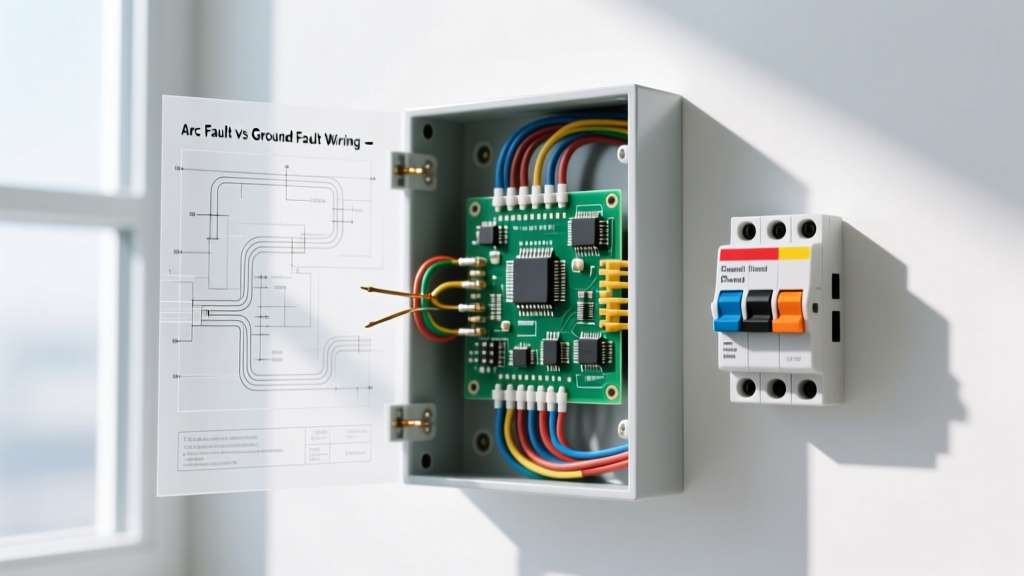
When upgrading a residential electrical panel or replacing a worn-out receptacle, DIYers and licensed electricians alike must navigate the critical distinction between arc fault vs ground fault protection. While both devices are designed to trip a circuit and save lives, they monitor entirely different electrical anomalies. Understanding the physics behind these breakers is the first step toward code-compliant, safe home wiring.
Ground Fault Circuit Interrupters (GFCI): Shock Prevention
A GFCI device protects against electrical shock by monitoring the current balance between the hot and neutral conductors. Inside a GFCI receptacle or breaker is a toroidal transformer (a current transformer). Under normal conditions, the current flowing out on the hot wire exactly equals the current returning on the neutral wire. If a person touches a live component while grounded, some current leaks through their body to the earth. The GFCI detects this imbalance. According to the Electrical Safety Foundation International (ESFI), a Class A GFCI is engineered to trip when the leakage current reaches a threshold between 4 and 6 milliamps (mA). This rapid trip (under 25 milliseconds) occurs well before the current can induce ventricular fibrillation in the human heart.
Arc Fault Circuit Interrupters (AFCI): Fire Prevention
Conversely, an AFCI protects against electrical fires caused by arcing. Arcing occurs when electricity jumps across a gap in a damaged wire, loose connection, or degraded insulation, creating intense heat (up to 10,000°F) that can ignite surrounding wood or drywall. AFCI breakers contain advanced microprocessors that continuously analyze the 60Hz AC sine wave. They are programmed to recognize the high-frequency 'noise' and waveform 'shoulders' that characterize both series arcs (a break in a single wire) and parallel arcs (a short between hot and neutral, or hot and ground). The AFCI Safety Coalition notes that traditional thermal breakers cannot detect these low-current, high-resistance arcs, making AFCIs essential for modern fire prevention.
NEC Code Requirements: Where Do They Belong?
The National Electrical Code (NEC) has progressively expanded the requirements for both devices over the last two decades. When planning a home renovation or new build, you must adhere to the latest adopted cycle in your jurisdiction (typically the 2020 or 2023 NEC). Below is a structural breakdown of where arc fault vs ground fault protection is mandated.
| Room / Area | GFCI Requirement (Shock) | AFCI Requirement (Fire) | NEC Reference (2020/2023) |
|---|---|---|---|
| Kitchens | Yes (All countertop receptacles) | Yes (All branch circuits) | 210.8(A)(6) & 210.12(A) |
| Bathrooms | Yes (All receptacles) | Yes (All branch circuits) | 210.8(A)(1) & 210.12(A) |
| Bedrooms | No (Unless near a sink) | Yes (All branch circuits) | 210.12(A) |
| Garages & Outdoors | Yes (All receptacles) | No (Typically exempt) | 210.8(A)(2) & (3) |
| Laundry Rooms | Yes (Receptacles within 6ft of sink) | Yes (All branch circuits) | 210.8(A)(7) & 210.12(A) |
| Unfinished Basements | Yes (All receptacles) | Yes (If finished living space) | 210.8(A)(5) |
Note: Always consult the National Fire Protection Association (NFPA) or your local Authority Having Jurisdiction (AHJ) for localized amendments to the NEC.
Dual Function (DF) Breakers: Solving the Overlap
Because areas like kitchens, bathrooms, and laundry rooms require both AFCI and GFCI protection, manufacturers developed the Dual Function (DF) breaker. A DF breaker combines the high-frequency arc signature recognition of an AFCI with the 5mA differential current sensing of a GFCI into a single 1-inch form factor.
Product Spotlight & Pricing
- Square D Homeline HOM120DF: A 20-Amp, 120V dual-function breaker. Ideal for standard Homeline panels. Retail price averages $48 - $55.
- Eaton BR220DF: A 20-Amp, 120/240V 2-pole dual-function breaker. Crucial for Multi-Wire Branch Circuits (MWBC) or 240V appliances requiring both protections. Retail price averages $85 - $95.
- Siemens Q120DF: Compatible with Siemens load centers, featuring their patented InstaWire technology to prevent loose neutral connections. Retail price averages $45 - $50.
The Shared Neutral Trap: Troubleshooting Nuisance Tripping
The most common point of failure and frustration for DIYers installing AFCI or GFCI breakers is the Multi-Wire Branch Circuit (MWBC), often called a 'shared neutral' circuit. In an MWBC, two hot wires (on opposite phases) share a single neutral wire to save copper.
Expert Diagnostic Rule: If you install a single-pole AFCI or GFCI breaker on one leg of an MWBC, it will trip instantly or under minimal load. The breaker's sensor will see the return current from the other hot leg traveling on the shared neutral, interpret it as current leaking to ground, and trip.
The Solution: You must use a 2-pole AFCI/GFCI breaker (like the Eaton BR220DF mentioned above) that monitors both hot legs and the shared neutral simultaneously, or you must install a handle-tie and pigtail the neutrals separately in the panel if using receptacle-based protection downstream.
Other Common Nuisance Trip Culprits
- Old Vacuum Cleaners & Power Tools: Universal motors with carbon brushes create natural electrical noise that mimics series arc signatures. Older AFCI breakers may trip when these are plugged in. Modern 'combination-type' AFCIs have better filtering algorithms to ignore benign brush arcing.
- Long Cable Runs: Extremely long 12 AWG or 14 AWG cable runs can accumulate enough capacitive leakage to ground to push the baseline current near the 4mA GFCI trip threshold.
- Dimmer Switches: Incompatible LED drivers and older TRIAC-based dimmers can introduce high-frequency harmonics onto the line, fooling the AFCI microprocessor into detecting a parallel arc.
Receptacle vs. Breaker: A Cost and Labor Framework
When retrofitting an older home, you must decide whether to install protection at the panel (breaker) or at the point of use (receptacle).
Panel-Level Protection (Breakers)
- Pros: Protects the entire circuit, including the wiring hidden inside the walls (critical for AFCI fire prevention). Easier to reset for elderly or mobility-impaired homeowners.
- Cons: Higher upfront cost ($45+ per breaker). Requires opening the main panel, which carries inherent arc-flash risks for untrained DIYers.
Point-of-Use Protection (Receptacles)
- Pros: Cheaper per device ($20-$25 for a 20A GFCI receptacle). Safer for DIYers to install as it only requires working inside a standard junction box.
- Cons: Does not protect the upstream wiring from arc faults. Requires strict adherence to LINE vs. LOAD terminal wiring; reversing these will leave downstream devices unprotected while the receptacle itself appears to function normally.
Final Installation Nuances for the Home DIYer
If you opt to install an AFCI or GFCI receptacle rather than a breaker, pay meticulous attention to the neutral pigtail and load terminals. The white pigtail on a GFCI receptacle must connect to the panel's neutral bar (or the circuit's equipment ground if specifically designed for it, though standard practice dictates the neutral bar). Furthermore, when daisy-chaining standard receptacles downstream from a GFCI, always connect the downstream wires to the LOAD terminals. Taping over the LOAD terminals with yellow electrical tape is a common industry best practice if you only intend to protect the single location, preventing future homeowners from mistakenly wiring downstream devices and assuming they are protected.
Ultimately, mastering the application of arc fault vs ground fault devices ensures your home project is not only functional but fundamentally safe, meeting the rigorous demands of modern electrical codes and protecting your family from the dual threats of electrocution and electrical fires.