
When you strip a piece of Romex and wire a receptacle, you are interacting with a highly dynamic energy delivery system. To work safely and effectively, you must understand what alternating current (AC) actually is beyond the basic 'it comes from the wall' explanation. For DIYers, makers, and apprentice electricians, grasping the physics of AC is the difference between a safe, code-compliant installation and a hazardous failure.
The Core Definition: What Alternating Current Actually Is
Unlike Direct Current (DC), where electrons flow continuously in a single direction from the negative to the positive terminal, alternating current periodically reverses direction. The electrons in an AC circuit do not travel from the power plant to your home; instead, they oscillate back and forth in place. This oscillation transfers energy via the electromagnetic field propagating through the wire.
This fundamental difference is why AC won the 'War of the Currents' against Thomas Edison's DC system. AC can be easily stepped up to massive voltages using transformers for efficient long-distance transmission, and then stepped down to safe, usable levels for residential wiring. According to Georgia State University's HyperPhysics, this ability to transform voltage levels with minimal loss remains the backbone of the modern electrical grid.
Sine Waves, Frequency, and the 60Hz Standard
In North America, the standard AC waveform is a sine wave operating at 60 Hertz (Hz). This means the current completes 60 full cycles per second. Each cycle consists of a positive half and a negative half, meaning the voltage crosses the zero-point 120 times every single second.
This 60Hz frequency has profound safety implications. The human body is highly susceptible to alternating current. At roughly 10 to 20 milliamps (mA) of 60Hz AC, a person reaches the 'let-go' threshold—the point where AC causes tetanic muscle contraction, freezing your hand to the live conductor. Because 60Hz closely matches the natural electrical frequencies of the human nervous system, it is exceptionally dangerous compared to higher frequencies or pure DC, which tends to cause a single violent muscle spasm that can throw you clear of the circuit.
RMS vs. Peak Voltage: The Hidden Danger in 120V Circuits
One of the most common points of confusion when asking what alternating current means for DIY electronics and wiring is the voltage rating. When we say a standard US outlet is '120V,' we are referring to the Root Mean Square (RMS) voltage, not the peak voltage.
RMS is a mathematical method used to express the equivalent heating effect of an AC waveform compared to DC. However, the actual voltage swings much higher. The peak voltage of a sine wave is the RMS value multiplied by the square root of 2 (approximately 1.414).
- 120V RMS Circuit: Peaks at ~169.7V
- 240V RMS Circuit: Peaks at ~339.4V
Crucial DIY Warning: If you are designing a DIY smart home relay, a custom LED driver, or repairing an appliance using TRIACs or MOSFETs, you must select components rated for the peak voltage, plus a safety margin for transient spikes. A component rated for exactly 120V will instantly fail when exposed to the 170V peak of a standard wall outlet.
AC Wire Sizing and the Reality of the Skin Effect
A pervasive myth in DIY electrical forums is that because of the 'skin effect,' alternating current only travels on the very outside of a wire, meaning solid core wire is inferior or requires massive derating. Let's look at the actual physics.
The skin effect dictates that as AC frequency increases, the current is pushed toward the outer perimeter of the conductor. However, the severity of this effect depends entirely on the frequency. According to All About Circuits, the skin depth of copper at 60Hz is approximately 8.5 millimeters.
Standard residential wire gauges (AWG 14 through AWG 4) have diameters far smaller than 17mm (twice the skin depth). Therefore, at 60Hz, the entire cross-sectional area of standard copper building wire is utilized efficiently. The skin effect only forces the use of stranded conductors, hollow busbars, or specialized Litz wire at radio frequencies (RF) or in massive utility-scale conductors exceeding 250 kcmil. For your home wiring projects, standard solid or stranded THHN and Romex are perfectly sized based strictly on thermal ampacity limits outlined in the NEC, not the skin effect.
AC vs. DC Arcing: Why Breakers Are Rated Specifically
Understanding what alternating current does at the exact moment a circuit is broken is critical for selecting the right protective devices. When a circuit breaker trips or a switch is opened, the air between the separating contacts ionizes, creating an electrical arc.
In an AC system, the arc is naturally extinguished every time the sine wave crosses zero (120 times a second). AC breakers are designed to stretch the arc just long enough for the next zero-crossing to put it out. DC, however, has no zero-crossing. A DC arc will continue to burn, generating immense heat and potentially causing a fire. This is why you must never use a standard AC breaker for a DC solar array or battery bank; DC requires specialized breakers with magnetic blowouts or wider contact gaps to physically snap the arc.
Practical Troubleshooting: Measuring AC with a Multimeter
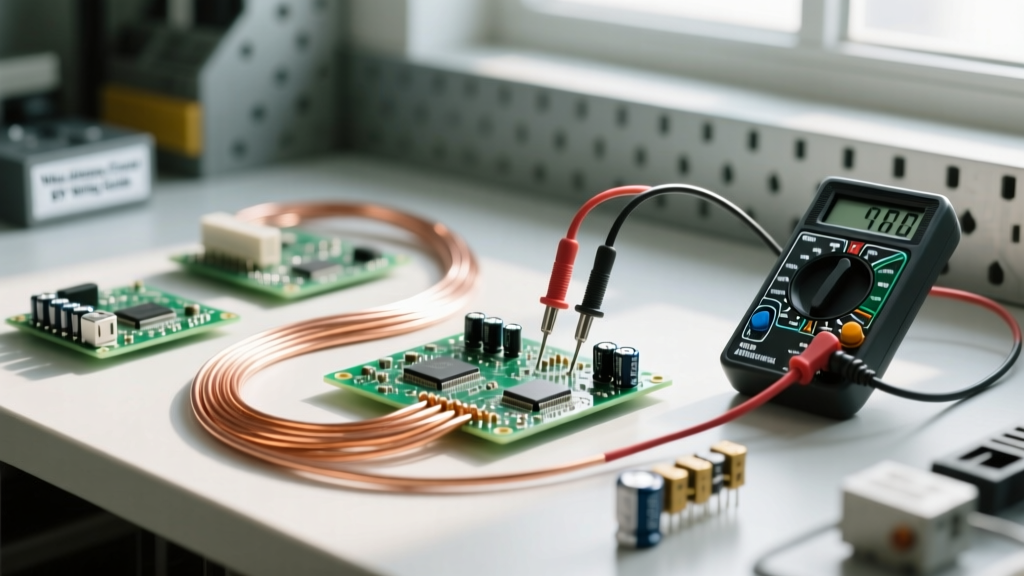
When troubleshooting an AC circuit, the type of multimeter you use matters immensely. Older or cheaper digital multimeters use 'averaging' techniques to calculate RMS voltage. They assume the AC waveform is a mathematically perfect sine wave.
Modern homes are filled with non-linear loads: LED drivers, computer switch-mode power supplies (SMPS), and variable frequency drives (VFDs). These devices draw current in sharp, distorted pulses rather than smooth sine waves. An averaging meter will give you wildly inaccurate readings on these circuits. As noted by Fluke Corporation, you must use a True-RMS multimeter to accurately measure the heating potential of distorted AC waveforms. If you are doing serious DIY electrical troubleshooting, investing in a True-RMS meter is non-negotiable.
AC Voltage Measurement Profiles
| Nominal System | RMS Voltage | Peak Voltage | Peak-to-Peak Voltage | Common Application |
|---|---|---|---|---|
| 120V Single Phase | 120V | 169.7V | 339.4V | Standard US Receptacles, Lighting |
| 240V Single Phase | 240V | 339.4V | 678.8V | Dryers, Ranges, EV Chargers |
| 208V Three Phase | 208V | 294.1V | 588.2V | Light Commercial HVAC, Servers |
Summary for the DIY Electrician
Understanding what alternating current is goes far beyond knowing which slot on the outlet is hot and which is neutral. It requires respecting the 170V peaks hiding inside a 120V circuit, understanding why 60Hz is uniquely dangerous to human physiology, and knowing how to properly measure distorted waveforms. By mastering these AC fundamentals, you ensure your wiring projects are not only functional but fundamentally safe and resilient.