
When designing, installing, or upgrading an electrical system, selecting the correct material of conductor is not merely a matter of budget or personal preference; it is a strict code compliance issue governed by rigorous safety standards. The National Electrical Code (NEC) and international equivalents dictate exactly which metals can safely carry current, how they must be terminated, and where they are permitted. Choosing the wrong material can lead to catastrophic thermal failures, galvanic corrosion, or immediate inspection rejection.
In this comprehensive guide, we dissect the code-mandated standards for conductor materials, comparing copper, aluminum, and controversial alternatives like Copper-Clad Aluminum (CCA). We will explore ampacity derating, termination temperature limits, and the specific alloy mandates that every electrical professional and DIY enthusiast must understand to ensure a safe, code-compliant installation.
Navigating NEC Article 310: Recognized Conductor Materials
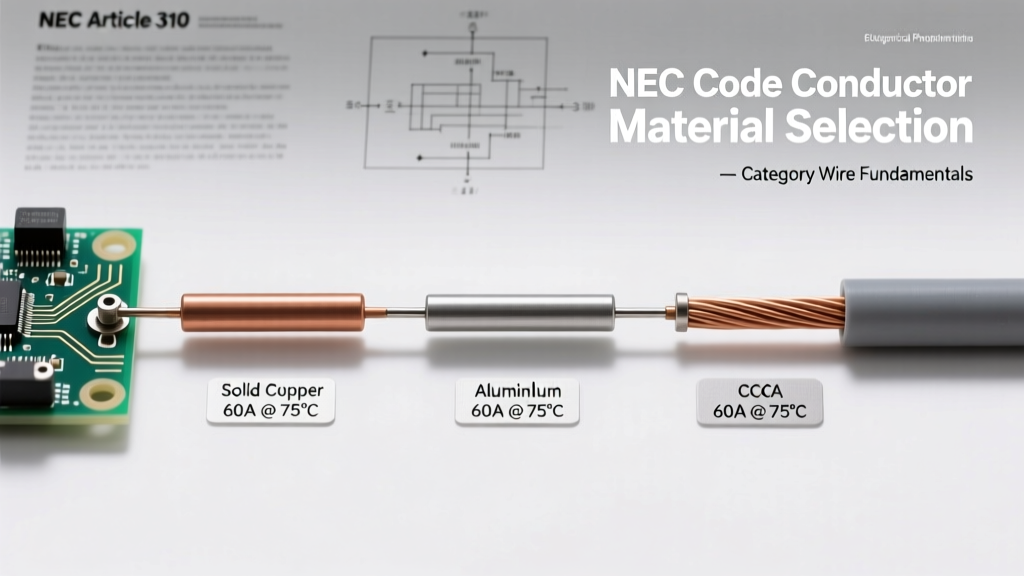
The foundation of conductor selection in North America is NFPA 70 (the NEC), specifically Article 310. Under NEC 310.104, the code explicitly recognizes specific materials for general wiring. The permissible materials include solid or stranded copper, aluminum, and copper-clad aluminum (under very specific, limited conditions). Silver is also technically recognized due to its superior conductivity, but its prohibitive cost restricts it to specialized high-frequency RF applications or precision aerospace wiring.
For standard branch circuits, feeders, and service entrance conductors, the decision almost always comes down to copper versus aluminum. However, the NEC does not treat these materials equally. Because they possess different physical and electrical properties, the code applies distinct sizing rules, ampacity tables, and installation mandates to each.
The Physics of Resistance: Copper vs. Aluminum
To understand why the code treats these materials differently, one must look at their inherent resistivity. Copper is significantly more conductive than aluminum. Specifically, copper has a resistivity of approximately 1.68 x 10^-8 Ω·m, while aluminum sits at 2.82 x 10^-8 Ω·m. This means that for a given wire gauge (cross-sectional area), copper can safely carry more current (ampacity) than aluminum.
To compensate for this, when an installer chooses aluminum as the material of conductor for a feeder or service, they must typically upsize the wire by one or two AWG sizes compared to copper to achieve the same ampacity. For example, a 100-amp residential service might require 3 AWG copper, but it will mandate 1/0 AWG aluminum.
Termination Temperature Provisions (NEC 110.14(C))
One of the most frequently violated code sections regarding conductor materials is NEC 110.14(C), which governs electrical connections and termination temperatures. Modern wire insulation (like THHN/THWN-2) is rated for 90°C. However, most standard residential and commercial circuit breakers, lugs, and disconnect switches are only rated for 75°C or 60°C.
Code Reality Check: You cannot use the 90°C ampacity column in NEC Table 310.16 to size your overcurrent protection device unless every single termination point in the circuit is explicitly rated and marked for 90°C. You must size the wire based on the lowest temperature rating of any connected component.
This rule heavily impacts aluminum conductors. Because aluminum expands and contracts at a different rate than copper or brass terminations, improper torque can lead to loose connections, arcing, and fires. The NEC now mandates the use of calibrated torque tools (NEC 110.14(D)) to ensure terminations are secured to the manufacturer's exact inch-pound specifications, a critical step when using aluminum.
Voltage Drop and the 'K' Constant
While the NEC primarily focuses on safety (preventing fires via ampacity limits), it also provides informational notes regarding voltage drop (NEC 310.15(B)). When calculating voltage drop over long distances, the material of conductor dictates the 'K' constant in the standard single-phase voltage drop formula: VD = (2 × K × I × D) / CM.
- Copper 'K' Constant: Approximately 12.9 ohms per mil-foot (at 75°C).
- Aluminum 'K' Constant: Approximately 21.2 ohms per mil-foot (at 75°C).
Because aluminum's 'K' value is roughly 64% higher than copper's, long feeder runs (such as powering a detached garage or a well pump) will suffer from severe voltage drop if aluminum is not upsized appropriately. Failing to account for this material property can result in motors overheating and premature equipment failure.
The AA-8000 Series Mandate for Aluminum Branch Circuits
Historically, aluminum branch circuit wiring (installed heavily in the 1960s and 70s) utilized AA-1350 grade aluminum. This older alloy was prone to creep (cold flow) and thermal expansion issues, leading to loose terminations and widespread house fires. In response, the industry developed the AA-8000 series alloys (such as AA-8176), which incorporate iron and other trace elements to drastically improve creep resistance and tensile strength.
Today, NEC 310.106(B) strictly mandates that solid or stranded aluminum conductors used for branch circuits (typically 8, 10, and 12 AWG) must be an AA-8000 series electrical grade aluminum alloy. If you are purchasing aluminum branch circuit wire, verify the alloy stamp on the jacket or the manufacturer's spec sheet. Using older, non-compliant AA-1350 aluminum for branch circuits is a severe code violation and an extreme fire hazard.
Copper-Clad Aluminum (CCA): A Code Compliance Warning
Copper-Clad Aluminum (CCA) features an aluminum core with a thin outer layer of copper. It is frequently sold in big-box stores and online marketplaces as a cheaper alternative to solid copper. However, from a Code & Standards perspective, CCA is highly problematic for AC power wiring.
The NEC does not broadly recognize CCA for standard branch circuit wiring in the same vein as pure copper or AA-8000 aluminum. Furthermore, organizations like the Copper Development Association actively warn against its use in AC power applications. CCA wire has a higher DC resistance than pure copper of the same AWG, meaning a 12 AWG CCA wire will overheat if subjected to the full 20-amp load permitted for 12 AWG pure copper. Most UL-listed breakers and receptacles are not tested or approved for termination with CCA, rendering its use in branch circuits a violation of NEC 110.3(B), which requires equipment to be installed in accordance with its listing.
Galvanic Corrosion and Anti-Oxidant Compounds
When aluminum is exposed to air, it rapidly forms a tough, insulating layer of aluminum oxide. This oxide layer increases contact resistance at terminations, generating excessive heat. To combat this, the NEC and manufacturers require the use of anti-oxidant compounds (such as Noalox or Penetrox-E) on aluminum terminations.
Furthermore, when aluminum comes into direct physical contact with copper or brass in the presence of moisture, galvanic corrosion occurs. The aluminum acts as an anode and rapidly corrodes away, destroying the connection. To prevent this, you must use connectors specifically rated for 'AL/CU' (Aluminum-to-Copper) applications, which often feature a physical barrier or specific plating to isolate the dissimilar metals. Connectors must be tested and listed under UL standards (such as UL 486E) for use with aluminum conductors.
Conductor Material Comparison Matrix
| Material | NEC Recognition | Relative Conductivity | Termination Requirements | Primary Use Case |
|---|---|---|---|---|
| Pure Copper | Fully Recognized | 100% (Baseline) | Standard torque; AL/CU lugs not required | Branch circuits, feeders, sensitive electronics |
| AA-8000 Aluminum | Fully Recognized | ~61% of Copper | Anti-oxidant paste; Calibrated torque; AL/CU rated lugs | Service entrances, large feeders, heavy commercial |
| CCA (Power) | Highly Restricted / Unlisted | ~63% (Varies by cladding) | Not approved for standard UL power terminations | Telecom, CATV, Grounding (specific sizes only) |
| Silver | Recognized (Rare) | ~105% of Copper | Specialized high-temp lugs | Aerospace, high-frequency RF, precision lab gear |
Global Standards: IEC 60228 vs. North American NEC
While the NEC dominates North America, international projects rely on the International Electrotechnical Commission (IEC). Under IEC 60228, conductors are classified not just by material, but by their stranding flexibility (Class 1 solid, Class 2 stranded, Class 5 flexible, Class 6 highly flexible). IEC standards heavily favor high-purity annealed copper and enforce strict limits on the resistivity of the metal itself at 20°C. Unlike the NEC, which uses American Wire Gauge (AWG) and Circular Mils (kcmil), IEC standards size the material of conductor strictly by cross-sectional area in square millimeters (mm²), which provides a more direct mathematical correlation to the metal's physical current-carrying capacity.
Final Decision Framework for Installers
When specifying the material of conductor for your next project, use this quick decision framework:
- Branch Circuits (15A - 20A): Always use pure copper. The cost savings of aluminum do not outweigh the termination risks and space constraints in standard residential junction boxes.
- Feeders and Services (100A+): AA-8000 series aluminum is the industry standard and highly cost-effective. Ensure you upsize for voltage drop and use a calibrated torque screwdriver/wrench with anti-oxidant paste.
- Never use CCA for AC Power: Reject any 'bargain' wire that is Copper-Clad Aluminum for branch wiring. The fire risk and inspection failures far outweigh the initial material savings.