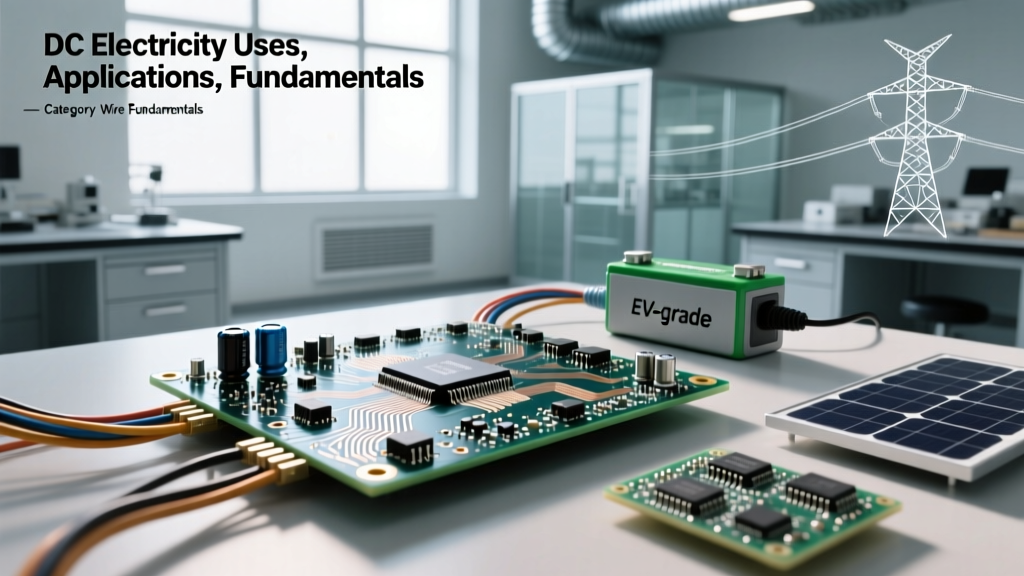

While the late 19th-century 'War of the Currents' crowned Alternating Current (AC) as the king of the power grid, the 21st century is undeniably witnessing a Direct Current (DC) renaissance. As an electrical engineer or DIY enthusiast, understanding what DC electricity is used for is no longer just about batteries and flashlights. Today, DC is the foundational lifeblood of renewable energy, electric mobility, and advanced computing.
'The future of the electrical grid is not purely AC. The proliferation of distributed energy resources, battery storage, and power electronics is driving a massive structural shift toward DC microgrids and HVDC transmission.' — National Renewable Energy Laboratory (NREL)
In this concept explainer, we will deconstruct the physics of Direct Current, explore its five most critical modern applications, and dive into the specific wire sizing and troubleshooting fundamentals required to build safe, efficient DC circuits.
The Core Physics: How Direct Current Actually Works
Direct Current (DC) is defined by the unidirectional flow of electric charge. Unlike AC, where electrons oscillate back and forth in a sinusoidal waveform (typically at 50Hz or 60Hz), DC electrons flow continuously in a single direction from the negative terminal to the positive terminal.
This unidirectional flow results in a constant voltage magnitude over time, which is a strict requirement for semiconductor logic. Transistors, microprocessors, and memory modules cannot interpret oscillating AC waves; they require a steady, flat DC voltage rail (such as 3.3V or 5V) to represent binary 1s and 0s reliably.
What Is DC Electricity Used For? (The Big 5 Applications)
To answer the question of what DC electricity is used for in modern infrastructure, we must look at sectors undergoing rapid electrification and digitalization.
1. Microelectronics and Embedded Systems
Every digital device on earth runs on DC. Microcontrollers like the ESP32 or STM32 require highly regulated, low-ripple DC voltage. Power supply units (PSUs) and voltage regulators (LDOs and Buck converters) are deployed to step down higher DC voltages (like 12V or 19V) into the precise 1.2V, 3.3V, and 5V rails needed for CPU cores, RAM, and GPIO pins.
2. Electric Vehicles (EVs) and Battery Storage
Lithium-ion battery cells inherently store and discharge chemical energy as DC. Modern EV platforms, such as Hyundai’s E-GMP or the Porsche Taycan, utilize 800V DC architectures. By doubling the voltage from the traditional 400V to 800V, engineers can halve the current required for the same power output (P = V × I). This reduces the thickness and weight of the copper wiring harness, minimizes I²R (heat) losses, and enables ultra-fast DC charging rates exceeding 350 kW.
3. Renewable Energy and Solar Microgrids
Photovoltaic (PV) solar panels generate DC electricity via the photoelectric effect. In a traditional setup, an inverter converts this to AC for home use. However, modern DC-coupled microgrids bypass this inefficient double-conversion. Solar charge controllers using Maximum Power Point Tracking (MPPT) directly feed DC into battery banks and native DC appliances, increasing overall system efficiency by up to 15%.
4. High-Voltage Direct Current (HVDC) Transmission
For long-distance power transmission (especially submarine cables and cross-continental lines), HVDC is vastly superior to HVAC. AC suffers from the 'skin effect' (where electrons migrate to the outer edge of the conductor, increasing resistance) and capacitive losses over long distances. DC utilizes the entire cross-sectional area of the conductor and has no reactive power losses, making it the standard for transmitting offshore wind farm energy to the mainland grid.
5. Data Centers and Telecom Infrastructure
Telecom towers and hyperscale data centers are increasingly adopting 48V DC or 380V DC bus distributions. According to research cited by the U.S. Department of Energy, utilizing DC distribution in data centers eliminates multiple AC-to-DC and DC-to-AC conversion stages, drastically improving Power Usage Effectiveness (PUE) and reducing thermal output.
AC vs. DC Power Distribution: A Technical Comparison
| Characteristic | Alternating Current (AC) | Direct Current (DC) |
|---|---|---|
| Electron Flow | Bidirectional (Oscillating) | Unidirectional (Constant) |
| Voltage Transformation | Easy (via passive Transformers) | Complex (requires active Power Electronics) |
| Energy Storage | Cannot be stored directly | Native to Batteries and Capacitors |
| Transmission Losses | High over long distances (Skin/Reactive effect) | Low over long distances (HVDC) |
| Zero-Crossing | Yes (helps extinguish arc faults) | No (requires specialized DC breakers to quench arcs) |
Wire Sizing Considerations for DC Circuits
When designing DC circuits—particularly low-voltage systems like 12V or 24V marine, RV, or solar setups—voltage drop is your primary adversary. Because the system voltage is low, even a small absolute voltage drop represents a massive percentage loss, which can cause microcontrollers to brown out or DC motors to overheat.
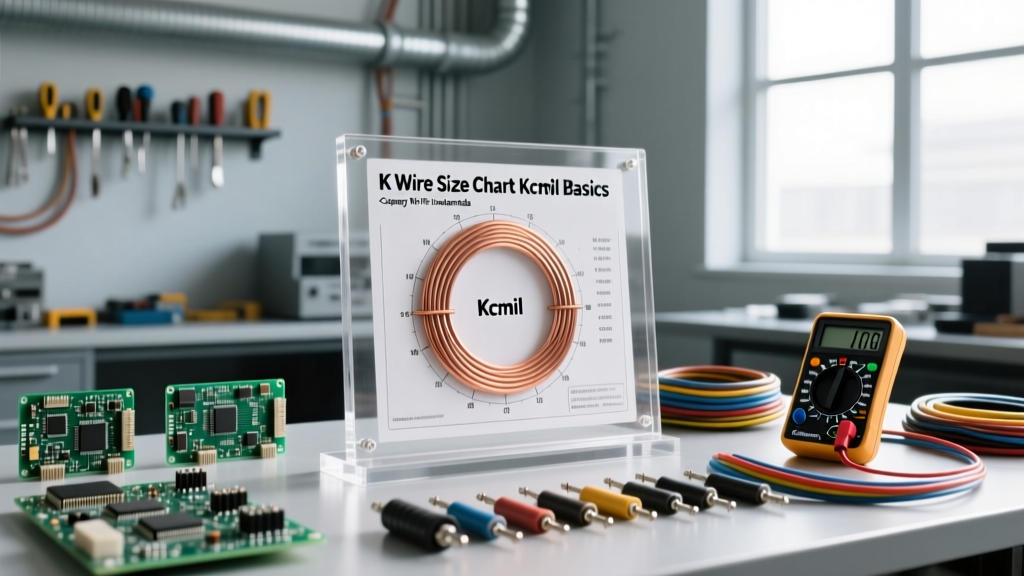
For DC wire sizing, we rely on the Circular Mil (CM) area of the conductor and the specific resistivity (K) of the metal. The standard voltage drop formula for a single-phase DC circuit is:
VD = (2 × K × I × L) / CM
- VD: Voltage Drop
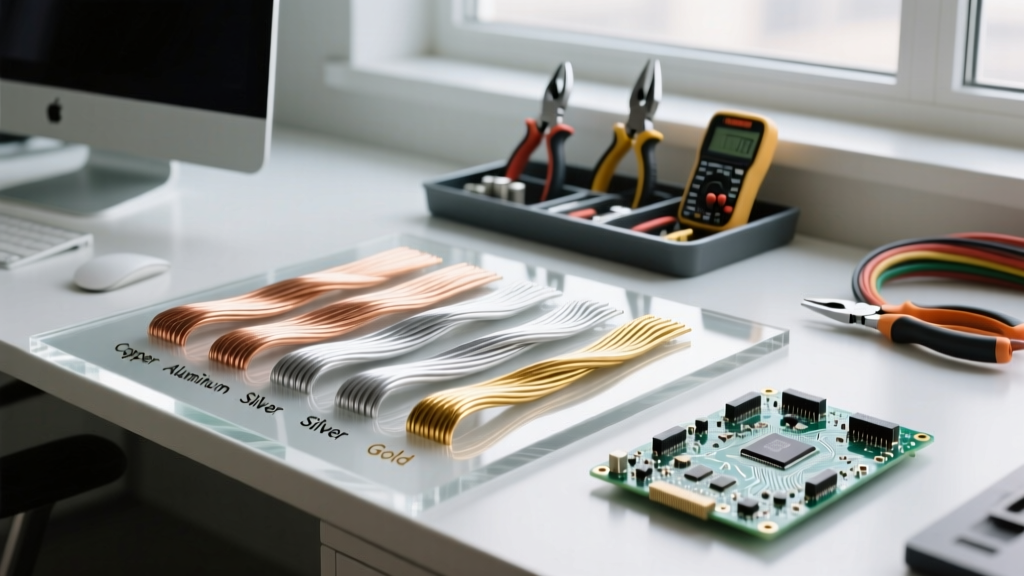
- K: Resistivity of the conductor (approx. 12.9 for Copper, 21.2 for Aluminum at 75°C)
- I: Current in Amps
- L: One-way length of the wire in feet
- CM: Circular Mils of the wire gauge
Practical Sizing Example
Imagine you are wiring a 12V DC water pump drawing 10 Amps, located 15 feet from the battery bank. The total wire run (positive and negative) is 30 feet. The industry standard dictates a maximum voltage drop of 3% for branch circuits (0.36V for a 12V system).
Rearranging the formula to solve for Circular Mils:
CM = (2 × 12.9 × 10 × 15) / 0.36 = 10,750 CM
Looking at a standard AWG chart, 10 AWG wire has 10,380 CM (slightly undersized), while 8 AWG wire has 16,510 CM. Therefore, to maintain a safe voltage drop under 3%, you must select 8 AWG copper wire. Using standard 12 AWG or 14 AWG (common in AC household wiring) would result in severe voltage sag and potential fire hazards due to thermal buildup.
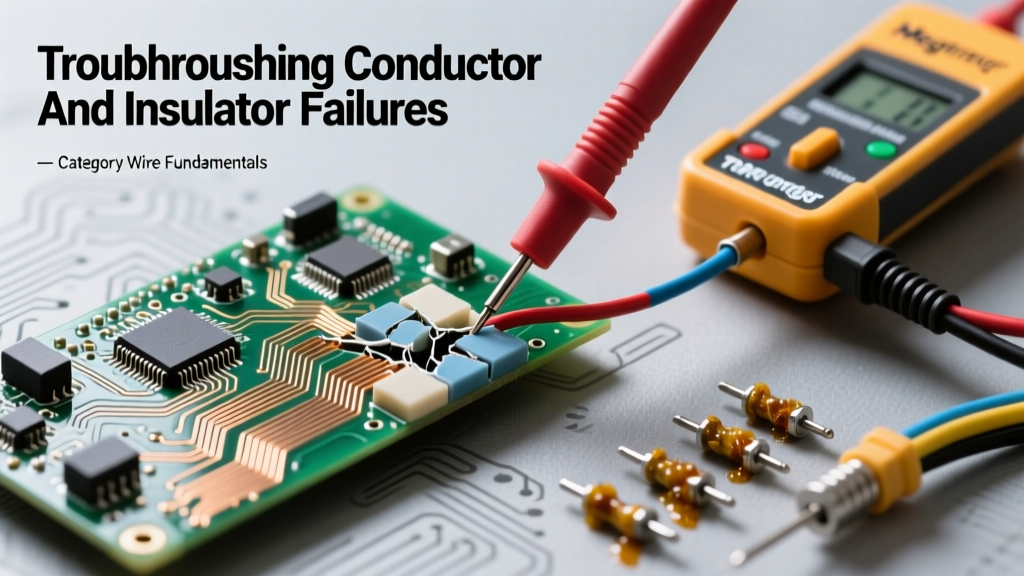
Troubleshooting Common DC Circuit Failures
Working with DC requires a different troubleshooting mindset than AC. Here are the most common failure modes encountered in DC systems:
- Polarity Reversal: Unlike AC, DC is strictly polarized. Connecting a DC power supply backward to a microcontroller or LED array will instantly destroy silicon junctions. Always use reverse-polarity protection diodes (like a Schottky diode) or P-channel MOSFETs at the power entry point.
- DC Arcing at Breakers: Because DC voltage never crosses zero, it does not naturally extinguish electrical arcs when a switch is opened. Standard AC breakers will melt and catch fire if used on high-voltage DC arrays. Always use breakers specifically rated for DC (e.g., rated for 1000V DC for solar applications) which feature internal magnetic blowouts to stretch and quench the arc.
- Ground Loops and Noise: In mixed-signal DC circuits (like audio amplifiers or sensitive sensor arrays), multiple ground paths can create 'ground loops,' introducing hum and logic errors. Implement a single-point 'star ground' topology to ensure all DC return currents flow back to the power source without interfering with one another.
Summary
So, what is DC electricity used for? It is the absolute prerequisite for the digital age, the backbone of the green energy transition, and the key to high-efficiency power transmission. Whether you are sizing 8 AWG wire for a 12V solar array, designing a 3.3V logic circuit for an IoT sensor, or studying 800V EV architectures, mastering DC fundamentals and proper wire sizing is essential for any modern electrical practitioner.