
The Evolution of the Weller Soldering Tip: 2026 Landscape
When building complex DIY electronics kits or executing professional PCB repairs, the iron itself is only half the equation. The true interface between your station and the solder joint is the Weller soldering tip. In 2026, with the hobbyist and professional markets heavily skewed toward high-density surface-mount devices (SMD) and aggressive lead-free flux chemistries, selecting the correct tip profile and metallurgical series is no longer optional—it is critical for joint reliability.
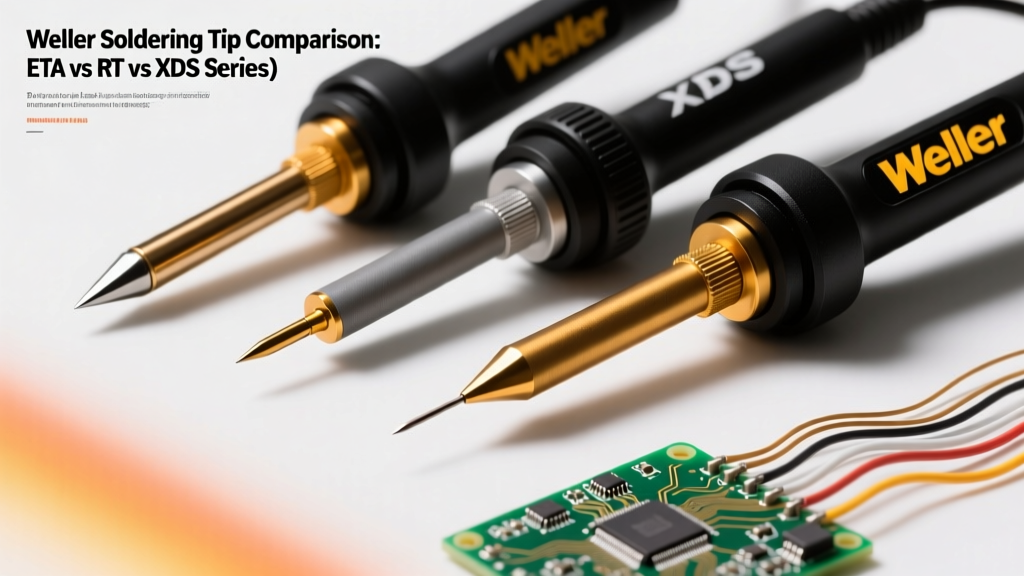
This guide provides a deep-dive comparison of the three most dominant Weller soldering tip ecosystems: the legacy ETA series, the precision RT active series, and the lead-free optimized XDS series. We will analyze thermal recovery, failure modes, and exact profile recommendations for specific kit types.
Metallurgical Anatomy: What Makes a Weller Tip Last?
To understand why a specific Weller soldering tip fails or excels, you must understand its internal architecture. According to manufacturing guidelines aligned with IPC standard workmanship requirements, a high-quality tip is not a solid piece of metal. It is a complex, multi-layered composite engineered for specific thermal and chemical challenges.
- Core: Oxygen-Free High Conductivity (OFHC) copper. This provides rapid heat transfer from the heating element to the working face.
- Plating: Electrolytic iron. Copper dissolves rapidly in molten tin. The iron layer acts as a sacrificial barrier that resists tin dissolution while maintaining a wettable surface.
- Shaft Coating: Chromium or specialized ceramic flash. This prevents solder from creeping up the sides of the tip, keeping the heat localized to the working face.
When the iron plating is compromised—either through mechanical abrasion or chemical dissolution—the molten solder attacks the copper core, resulting in 'hollowing' and catastrophic tip failure.
Weller ETA Series: The WES51 Workhorse
The ETA (Long Barrel) series is designed for the legendary Weller WES51 and WESD51 analog stations, which remain staples in DIY kit-building workspaces. These tips feature a 1/4-inch (6.35mm) base diameter and rely on conductive heat transfer from a separate ceramic heating element.
Key ETA Profiles for Kit Building
- ETB (1/32" Chisel): The ultimate general-purpose profile. Ideal for standard through-hole kit assembly, 0805 SMD components, and tinning 22AWG hookup wire. The narrow face allows for precise heat application without bridging adjacent pads on standard 2.54mm pitch headers.
- ETD (1/8" Heavy Chisel): Essential for power electronics kits. When soldering heavy gauge wires (14AWG to 18AWG) to large ground planes or thick copper pours, the ETB will suffer from thermal droop. The ETD's massive thermal mass ensures the joint reaches the 217°C+ liquidus temperature required for SAC305 lead-free solder within 2 to 3 seconds.
- ETK (Conical): Best reserved for point-to-point wiring in tube amplifiers or tight chassis work. It is generally not recommended for modern SMD PCB kits due to its poor thermal transfer surface area compared to a chisel profile.
Weller RT Series: Active Micro-Tips for High-Density SMD
As DIY kits increasingly incorporate Wi-Fi modules, ESP32-S3 breakouts, and 0402 passive components, the thermal mass of the ETA series becomes a liability. Enter the RT series, designed for Weller's WMRP, WXMP, and WXMPR micro-handles.
The defining feature of an RT Weller soldering tip is its active architecture. The heating element and the temperature sensor are integrated directly into the tip itself, mere millimeters from the working face. This eliminates the thermal lag inherent in conductive barrel tips.
RT Profiles for Micro-Soldering
- RT1 (0.8mm Micro Chisel): The gold standard for 0402 and 0603 SMD kit assembly. The 20-watt continuous power delivery allows for instant reflow of small pads without risking thermal damage to sensitive ICs.
- RT2 (0.4mm Pencil): Used for reworking fine-pitch QFN packages or soldering 0201 components under a microscope. Requires a steady hand and high-quality flux (e.g., Chip Quik NC191).
- RT4 (1.6mm Blade): The secret weapon for drag-soldering SOIC, SOIC-W, and TSSOP chips commonly found in advanced microcontroller kits. The wide blade holds a uniform curtain of molten solder, allowing you to drag across 20+ pins in a single, fluid motion.
Weller XDS Series: Solving the Lead-Free Dissolution Crisis
The transition to RoHS-compliant, lead-free solders (like SAC305 and SN100C) introduced a severe problem: tin-silver-copper alloys are highly aggressive and dissolve standard iron tip plating up to three times faster than traditional 63/37 SnPb eutectic solder. For professionals or hobbyists exclusively building lead-free kits, standard ETA or RT tips may degrade in weeks.
This necessitates the use of the Weller XDS series. According to Weller Tools engineering data, XDS tips feature a proprietary multi-alloy diffusion barrier between the copper core and the iron plating. This layer prevents the micro-cracking and rapid dissolution that plagues standard tips when exposed to high-temperature lead-free profiles (350°C - 380°C).
Pro Tip for Lead-Free Kit Assembly: Never exceed 360°C when using an XDS tip with SAC305 solder. If the solder refuses to flow, the issue is rarely the tip temperature; it is almost always insufficient flux activation. Apply additional no-clean flux rather than turning up the station dial.Weller Soldering Tip Comparison Matrix
| Series | Compatible Handle | Best Application | Thermal Response | Lead-Free Durability | Avg. Cost (2026) |
|---|---|---|---|---|---|
| ETA | WESP (WES51/WESD51) | Through-hole, heavy wire, general DIY kits | Moderate (Conductive) | Standard | $8.50 - $11.00 |
| RT | WMRP / WXMP / WXMPR | 0402/0603 SMD, fine-pitch ICs, drag soldering | Instant (Active) | Standard (RT) / High (RT XMS) | $45.00 - $58.00 |
| XDS | WSP80 / WXP120 | High-volume lead-free PCB assembly | Fast (Conductive) | Exceptional | $14.00 - $18.00 |
Real-World Failure Modes and Edge Cases
Even the best Weller soldering tip will fail prematurely if subjected to poor workshop habits. Understanding these failure modes is essential for maintaining your kit-building arsenal.
1. Iron Plating Dissolution (Hollowing)
Cause: Using highly active fluxes (like RA or water-soluble organic acids) without post-solder cleaning, combined with high idle temperatures. The flux eats through the microscopic pores in the iron plating, allowing molten solder to reach the copper core.
Symptom: The tip develops a concave crater on the working face. Solder balls up and rolls off.
Fix: The tip is permanently ruined. Switch to a milder RMA or No-Clean flux for standard kit assembly.
2. Thermal Fatigue Cracking
Cause: Rapidly quenching a hot tip in water or aggressively wiping it on a soaking wet cellulose sponge. The sudden temperature drop causes the iron plating (which has a different coefficient of thermal expansion than the copper core) to micro-crack.
Symptom: Visible spider-web cracks near the working face, leading to rapid oxidation.
Fix: Always use a dry brass wire sponge (like the Weller WDC2). It cleans the tip without dropping the surface temperature drastically.
3. De-wetting (Oxidation Build-up)
Cause: Leaving the station on at 400°C for hours without use. The iron plating oxidizes, forming a barrier that solder cannot wet.
Symptom: Solder refuses to stick to the tip, forming distinct beads that fall off.
Fix: Never use sandpaper or a file. Apply a generous amount of tip tinner paste (e.g., Weller 0058715999), heat to 350°C, and wipe on brass wool. Repeat until the silver color returns.
Maintenance Protocol for Kit Builders
To maximize the lifespan of the ETA, RT, or XDS series tip, follow this strict operational protocol recommended by high-reliability ANSI/IPC certified trainers:
- Pre-Heat: Turn the station on only when you are ready to solder. Do not let the iron idle for more than 5 minutes without use.
- Flux First: Always apply flux to the joint before the tip touches the pad. This prevents the tip from oxidizing during the heat transfer phase.
- Clean Properly: Use a high-quality brass wool cleaner. If using a cellulose sponge, use distilled water and wring it out until it is barely damp.
- Retin Before Storage: Before turning off the station, melt a large blob of 63/37 leaded solder onto the working face. This sacrificial layer protects the iron plating from atmospheric oxidation while cooling.
Frequently Asked Questions (FAQ)
Can I use an RT tip on a standard WES51 station?
No. The RT series requires a Weller micro-handle (WMRP, WXMP, or WXMPR) because the power delivery and sensor reading mechanisms are entirely different. The WES51 outputs power to an internal ceramic heater in the WESP handle, which transfers heat conductively to ETA tips.
Which Weller soldering tip is best for beginners building Arduino kits?
For standard Arduino starter kits featuring through-hole DIP packages and 2.54mm headers, the Weller ETB (1/32" Chisel) is the optimal choice. It provides enough surface area to heat the pad and lead simultaneously without bridging adjacent pins.
How often should I replace my Weller tip?
In a typical hobbyist environment (10-15 hours a week), a well-maintained ETA or XDS tip should last 1 to 2 years. RT tips, due to their integrated heating elements, typically last 6 to 12 months depending on the operating temperature and frequency of use.
Conclusion
Selecting the correct Weller soldering tip is an exercise in matching thermal mass and metallurgical durability to your specific kit requirements. For robust through-hole and power electronics, the ETA series remains an economical and reliable workhorse. For modern, high-density SMD microcontroller kits, the active heating of the RT series is an absolute necessity to prevent thermal damage to delicate silicon. Finally, if your workflow is dominated by aggressive lead-free solders, investing in the XDS series will save you significant time and frustration by eliminating premature tip dissolution. Equip your station with the right profile, maintain your iron plating, and your solder joints will consistently meet professional reliability standards.