
The Evolution of Sensor-Driven Arduino Projects and Codes
When browsing through legacy arduino projects and codes, most tutorials rely on a single sensor and blocking delay() functions. In 2026, real-world environmental monitoring demands multi-sensor fusion, non-blocking asynchronous architectures, and strict power profiling. Building a reliable indoor air quality (IAQ) node requires moving beyond basic temperature readings into the realm of photoacoustic NDIR CO2 sensing and Metal-Oxide (MOX) volatile organic compound (VOC) detection.
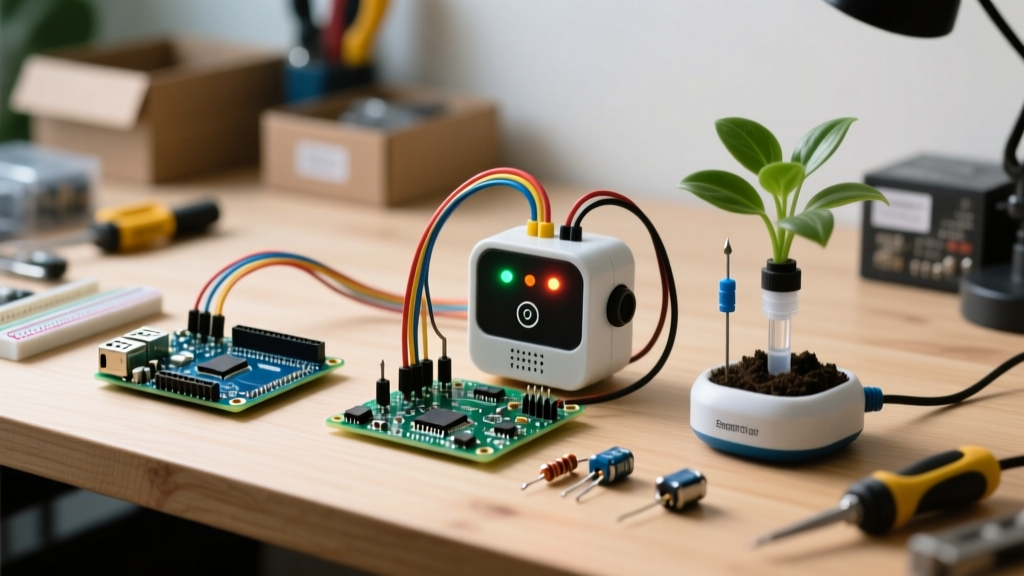
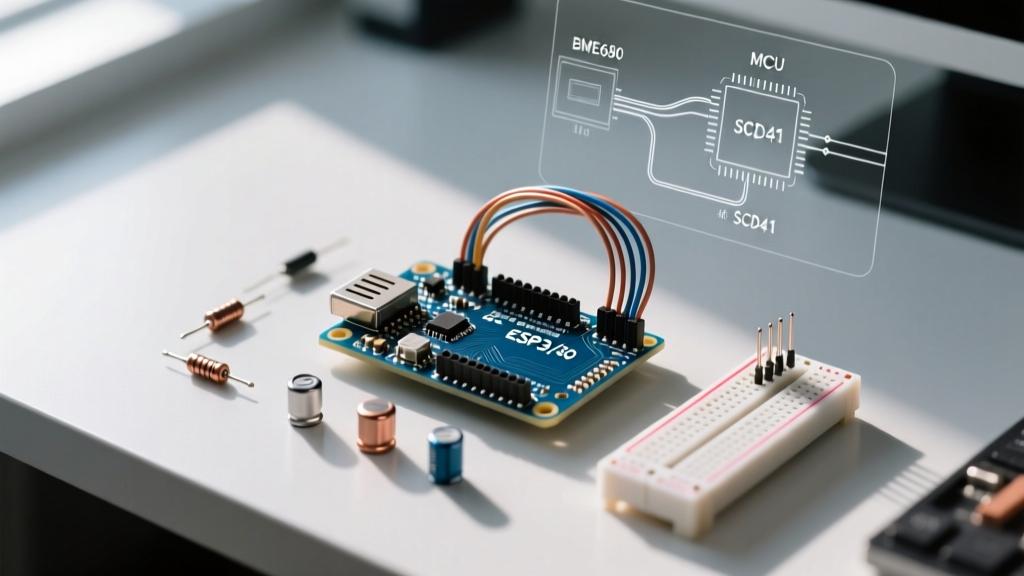
This guide deconstructs the hardware selection, I2C bus physics, and non-blocking C++ code required to fuse data from a Bosch BME680 and a Sensirion SCD41 onto an Arduino Nano ESP32. By the end, you will have a production-ready sensor node capable of Wi-Fi telemetry without dropping packets due to sensor read latencies.
The Blocking Code Trap: The Sensirion SCD41 requires up to 5 seconds to complete a single CO2 measurement cycle. Using delay(5000) in your Arduino code will starve the ESP32's Wi-Fi and Bluetooth stacks, leading to random disconnects and watchdog timer (WDT) resets. Non-blocking state machines are mandatory for modern sensor-driven projects.
Hardware BOM: 2026 Multi-Sensor Stack
Selecting components with non-overlapping I2C addresses and compatible logic levels eliminates the need for bulky multiplexers or level shifters. The Arduino Nano ESP32 operates natively at 3.3V, which perfectly matches the logic requirements of both the BME680 and SCD41.
| Component | Model / Part Number | Est. Price (2026) | I2C Address | Primary Function |
|---|---|---|---|---|
| Microcontroller | Arduino Nano ESP32 (ABX00083) | $21.50 | N/A | Wi-Fi/BLE Processing & Deep Sleep |
| Environmental Sensor | Bosch BME680 (Adafruit 3660) | $18.00 | 0x76 / 0x77 | Temp, Humidity, Pressure, VOC (MOX) |
| CO2 Sensor | Sensirion SCD41 (SparkFun SEN-18365) | $28.50 | 0x62 | NDIR CO2, Temp, Humidity |
| Pull-up Resistors | 2.2kΩ 1/4W Carbon Film | $0.10 | N/A | I2C Bus Capacitance Compensation |
I2C Bus Architecture and Wiring Pitfalls
A common failure mode in advanced arduino projects and codes involving multiple I2C sensors is bus capacitance. The SCD41 has a relatively high internal capacitance. While the Arduino Nano ESP32 features internal pull-up resistors, they are approximately 45kΩ—far too weak to pull the SDA/SCL lines high quickly enough for 400kHz Fast Mode I2C.
Wiring Protocol
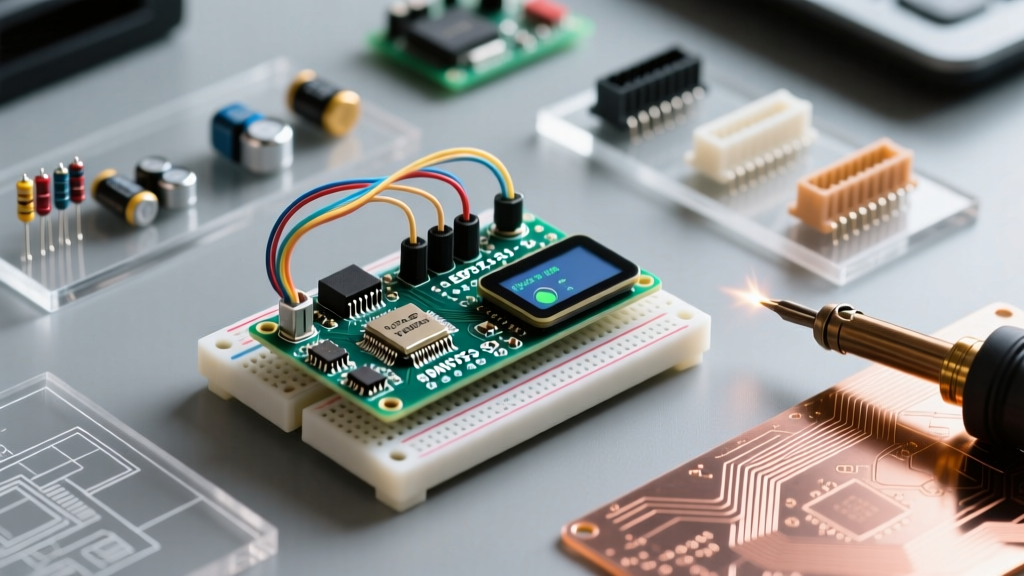
- SDA / SCL: Connect the SDA and SCL pins of both the BME680 and SCD41 in parallel to the Nano ESP32's A4 (SDA) and A5 (SCL) pins.
- Power: Tie both sensor VCC pins to the Nano ESP32's 3.3V output. Do not use the 5V pin; the SCD41's internal logic will be damaged.
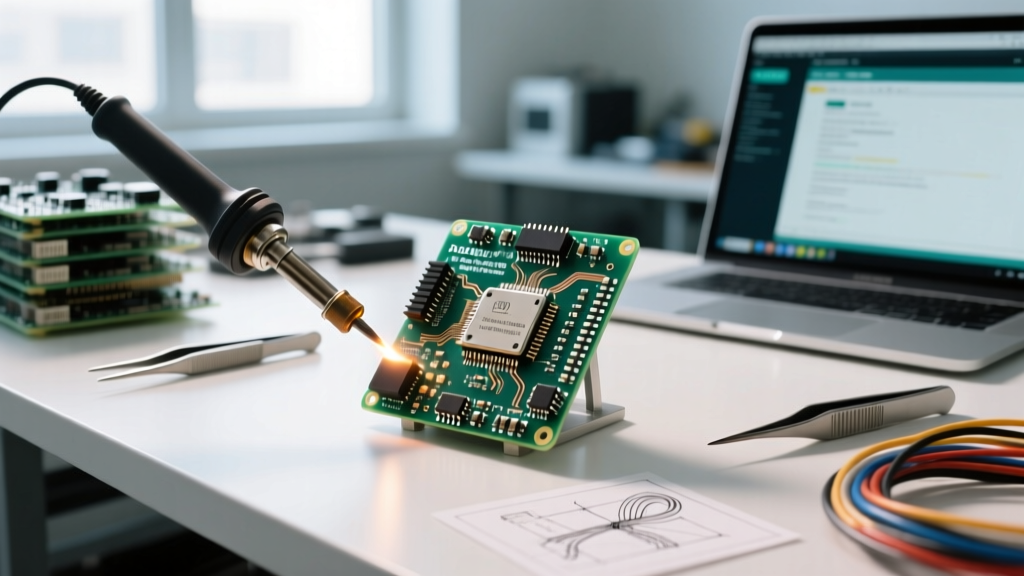
- External Pull-ups: Solder a 2.2kΩ resistor between SDA and 3.3V, and another 2.2kΩ between SCL and 3.3V. This ensures crisp square wave edges on the I2C bus, preventing CRC checksum errors during data transmission.
Non-Blocking Arduino Code for Sensor Fusion
Below is the core C++ architecture for polling both sensors without halting the ESP32's background RF tasks. We utilize the millis() function to create a non-blocking timer specifically for the SCD41's 5-second measurement window, while the BME680 is polled on a separate 2-second interval.
#include <Wire.h>
#include <Adafruit_BME680.h>
#include <SparkFun_SCD4x_Arduino_Library.h>

Adafruit_BME680 bme;
SCD4x mySensor;

unsigned long lastBMERead = 0;
unsigned long lastSCD41Command = 0;
const long BME_INTERVAL = 2000;
const long SCD41_INTERVAL = 5000;

bool scd41Measuring = false;

void setup() {
  Serial.begin(115200);
  Wire.begin();
  Wire.setClock(400000); // 400kHz Fast Mode

  if (!bme.begin(0x76)) {
    Serial.println("BME680 Init Failed. Check I2C pull-ups.");
    while (1);
  }

  // Set BME680 oversampling for stable indoor readings
  bme.setTemperatureOversampling(BME680_OS_8X);
  bme.setHumidityOversampling(BME680_OS_2X);
  bme.setPressureOversampling(BME680_OS_4X);
  bme.setIIRFilterSize(BME680_FILTER_SIZE_3);
  bme.setGasHeater(320, 150); // 320*C for 150ms

  if (mySensor.begin(Wire, true) == false) {
    Serial.println("SCD41 Init Failed. Address 0x62 not found.");
    while (1);
  }
  mySensor.startPeriodicMeasurement();
  lastSCD41Command = millis();
}

void loop() {
  unsigned long currentMillis = millis();

  // Non-blocking BME680 Read
  if (currentMillis - lastBMERead >= BME_INTERVAL) {
    lastBMERead = currentMillis;
    if (bme.performReading()) {
      Serial.print("BME680 Temp: "); Serial.print(bme.temperature);
      Serial.print(" | VOC: "); Serial.println(bme.gas_resistance);
    }
  }

  // Non-blocking SCD41 Read (5s latency handled via state check)
  if (currentMillis - lastSCD41Command >= SCD41_INTERVAL) {
    lastSCD41Command = currentMillis;
    if (mySensor.readMeasurement()) {
      Serial.print("SCD41 CO2: "); Serial.print(mySensor.getCO2());
      Serial.println(" ppm");
    }
  }

  // Yield to ESP32 Wi-Fi/BT stacks
  yield();
}
Calibration Physics: NDIR vs. MOX Sensors
Understanding the physical sensing elements is critical when interpreting the data outputted by your code. The BME680 and SCD41 measure overlapping metrics (temperature and humidity) but use entirely different physics for air quality.
SCD41 Photoacoustic NDIR CO2 Sensing
The SCD41 uses a miniature photoacoustic sensor. A modulated infrared light source excites CO2 molecules, causing them to expand and create a pressure wave that a MEMS microphone detects. Because it relies on acoustic resonance, it is highly immune to dust and humidity interference. However, it requires Automatic Self-Calibration (ASC). The sensor assumes the lowest CO2 reading it sees over a 7-day period is 420 ppm (outdoor baseline). If deployed in a sealed, unventilated room, the ASC will drift, reporting inaccurate lows. Actionable fix: Expose the node to fresh outdoor air for 10 minutes and trigger mySensor.performForcedRecalibration(420) via code if baseline drift is suspected.
BME680 Metal-Oxide (MOX) VOC Sensing
The BME680's gas sensor relies on a heated metal-oxide layer. VOCs in the air react with oxygen on the heated surface, changing the layer's electrical resistance. Unlike the SCD41, the BME680 does not output a specific ppm value for a single gas; it outputs a raw resistance value (Ohms). A drop in resistance indicates an increase in VOCs. To make this useful in your Arduino projects, you must implement a software baseline tracker that calculates the rolling average of the highest resistance values over 24 hours to define your 'clean air' benchmark.
Power Profiling and Battery Edge Cases
For remote environmental nodes, battery life dictates deployment viability. The Arduino Nano ESP32 supports deep sleep, but sensor behavior during sleep states is a frequent point of failure.
- SCD41 Sleep Current: When not actively measuring, the SCD41 drops to roughly 1.2 mA. However, if you put the ESP32 into deep sleep without sending the SCD41 a stop command (
mySensor.stopPeriodicMeasurement()), the sensor will continue drawing power. Always issue the stop command before triggering ESP32esp_deep_sleep_start(). - BME680 Heater Drift: The BME680's gas heater draws ~30 mA when active. In battery-powered setups, configure the code to only power the heater for the 150ms required for a reading, rather than leaving it in continuous mode.
- Quiescent System Draw: With both sensors in standby and the Nano ESP32 in light sleep (modem sleep), expect a baseline draw of ~8 mA. Running a 2000mAh 18650 LiPo cell, this yields approximately 10 days of continuous operation, or up to 6 months if utilizing a 5-minute deep sleep telemetry interval.
Troubleshooting Common Sensor-Driven Coding Roadblocks
Even with perfect wiring, environmental factors can cause code execution anomalies. Here is how to handle the most common edge cases in 2026 sensor arrays:
- I2C Bus Lockups: If the ESP32 experiences a brownout, the I2C clock line can get stuck low. Implement a software I2C bus recovery routine in your
setup()that toggles the SCL pin as a GPIO 9 times to release the bus before callingWire.begin(). - Condensation on SCD41: If humidity exceeds 95% RH, condensation can form on the SCD41's acoustic membrane, completely blocking CO2 readings and returning 0 ppm. Add a logic gate in your code: if BME680 humidity reads > 92%, flag the SCD41 CO2 data as invalid in your database payload.
- Thermal Crosstalk: The BME680's internal heater will artificially raise the temperature readings of the SCD41 if they are placed less than 2cm apart on a custom PCB. Maintain a minimum 3cm physical separation, or use the SCD41's built-in temperature offset compensation register via
mySensor.setTemperatureOffset(2.5)to correct the delta.
By mastering the intersection of I2C physics, non-blocking code structures, and sensor material science, you elevate your builds from simple hobbyist experiments to robust, deployment-ready environmental monitors. For further technical specifications on sensor timing diagrams, refer to the Sensirion SCD41 official datasheet and the Bosch BME680 product documentation. Hardware integration guidelines for the microcontroller can be found in the Arduino Nano ESP32 official docs.