
The Carbon Track Bottleneck: Why Migrate?
Every maker’s journey begins with the same ubiquitous component: the 10K Ohm carbon-track rotary potentiometer. Included in almost every starter kit, these mechanical variable resistors are perfect for learning basic analog-to-digital conversion. However, as projects evolve from blinking LEDs to precision motor control, audio mixing, or industrial HMI (Human-Machine Interface) panels, the standard potentiometer in Arduino circuits quickly becomes the weakest link.
Carbon track pots suffer from mechanical wiper degradation, environmental sensitivity (dust and moisture cause open-circuit dead spots), and inherent electrical noise. In 2026, with advanced sensor modules cheaper than ever, clinging to legacy carbon tracks limits your project's reliability. This migration guide explores three distinct upgrade paths to replace your mechanical potentiometer, detailing exact hardware models, wiring changes, and code adaptations.
Path 1: Conductive Plastic Precision Pots (The Analog Upgrade)
If your application strictly requires an analog voltage divider and you want to retain the analogRead() function without adding I2C overhead, migrating to a conductive plastic element is the first step.
The Hardware: Bourns 3590 Series
Unlike carbon, conductive plastic elements offer a vastly superior lifespan and tighter linearity. The Bourns 3590S-1-103L (a 10K Ohm, 10-turn precision pot) is an industry standard. While a standard carbon pot survives roughly 10,000 to 15,000 rotation cycles, the 3590 series is rated for 5,000,000 cycles. Furthermore, it boasts a linearity of 0.25%, meaning the physical rotation maps almost perfectly to the electrical output, eliminating the "dead zones" common in cheap audio-taper or linear carbon pots.
- Cost: ~$14.00 - $16.00 per unit.
- Best For: High-precision manual calibration dials, analog synthesizers, and medical prototyping.
- Wiring: Identical to standard pots (VCC, GND, Wiper to Analog Pin).
Path 2: Contactless Hall Effect Encoders (The Modern Standard)
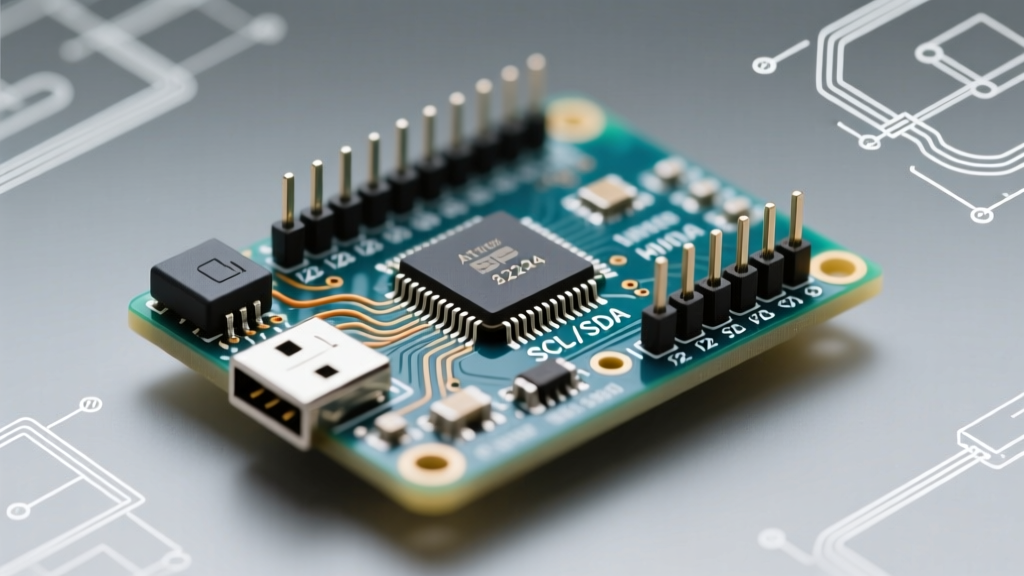
For infinite rotation, zero mechanical wear, and immunity to physical vibration, magnetic rotary encoders represent the ultimate migration path. These devices read the angular position of a diametric magnet using the Hall effect, outputting digital data over I2C.
The Hardware: AMS OSRAM AS5600 Breakout
The AS5600 is a 12-bit programmable contactless encoder. It provides 4,096 discrete steps per revolution (compared to the ~800 usable steps of a 10-bit Arduino ADC reading a noisy carbon pot). Because there is no physical wiper scraping a resistive track, the lifespan is theoretically infinite, limited only by the bearing of the magnet mount.
Expert Insight: The ATmega328P ADC requires a source impedance of less than 10kΩ to fully charge its internal 14pF sample-and-hold capacitor within 1.5 ADC clock cycles. Using a standard 100K carbon pot creates a 25K impedance at the midpoint, causing massive ADC jitter. The AS5600 completely bypasses the Arduino's internal ADC, relying on its own highly stable internal 12-bit ADC and transmitting clean digital data via I2C.
- Cost: ~$2.00 - $3.50 for a breakout board (2026 pricing).
- Best For: Volume knobs, robotic joint feedback, and infinite-scroll UI menus.
- Wiring: VCC to 5V/3.3V, GND to GND, SDA to A4, SCL to A5 (on Uno/Nano).
For a deeper understanding of how magnetic sensing eliminates mechanical failure points, refer to the Texas Instruments Hall-Effect Sensor Overview.
Path 3: Digital Potentiometers (The Automated Upgrade)
Sometimes, you don't want a human turning a knob at all. If your goal is to replace a potentiometer used for biasing, gain control, or automated calibration, a digital potentiometer (digipot) controlled via I2C or SPI is the correct migration.
The Hardware: Microchip MCP4551
The MCP4551-104E/MS is a single, 7-bit volatile, 100K Ohm digital potentiometer. It features 257 wiper steps and retains its wiper position in non-volatile memory (EEPROM) across power cycles. This allows your Arduino to automatically calibrate sensor offsets on startup without requiring manual trimming by a technician.
- Cost: ~$1.20 - $1.80 per IC.
- Best For: Programmable gain amplifiers (PGA), automated offset nulling, and IoT-controlled analog circuits.
- Wiring: I2C bus (SDA/SCL), plus the three terminal pins (A, W, B) integrated into your analog circuit.
You can explore the full architecture of these components in the Microchip Digital Potentiometers Documentation.
Migration Comparison Matrix
| Technology | Model Example | Lifespan (Cycles) | Resolution | Interface | Est. Cost (2026) |
|---|---|---|---|---|---|
| Carbon Track (Baseline) | Alpha SRV1611 (10K) | ~15,000 | ~800 steps (ADC limited) | Analog Voltage | $0.15 |
| Conductive Plastic | Bourns 3590S-1-103L | 5,000,000 | ~1000 steps (ADC limited) | Analog Voltage | $14.50 |
| Hall Effect Encoder | AS5600 Breakout | Infinite (Contactless) | 4,096 steps (12-bit) | I2C / Analog Out | $2.50 |
| Digital Potentiometer | MCP4551-104E | 50,000 (Wiper writes) | 257 steps | I2C | $1.50 |
Code Migration: From Analog to I2C
When migrating from a standard potentiometer in Arduino setups to an I2C-based solution like the AS5600, your code must shift from simple analog polling to digital bus communication. The Arduino analogRead() documentation is great for basics, but I2C requires the Wire.h library.
Legacy Carbon Pot Code
int sensorValue = analogRead(A0);
int mappedValue = map(sensorValue, 0, 1023, 0, 255);
Upgraded AS5600 Hall Effect Code
#include <Wire.h>
#define AS5600_ADDR 0x36

void setup() {
  Wire.begin();
  Serial.begin(115200);
}

void loop() {
  Wire.beginTransmission(AS5600_ADDR);
  Wire.write(0x0C); // Raw angle MSB register
  Wire.endTransmission();
  Wire.requestFrom(AS5600_ADDR, 2);

  if (Wire.available() == 2) {
    int rawAngle = (Wire.read() << 8) | Wire.read();
    // rawAngle is 0-4095 (12-bit resolution)
    int mappedValue = map(rawAngle, 0, 4095, 0, 255);
    Serial.println(mappedValue);
  }
  delay(10);
}
Staying Analog? Mitigating Wiper Jitter
If your project constraints force you to remain on an analog potentiometer (e.g., repairing vintage gear or ultra-low BOM cost constraints), you must address ADC jitter. A standard 10K pot on a 5V Arduino Uno yields 4.88mV per step. Electromagnetic interference and wiper micro-disconnects easily cause +/- 2 LSB (Least Significant Bit) jitter, making your readings fluctuate wildly.
Hardware Fix: The RC Low-Pass Filter
Do not rely solely on software averaging. Place a passive RC low-pass filter between the potentiometer wiper and the Arduino analog pin.
- Resistor: 10KΩ in series with the wiper.
- Capacitor: 100nF (0.1μF) ceramic capacitor from the analog pin to GND.
- Math: The cutoff frequency is calculated as f = 1 / (2πRC). With these values, the cutoff is approximately 159 Hz. This filters out high-frequency electrical noise while perfectly passing the sub-5Hz frequency of a human hand turning a knob.
Software Fix: Exponential Moving Average (EMA)
If hardware filtering isn't enough, implement an EMA filter in your sketch. Unlike a simple rolling average that introduces lag and requires large arrays, an EMA uses minimal memory and responds smoothly:
float alpha = 0.1; // Smoothing factor (lower = smoother but more lag)
float smoothedValue = 0;

void loop() {
  float newReading = analogRead(A0);
  smoothedValue = (alpha * newReading) + ((1.0 - alpha) * smoothedValue);
}
Summary: Choosing Your Upgrade Path
Migrating away from the basic carbon potentiometer in Arduino circuits is a hallmark of transitioning from hobbyist prototypes to robust, production-ready electronics. Choose Conductive Plastic if you need high-resolution analog voltage dividers for precision lab equipment. Choose Hall Effect Encoders (AS5600) for consumer-facing knobs, infinite rotation, and immunity to mechanical wear. Finally, select Digital Potentiometers when your microcontroller needs to autonomously tune analog circuit parameters without human intervention.