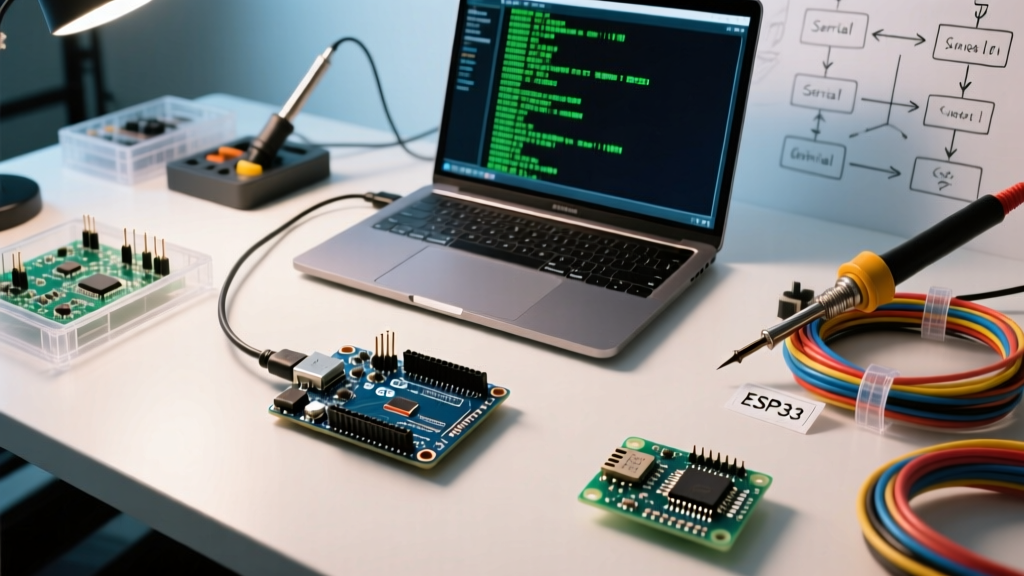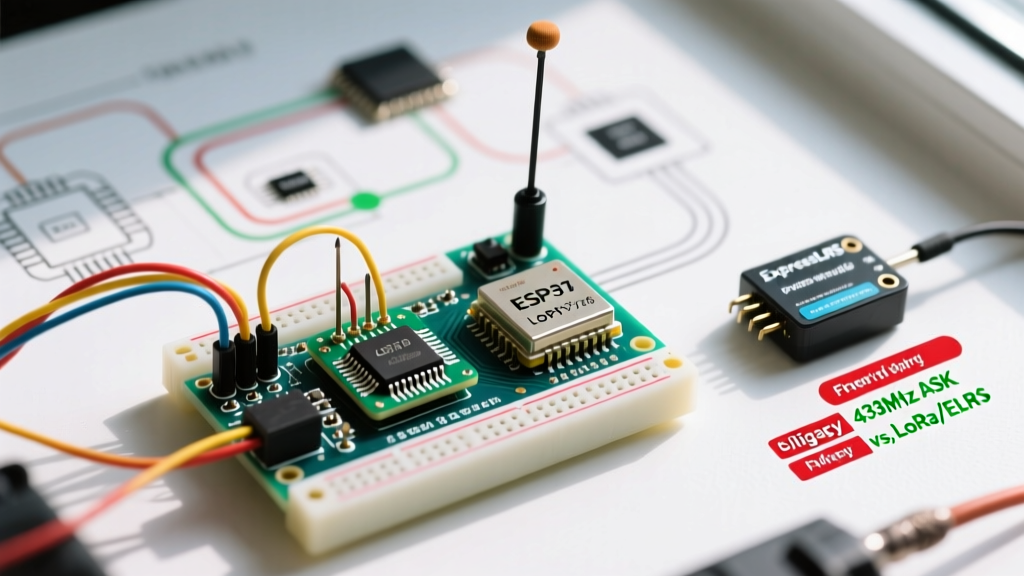

The Legacy Bottleneck: Why Ditch 433MHz ASK/OOK?
For over a decade, the FS1000A transmitter and XY-MK-5V receiver have been the default entry point for almost every radio control Arduino project. Operating on the 433MHz or 315MHz ISM bands using Amplitude Shift Keying (ASK), these $2 modules are inexpensive but fundamentally flawed for modern robotics, custom RC vehicles, or drone telemetry. ASK modulation lacks Forward Error Correction (FEC) and Cyclic Redundancy Checks (CRC), meaning your RC commands are highly susceptible to multipath interference and noise from brushless motor ESCs.
Furthermore, legacy 433MHz setups are strictly one-way (simplex) and typically bottleneck at 2400 baud. If you are building a custom RC rover, boat, or quadcopter in 2026, relying on ASK modules introduces unacceptable latency (often exceeding 40ms with software debouncing) and failsafe risks. When the signal drops, the receiver simply outputs random noise or holds the last state indefinitely—a catastrophic failure mode for any moving vehicle.
Migration Matrix: Choosing Your Modern RF Protocol
Upgrading your RF link requires selecting a protocol that matches your specific range, latency, and telemetry requirements. Below is a comparison matrix to guide your hardware migration.
| Protocol | Primary Module | Frequency | Max Range (LOS) | Avg. Latency | Est. Cost (2026) |
|---|---|---|---|---|---|
| ASK/OOK (Legacy) | FS1000A / XY-MK-5V | 433MHz / 315MHz | 30m - 50m | >40ms (Unreliable) | $2.00 |
| Enhanced ShockBurst | nRF24L01+ (PA+LNA) | 2.4GHz | 100m - 300m | ~2ms | $4.50 |
| LoRa (Long Range) | SX1276 / RFM95W | 868MHz / 915MHz | 2km - 5km | 15ms - 50ms | $9.00 |
| ExpressLRS (ELRS) | ESP32/ESP8285 ELRS TX/RX | 900MHz / 2.4GHz | 10km+ | <1ms (500Hz+) | $25.00 (Pair) |
Note: For pure RC vehicle control where sub-millisecond latency is critical, migrating to an ExpressLRS ecosystem via ESP32 is the definitive 2026 standard. For custom Arduino-based telemetry and moderate-range control, the SX1276 LoRa module offers the best balance of range and ease of integration.
Hardware Swap: Pinout and Wiring Migration
Legacy 433MHz modules use a simple 1-wire data protocol, which is why they were often paired with the now-deprecated VirtualWire library. Modern RF modules utilize the SPI (Serial Peripheral Interface) bus. This requires a fundamental shift in your Arduino wiring strategy.
Wiring the SX1276 LoRa Module to Arduino
When migrating to an SX1276-based board (like the Adafruit RFM9x or generic LoRa shields), you must map the SPI pins correctly. A common migration error is attempting to use a 5V Arduino Uno or Pro Mini directly with a 3.3V LoRa module, which will instantly fry the SX1276 silicon.
- VCC: 3.3V ONLY. Do not exceed 3.6V.
- GND: Common ground with the Arduino.
- SCK, MOSI, MISO: SPI Clock, Master-Out-Slave-In, Master-In-Slave-Out.
- CS (NSS): Chip Select (typically Pin 10 on Arduino Uno/Nano).
- RST: Reset pin (typically Pin 9).
- DIO0: Interrupt pin used to signal packet reception/transmission completion (typically Pin 2).
Expert Migration Tip: If you are upgrading an existing 5V Arduino Nano build, do not rely on cheap resistor-divider networks for SPI level shifting. SPI bus capacitance at high frequencies causes signal degradation through resistors. Use a dedicated logic level shifter IC like the 74LVC245 or a BSS138 MOSFET-based bidirectional shifter to ensure clean 3.3V logic edges.
Power Supply Pitfalls and Brownout Failures
The most frequent point of failure when upgrading a radio control Arduino RF link is inadequate power delivery. RF transmission is not a continuous draw; it occurs in high-current microsecond bursts.
- The AMS1117 Thermal Trap: Many makers power their 3.3V RF modules using the onboard AMS1117-3.3 linear regulator found on Arduino clones. During a +20dBm LoRa transmission burst, the SX1276 draws up to 120mA. An nRF24L01+ with a PA/LNA (Power Amplifier/Low Noise Amplifier) draws up to 150mA. Dropping 5V (or 7V from a 2S LiPo) to 3.3V at these currents generates massive heat, causing the AMS1117 to thermally throttle or shut down entirely, resulting in random Arduino resets.
- The Decoupling Mandate: You must place a 100µF electrolytic capacitor and a 100nF (0.1µF) ceramic capacitor as close to the VCC and GND pins of the RF module as physically possible. This local energy reservoir handles the microsecond TX bursts without pulling the voltage rail below the module's 3.3V brownout threshold.
- The 2026 Solution: Ditch linear regulators for your RF power rail. Use a micro-buck converter like the Pololu D24V5F3 or a TI TPS5430-based module. These switch-mode regulators handle 500mA+ with minimal heat generation, ensuring your RC link stays stable even during continuous high-power telemetry bursts.
Firmware Migration: Adapting Your Arduino Sketch
Moving away from legacy ASK means abandoning the VirtualWire library. For LoRa migration, the industry standard is Sandeep Mistry's Arduino LoRa Library or the more robust RadioHead suite. This shift requires you to restructure how your RC data packets are formed and parsed.
Structuring the RC Payload
Legacy setups often sent raw PWM values as ASCII strings (e.g., "1500,1200,1800"). This is incredibly inefficient and wastes bandwidth. Modern RF migration demands binary struct packing.
By defining a C++ struct, you can pack multiple RC channel values, battery voltage telemetry, and RSSI (Received Signal Strength Indicator) into a fixed-length byte array. For example, six 10-bit RC channels can be packed into 8 bytes, leaving room for CRC and telemetry data, drastically reducing airtime and improving packet success rates.
Implementing Failsafes via RSSI and Timeouts
Unlike legacy receivers that hold their last position upon signal loss, modern libraries allow you to read the RSSI and SNR (Signal-to-Noise Ratio) of the last received packet. In your Arduino sketch, implement a watchdog timer: if a valid packet with an RSSI above -110dBm is not received within 250ms, trigger a hardware failsafe (e.g., cut throttle to a rover, or deploy a parachute/flaps on a fixed-wing UAV).
Real-World Range Testing & Antenna VSWR
Upgrading your RF hardware is useless if your antenna system is mismatched. A critical concept often ignored in Arduino RC builds is VSWR (Voltage Standing Wave Ratio).
If you transmit at +20dBm without an antenna attached, or with an antenna tuned for 433MHz plugged into a 915MHz LoRa module, the RF energy reflects back into the SX1276 chip. This reflected energy will permanently destroy the internal Power Amplifier within seconds. Always ensure your antenna is tuned to the exact center frequency of your regional ISM band (e.g., 915MHz for the Americas, 868MHz for Europe) before initiating your first LoRa.beginTransmission() command. For custom RC enclosures, use an SMA pigtail to mount the antenna externally; carbon fiber and metallic chassis will completely block 2.4GHz and severely attenuate 900MHz signals.
Frequently Encountered Migration Failures
When upgrading your radio control Arduino ecosystem, expect to run into these specific edge cases:
- SPI Clock Speed Mismatch: The SX1276 supports SPI clock speeds up to 10MHz, but long jumper wires on a breadboard introduce capacitance that causes data corruption at high speeds. If your Arduino fails to initialize the LoRa module, force the SPI clock divider down in your setup function (e.g.,
SPI.setClockDivider(SPI_CLOCK_DIV4)). - Floating CS Pins: If you are sharing the SPI bus with an SD card module for flight logging, ensure the SD card's Chip Select pin is driven HIGH when the LoRa module is active. A floating CS pin will cause the SD card to talk over the MISO line, corrupting your RC telemetry data.
- Regional Duty Cycle Limits: If you are operating in the 868MHz band in Europe, strict ETSI regulations enforce a 1% duty cycle limit per sub-band. Broadcasting RC telemetry at 50Hz on a single frequency will violate this and cause the transceiver to lock up if using LoRaWAN MAC layers. For raw peer-to-peer RC control, stick to the 915MHz band (FCC) or implement frequency hopping spread spectrum (FHSS) in your sketch.
Migrating from legacy 433MHz ASK to modern LoRa or ExpressLRS transforms a hobbyist Arduino toy into a robust, professional-grade RC platform. By addressing SPI logic levels, implementing proper buck-regulated power delivery, and utilizing binary struct payloads, your custom radio control builds will achieve unprecedented range and reliability in 2026 and beyond.