
The Core Distinction: Arduino vs. AVR
To understand the foundation of modern physical computing, one must separate the software abstraction from the silicon reality. 'Arduino' is an ecosystem—comprising the Integrated Development Environment (IDE), the C++ wrapper libraries (like Wire.h and SPI.h), and the bootloader specification. 'AVR', on the other hand, is the actual 8-bit RISC microcontroller architecture executing the compiled machine code. Originally developed by Atmel in the late 1990s and acquired by Microchip Technology in 2016, the AVR family remains the beating heart of classic boards like the Uno and Mega.
While 32-bit ARM Cortex-M and dual-core Xtensa (ESP32) processors dominate high-compute IoT applications in 2026, the Arduino AVR architecture retains a massive footprint in industrial automation, education, and legacy hardware integration. This explainer breaks down the silicon-level mechanics of AVR, its memory topography, and why its 5-volt logic tolerance keeps it highly relevant today.
Inside the Silicon: 8-Bit RISC and the Harvard Architecture
The AVR architecture utilizes a modified Harvard architecture, meaning it employs separate physical buses and memory spaces for program instructions (Flash) and data (SRAM). This separation allows the CPU to fetch the next instruction while simultaneously executing the current one, enabling a highly efficient single-cycle execution pipeline.
The Execution Pipeline and Clocking
Most classic Arduino boards, such as the Uno Rev3, rely on the ATmega328P clocked at exactly 16.000 MHz via an external quartz crystal oscillator. Because the AVR instruction set is heavily optimized for Reduced Instruction Set Computing (RISC), most of the 133 instructions execute in a single clock cycle. This yields a theoretical throughput of 16 MIPS (Million Instructions Per Second). Unlike complex 32-bit MCUs that rely on deep pipelines and branch prediction, the AVR pipeline is a simple two-stage design (Fetch and Execute), making timing highly deterministic—a critical trait for bare-metal pulse generation and software-based serial protocols.
Memory Topography: Flash, SRAM, and EEPROM
Understanding how the ATmega328P partitions its memory is essential for optimizing sketch size and managing variable lifecycles. The AVR memory map is divided into three distinct physical blocks:
- Flash Memory (32 KB): Non-volatile memory where your compiled sketch (machine code) and constant data reside. The Arduino bootloader typically occupies the top 0.5 KB to 2 KB, leaving roughly 30 KB for user code. Flash has a write endurance of about 10,000 cycles.
- SRAM (2 KB): Volatile memory used for the heap (dynamic allocation via
malloc()orStringobjects), the stack (function calls and local variables), and static/global variables. Exhausting this 2 KB limit leads to stack collisions and unpredictable resets, the most common cause of 'silent failures' in beginner sketches. - EEPROM (1 KB): Non-volatile memory designed for long-term data storage (e.g., calibration offsets, device state). It boasts a 100,000 write-cycle endurance. In 2026, best practices dictate using the
EEPROM.update()function rather thanEEPROM.write()to only commit bytes that have actually changed, drastically extending silicon lifespan.
The Big Three: AVR Chips Powering the Ecosystem
The Arduino ecosystem standardizes around three primary AVR microcontrollers, each serving a distinct engineering niche. Below is a technical comparison of their specifications and approximate 2026 DIP/SMD pricing for bare silicon.
| AVR Chip | Common Board | Architecture | Flash / SRAM / EEPROM | I/O Pins (5V Tolerant) | 2026 Bare Silicon Price |
|---|---|---|---|---|---|
| ATmega328P-PU | Uno R3 / Nano | 8-bit RISC | 32KB / 2KB / 1KB | 20 (incl. 6 ADC) | $2.60 - $3.10 (DIP-28) |
| ATmega2560 | Mega 2560 | 8-bit RISC | 256KB / 8KB / 4KB | 86 (incl. 16 ADC) | $13.50 - $15.00 (TQFP-100) |
| ATmega32U4 | Leonardo / Micro | 8-bit RISC + USB | 32KB / 2.5KB / 1KB | 20 (incl. 12 ADC) | $4.50 - $5.20 (TQFP-44) |
| ATtiny85 | Trinket / Digispark | 8-bit RISC | 8KB / 512B / 512B | 6 (incl. 4 ADC) | $1.10 - $1.40 (DIP-8) |
The 5-Volt Advantage: Why AVR Survives the 3.3V Shift
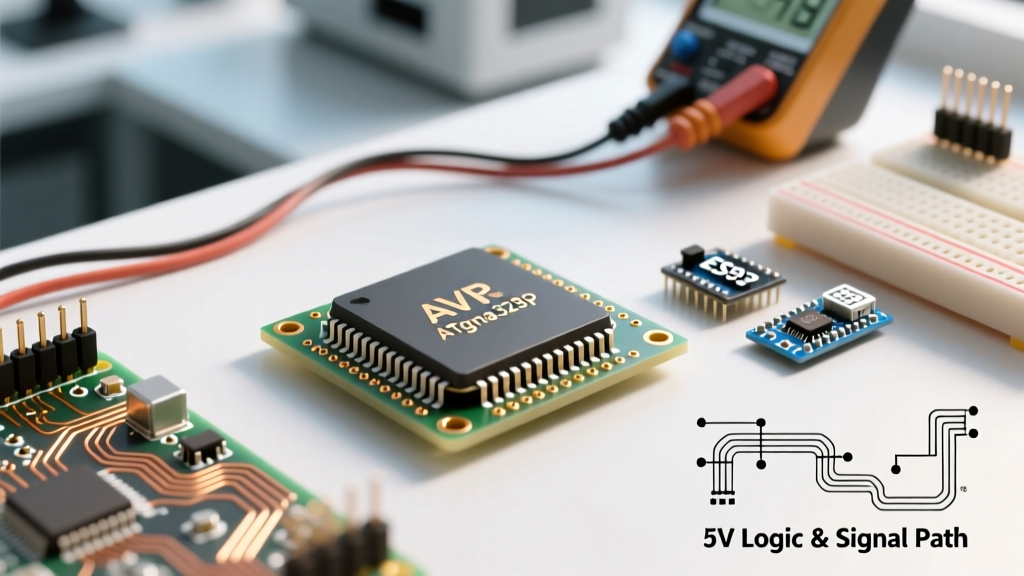
Modern computing has largely migrated to 3.3V or lower logic levels to reduce power consumption and accommodate smaller silicon geometries. However, the Arduino AVR architecture operates natively at 5V. In 2026, this is not a limitation; it is a distinct engineering advantage for specific use cases.
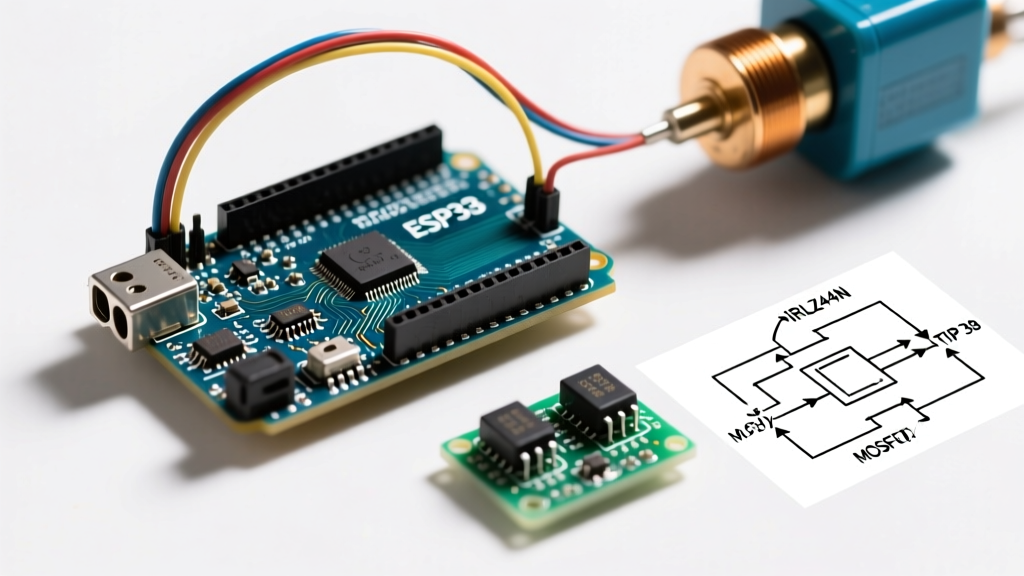
The Industrial Interface Edge: Driving a 5V mechanical relay module, interfacing with legacy 4-20mA industrial sensors, or triggering high-voltage optocouplers (like the PC817) requires significantly less support circuitry when using a 5V AVR compared to a 3.3V ESP32. With 3.3V MCUs, engineers must add level-shifters (like the BSS138 MOSFET circuit) or buffer ICs, increasing BOM cost, board footprint, and failure points.
Furthermore, the ATmega328P features remarkably robust Electrostatic Discharge (ESD) protection on its I/O pins compared to highly sensitive ARM Cortex-M0 alternatives. While you should never hot-swap unshielded cables in production, the AVR's thicker gate oxides and 5V noise margins make it vastly more forgiving in electrically noisy environments like automotive prototyping or motor-control testbenches.
Bypassing the Abstraction: Bare-Metal AVR Port Manipulation
The standard Arduino digitalWrite(pin, HIGH) function is notoriously slow, taking roughly 3 to 5 microseconds to execute because it must look up the pin mapping, verify the timer configuration, and toggle the correct register. For high-frequency signal generation (e.g., bit-banging a custom RF protocol or driving WS2812B addressable LEDs), this overhead is unacceptable.
Because the Arduino AVR architecture maps directly to hardware registers, you can bypass the Arduino API entirely using direct port manipulation. By writing directly to the Data Direction Register (DDRD) and the Port Register (PORTD), you can toggle pins in a single clock cycle (62.5 nanoseconds at 16 MHz).
// Standard Arduino API (Slow: ~4.5 µs)
digitalWrite(8, HIGH);

// Direct AVR Port Manipulation (Fast: 62.5 ns)
DDRB |= (1 << PB0);  // Set Pin 8 (PB0) as OUTPUT
PORTB |= (1 << PB0); // Set Pin 8 HIGH
This direct hardware access is facilitated by the avr-gcc toolchain and the <avr/io.h> library, which are seamlessly integrated into the Arduino IDE backend. Understanding these registers bridges the gap between a casual maker and an embedded systems engineer.
2026 Decision Framework: When to Specify AVR vs. ARM/ESP32
Choosing the right microcontroller architecture dictates the success of your hardware project. Use this decision matrix to determine if an Arduino AVR is the correct specification for your 2026 design.
Specify Arduino AVR (ATmega328P / ATmega2560) When:
- 5V Logic is Mandatory: You are interfacing with legacy 5V TTL logic, industrial relays, or unshielded analog sensors where 3.3V noise margins are insufficient.
- Deterministic Timing is Required: You need predictable, OS-free, bare-metal interrupt latency without the jitter introduced by Wi-Fi stacks or RTOS task schedulers.
- DIP Packaging for Prototyping: You require the ATmega328P-PU in a 28-pin DIP package for breadboarding or through-hole PCB manufacturing, which is unavailable for modern BGA/QFN-only ARM chips.
- Simplicity and Bootloader Robustness: You want a device that recovers gracefully from brownouts without complex flash-partitioning or secure-boot lockouts.
Migrate to ESP32-S3 / STM32 (ARM/Xtensa) When:
- Connectivity is Needed: Your project requires native Wi-Fi 4, Bluetooth 5 LE, or Ethernet MAC.
- High Compute or DSP: You are performing Fast Fourier Transforms (FFT), running TinyML neural networks, or processing high-resolution audio streams.
- High-Speed Peripherals: You need hardware-driven high-speed USB, SDIO for SD cards, or I2S for digital audio DACs, which the AVR architecture lacks entirely.
Summary
The Arduino AVR architecture is far more than a legacy stepping stone; it is a highly specialized, 5-volt tolerant, 8-bit RISC workhorse. By understanding its Harvard memory architecture, leveraging direct port manipulation for nanosecond-level timing, and utilizing its native voltage levels to simplify industrial hardware design, engineers can deploy ATmega-based systems that are robust, cost-effective, and immune to the complexities of modern 32-bit IoT stacks. Whether you are driving a simple PWM motor controller or building a custom MIDI synthesizer, the AVR core remains an indispensable tool in the 2026 electronics engineering toolkit.