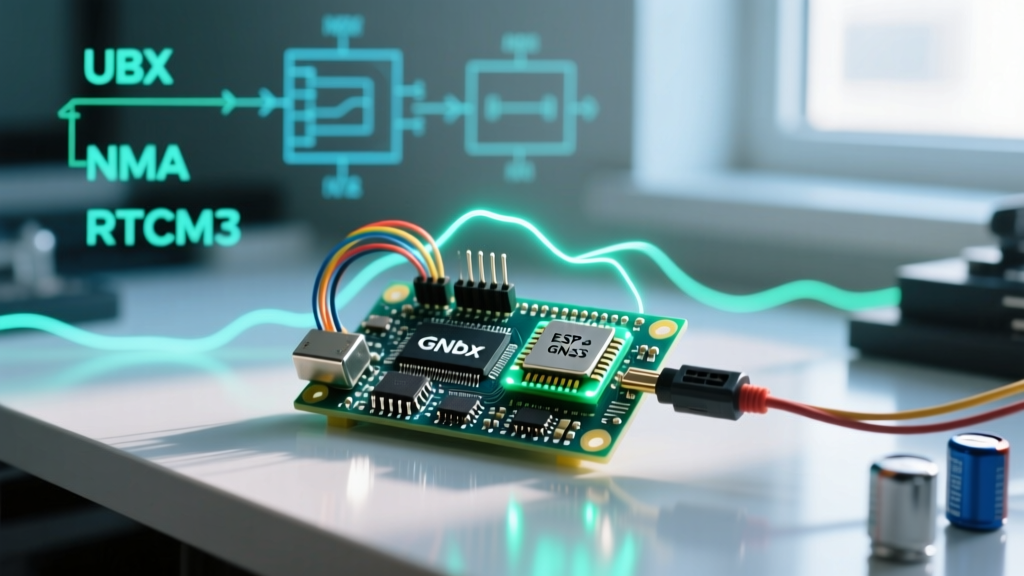

The Protocol Trinity: UBX, NMEA, and RTCM3
When engineers integrate high-precision positioning into embedded systems, the SparkFun u-blox GNSS Arduino Library (currently in its robust v3.x architecture) serves as the critical bridge between microcontroller logic and u-blox silicon like the ZED-F9P or MAX-M10S. However, treating this library merely as an 'NMEA parser' leaves 90% of its capabilities on the table. To achieve millimeter-level accuracy and reliable telemetry, you must understand the three distinct protocols the library manages simultaneously.
| Protocol | Format | Max Payload | Primary Use Case | Library Handling |
|---|---|---|---|---|
| NMEA 0183 | ASCII Text | 82 Bytes | Basic logging, marine legacy systems | Parsed via getLatitude(), high overhead |
| UBX | Binary | 65,535 Bytes | Configuration, NAV-PVT telemetry, mm-precision | Hardware-parsed, low overhead, auto-reporting |
| RTCM 3.x | Binary | Variable | RTK correction injection (Base to Rover) | Buffered injection via pushRawData() |
While NMEA is human-readable, it lacks the precision required for Real-Time Kinematic (RTK) applications. The UBX binary protocol, native to u-blox, provides full 3D position, velocity, and time (PVT) data with minimal bus overhead. Meanwhile, RTCM3 is the lifeblood of RTK, carrying differential corrections from a base station to your rover.
Hardware Abstraction: I2C, UART, and SPI Realities
The SparkFun library abstracts the physical transport layer, but ignoring the electrical realities of these interfaces will lead to silent data corruption. In 2026, the standard SparkFun GPS-RTK-SMA breakout (featuring the ZED-F9P) retails around $285, making hardware-level mistakes costly.
The I2C 0x42 Bottleneck and Buffer Management
By default, u-blox modules expose their DDC (Display Data Channel) interface, which is I2C-compatible, at the hex address 0x42. The primary failure mode for beginners using the SparkFun u-blox GNSS Arduino Library over I2C is buffer truncation. Standard Arduino Wire.h implementations limit the RX buffer to 32 bytes. A standard UBX-NAV-PVT packet is 92 bytes of payload plus 8 bytes of header/checksum.
Expert Insight: The v3.x SparkFun library circumvents the 32-byte Wire.h limit by utilizing internal ring buffers and executing consecutive I2C reads. However, if you are using an ESP32-S3, you must ensure I2C clock stretching is properly handled in your board definitions, or the u-blox module will freeze the bus during heavy RTCM3 injection.
UART Baud Rate Scaling for RTK
If you opt for UART, the default baud rate is 38400. This is sufficient for 1Hz NMEA output. However, if you are injecting RTCM3 correction data for RTK while simultaneously outputting 10Hz UBX-NAV-PVT data, 38400 baud will bottleneck and drop packets. Use the library's setUART1Output() and configuration keys to push the UART baud rate to 460800 or 921600 before initializing your main data loop.
Decoding UBX: Beyond NMEA Sentences
The UBX protocol relies on a structured binary frame: two sync characters (0xB5, 0x62), a Class byte, an ID byte, a 16-bit little-endian length, the payload, and a Fletcher-8 checksum (CK_A and CK_B).
Instead of manually polling the module for data—which wastes I2C bus time and MCU clock cycles—the SparkFun library allows you to configure the module's internal navigation engine to auto-report specific UBX messages.
Configuring Auto-Reporting via UBX-VALSET
Modern u-blox modules (Generation 9 and 10, like the ZED-F9P and MAX-M10S) use the UBX-VALSET and UBX-VALGET messages for configuration, replacing the legacy UBX-CFG-MSG. The library wraps this complex key-value system into simple boolean functions.
- Enable Auto-PVT:
myGNSS.setAutoPVT(true)tells the module to generate a UBX-NAV-PVT packet every navigation cycle and push it to the I2C/UART buffer. - Disable NMEA:
myGNSS.setNMEAOutputPort(Serial)can be omitted, and NMEA messages disabled viamyGNSS.setI2COutput(COM_TYPE_UBX)to free up bus bandwidth entirely for binary UBX data.
By relying on UBX-NAV-PVT, you gain access to the hMSL (Height above Mean Sea Level) and hAcc (Horizontal Accuracy Estimate) parameters, which are heavily truncated or entirely missing in standard NMEA GGA sentences.
RTCM3 Injection for Centimeter RTK
Achieving a 'Fixed' RTK solution requires feeding RTCM3 correction messages into the rover module. The SparkFun u-blox GNSS Arduino Library handles this via the pushRawData() method. This is critical when building NTRIP clients using an ESP32 connected to WiFi.
Step-by-Step RTCM Push via I2C
- Fetch Data: Your ESP32 NTRIP client pulls a raw byte stream from an NTRIP caster (e.g., RTK2GO or a local CORS network).
- Buffer Locally: Store the incoming RTCM3 bytes in a local MCU array. RTCM3 messages are framed with a preamble (
0xD3) and a 24-bit CRC. - Inject via Library: Call
myGNSS.pushRawData(&rtcmBuffer[0], bytesReceived). - Internal Routing: The library automatically routes these raw bytes to the u-blox module's I2C or UART port, where the module's internal baseband processor parses the RTCM3 frames and applies the differential corrections to the carrier-phase measurements.
Crucial Note: Ensure your NTRIP caster is broadcasting the correct RTCM3 message types. For GPS and Galileo RTK, you typically need messages 1005 (Base Station Coordinates), 1077 (GPS MSM7), and 1087 (Galileo MSM7). Without 1005, the rover cannot calculate the baseline vector, and you will remain stuck in a 'Float' or '3D' solution.
Edge Cases and Debugging Matrix
Even with a premium ZED-F9P module, protocol mismatches will cause silent failures. Below is a troubleshooting matrix based on real-world field testing of the SparkFun library.
| Symptom | Protocol Root Cause | Library / Code Fix |
|---|---|---|
Module connects, but getLatitude() returns 0 or stale data. | NMEA is disabled on the I2C port, or UBX-NAV-PVT is not set to auto-report. | Call myGNSS.setI2COutput(COM_TYPE_UBX) and myGNSS.setAutoPVT(true). |
| RTK status stuck on 'Float', never reaches 'Fixed'. | RTCM3 Message 1005 is missing from the NTRIP stream, or base coordinates are corrupt. | Verify NTRIP mount point. Use myGNSS.getRTCMFrame() to debug incoming RTCM3 preamble bytes. |
| I2C Bus locks up completely after 10 minutes of RTK operation. | ESP32 I2C clock stretching timeout during heavy RTCM3 injection via pushRawData(). | Increase I2C timeout in Wire.h, or switch the primary data interface to UART at 460800 baud. |
| Configuration changes revert after power cycle. | UBX-VALSET was sent to the volatile RAM layer instead of the BBR (Battery Backed RAM) or Flash layer. | Use myGNSS.saveConfiguration() or specify the VAL_LAYER_BBR bitmask in your VALSET calls. |
Final Thoughts on Architecture
The SparkFun u-blox GNSS Arduino Library is a masterpiece of embedded abstraction, but it requires the developer to respect the underlying protocol mechanics. By shifting your architecture away from legacy NMEA parsing and embracing binary UBX auto-reporting, combined with careful I2C buffer management and precise RTCM3 injection, you can reliably extract the full $285+ hardware potential of your GNSS modules. For deeper hardware integration steps, refer to the official SparkFun ZED-F9P Hookup Guide and explore advanced base station configurations via the DIY GNSS Reference Station tutorial.